Certain members of a social group can listen to an opposing (and not always truthful) side of a dispute and choose to believe the opposing version without approaching their other associates to hear the full story. I have reasearched why this occurs.
This subject has also been raised by clients during consultations so these occurrences inspired me to do further research.
There are however a variety of opinions on this matter which I have researched. In this post I have included the opinions of Psychologists, a Psychic Author and a Healer.
Autism is a widespread condition and I have clients, friends and family who have been affected by this condition. Researching this subject and how to deal with the individuals affected can assist in coping with difficult relationships. Read more here:
Thefollowing article is written by the mother of a son with Aspergers. High Functioning Autism and I am sure many can relate to this:
“There is a dark side to raising a child with these challenges. My son’s honest expressions can be downright mean. He will say that I am lazy. He will say that I don’t ever do anything. He will say that I am selfish or a hypocrite. Of course, he is a teenager and I am sure from his narrow perspective what he says is truth.
Meltdowns are more frequent now than in the past. The physicality associated with his meltdowns now reminds me of when he was 3, more than when he was 10. These meltdowns are more disturbing and scary in the body of a 5’11” young man than they were in a small child. The glimmers of the sweet boy I remember are few and far between.
There are a lot of aspects of life that we as humans do not include in the stories we pass down. We don’t talk about the messier and darker aspects of common life occurrences. A great example is our tendency to remain silent on the terrifying nature of postpartum depression and psychosis. We don’t want to admit that even the most joyful parts of life can come with a dark lining.
As a parent of an Aspergers child, I live in a strange world. Strangers do not understand and even from friends and family there can be a lot of judgment. I have been told that I am not consistent enough with my son. I have been told that I am not disciplined enough. Even when there is no overt comment, there is the change in body language, tone of voice and the distancing by people who are affronted by my son.
On the other hand, my son judges me as inadequate, unfair, lazy and hypocritical. He expresses hatred for the help that I sacrifice to give him. I stand in the middle making the decisions as best I know how. This is an emotionally draining position.
My NT son sees all of this and so he asks if I regret having my Aspergers Son.
“No!” I responded without hesitation, “Raising him is challenging and there are times that he can be such a jerk but I have learned so much about myself and life through this process. I have learned to look beyond the external and set aside a lot of my preconceived judgments. I have learned to make my decisions based on who I am and who I want to be, not based on what that decision will get from others in the way of approval, acceptance, etc. It has made me so much stronger. I am proud of the person I have become and if this is the road that it took to become this person, well that is fine. I love him because he is my son, not because of what he can give me and I believe that he is an amazing person traveling his own tough road.”
That statement reflects the decision I have made. I don’t always feel the feelings that would inspire that statement therefore I don’t despise the mother that said she hated her son. I am thankful that my NT son didn’t ask me 20 minutes earlier. I don’t know that I would have regained my balance enough to answer the way I did. Just because I don’t act on the dark moments doesn’t mean they don’t exist.
My Aspergers son is mismatched to the world we live in. It seemed that My son is the round peg to the outside world’s square hole. I thought I was accepting this fact.
I have realized that I my acceptance was conditional on a belief that I could fill in the gaps between the outside expectation and my son’s reality. I believed I could make the world accept my son and acknowledge his successes. I had a distorted perception of who I needed to be in my son’s life.
I can never do or be enough to make my son and the typical world’s expectations mesh. Accepting my limitations, opened a new path. Instead of seeing the world as rigid, I saw flexibility. As I expanded my view beyond the world of the public school structure, I could see the endless variations that our world allows. My role is to guide my son as he creates his path in this world and finds his purpose.
My Aspergers-son is an important part of my life, but he is not my whole life. I did not cease to exist when he was born. Additionally, there are other small lives in my care. The loudest need cannot drown out the other needs. My son and my typical children learn from how I live.How can I tell my son that I believe that he can be an independent adult and then do everything for him?
When I give my focus to the moment at hand, I honor all the parts of my life. My time with my husband is for him alone. My time with each of my children is sacred and preserved. The time I set aside for caring for myself is spent doing ONLY that. This is a practice I have yet to perfect but the practice alone has increased my self-awareness and increase the balance between the various aspects of my life.”
In the workplace as a young woman of 17 years of age, I witnessed and experienced sexual harassment of women by men. When I consulted mature women in the workplace, I was advised to ‘turn a blind eye’ if you wished to keep your place of employment. There have been occasions when I have spoken out and lost employment or friendships.
In my social and performance life, I have also spoken out about ‘sexist’ behaviour and sexual harrassment only to be the target of aggression by the guilty party who then created false rumours to divert the attention away from themselves.
This is a widespread problem for women and also one of the reasons clients consult us.
Image – Counselling
If you’re interested in sexuality, consider the following scenario. It’s a COMPOSITE of various situations that recur at conferences and other large gatherings. It’s particularly important that people interested in progressive politics and gender relations work this out. Again, this is a COMPOSITE–the way therapists write about cases, changing some details and adding others.
A while back I attended the national conference of a large progressive organization. It was well-organized, stimulating, and fun. The people were mostly energetic, interesting, and friendly; it was a good mix of ages, sexual orientations, and divided almost 50/50 male-female.
I was eventually asked, as a sex therapist, what I thought about Sexual Harassment. Apparently a couple at last year’s conference had approached a particular woman in her mid-30s. Eventually “Mary & John” handed the woman their card—suggesting quite clearly that they were “open” to “adult activities.”
The woman didn’t want to share this kind of fun, which of course is perfectly fine. But she was somehow “offended,” which is unfortunate. In fact, the woman felt that this invitation constituted Sexual Harassment, and she complained. Dissatisfied and emotionally distressed, this previously loyal movement member blogged about it, urging her female readers to stay away from the organization. Now the word is out to younger progressive women—don’t go to this group’s conferences.
So the leadership of said organization is scurrying around, trying to figure out what to do. “About what?” I asked. Apparently,
* Some people want a policy on Sexual Harassment * Some people want a zero-tolerance policy on Sexual Harassment—one COMPLAINT and you’re out * Some people want to issue a statement about the organization’s policy on Sexual Harassment * Some people want to persuade this woman to attend next year’s conference * Some people want to persuade this woman to stop trashing the organization
For someone who didn’t want one kind of attention, this woman has certainly managed to get plenty of another kind of attention.
This woman—and the more intimidated members of the organization—need a history lesson. In the Bad Old Days, people—men—with institutional power (professors, bosses, doctors) used sex as a bargaining chip. “Sleep with me and you’ll get ahead,” some of them told the women who reported to them. “Refuse me and you won’t.” It was ugly. It was How Things Are Done. You can see it in the show Mad Men.
In the 1970s, women began to sue their employers under the 1964 Civil Rights Act. Women demanded an end to the discrimination (“put out or get out”), and to the maintenance of hostile work or learning environments created by continuous sexual pressure. Nowadays, both kinds of pressure are considered unacceptable in most American institutions, and both employees and employers (and students and professors, etc.) have some sense of this.
But Sexual Harassment law was never designed to protect women from merely feeling uncomfortable. In a typical workday, men and women alike face many sources of discomfort: atheists face clerks wearing crosses; able-bodied people face colleagues in wheelchairs; Fundamentalist Muslims and Jews face professors dressed with arms and legs uncovered; the infertile face coworkers’ desks with photos of their kids, and parents are given time off for parenting events such as piano recitals.
No, the law is designed to simply create a level playing field of opportunity—not of emotional experience. It doesn’t require anyone to be a mind-reader, it doesn’t undo the normal uncertainties of social interaction, and it doesn’t require anyone’s social skills to be smooth as silk. Occasionally feeling offended is still considered part of the cost of being out in the world.
So what did that young woman experience? Not Sexual Harassment, but Unwanted Sexual Attention. And when the woman made it clear it was unwanted, the attention went away. That should have been the end of the story. But if the recipient of a friendly, non-pressuring, non-institutional (and OK, let’s say clumsy or even stupid) sexual invitation isn’t grown up enough, she (or he) will feel assaulted. And with today’s heightened consciousness—and internet access—she will have the option of describing herself as victimized to a large number of people.
And yet why do we privilege unwanted attention that happens to involve sexuality? Again, we’re not talking about coercion or even pressure—we’re talking about attention, invitation, or suggestion that has no connection with real-world consequences like job evaluation. Adults are the recipients of unwanted attention every single day: stories from strangers on airplanes, awkward compliments from co-workers, grocery clerks sympathetically inquiring about the brace on your wrist or that cold medicine you’re buying, Jehovah’s Witnesses or Mormon missionaries asking if they can talk with you for a just a moment about their Invisible Friend In The Sky.
Unwanted attention—whether sexual or non-sexual—is part of the cost of stepping outside your front door. With Jehovah’s Witnesses, you don’t even have to go out—you get the attention by just opening the door. When American society privileges our discomfort if the unwanted attention is sexual, that’s more about our cultural values than about any inherent hierarchy of discomfort.
Ihope these articles will help you through difficult times:
The 5 stages of grief and loss are:
1. Denial and isolation;
2. Anger;
3. Bargaining;
4. Depression;
5. Acceptance.
People who are grieving do not necessarily go through the stages in the same order or experience all of them. The stages of grief and mourning are universal and are experienced by people from all walks of life, across many cultures. Mourning occurs in response to an individual’s own terminal illness, the loss of a close relationship, or to the death of a valued being, human, or animal. There are five stages of grief that were first proposed by Elisabeth Kübler-Ross in her 1969 book On Death and Dying.
In our bereavement, we spend different lengths of time working through each step and express each stage with different levels of intensity. The five stages of loss do not necessarily occur in any specific order. We often move between stages before achieving a more peaceful acceptance of death. Many of us are not afforded the luxury of time required to achieve this final stage of grief. The death of your loved one might inspire you to evaluate your own feelings of mortality. Throughout each stage, a common thread of hope emerges: As long as there is life, there is hope. As long as there is hope, there is life.
Many people do not experience the stages of grief in the order listed below, which is perfectly okay and normal. The key to understanding the stages is not to feel like you must go through every one of them, in precise order. Instead, it’s more helpful to look at them as guides in the grieving process — it helps you understand and put into context where you are. Please keep in mind that everyone grieves differently. Some people will wear their emotions on their sleeve and be outwardly emotional. Others will experience their grief more internally, and may not cry. You should try not to judge how a person experiences their grief, as each person will experience it differently.
Although it will happen to us all, the loss of a parent is always a major shock in our lives and a time of grief and sadness. Everyone copes in their own way, but some will find it more difficult than others. Some of the ideas on these pages may help you to cope if you have lost your father or mother. It can help enormously to get involved in the funeral arrangements and make sure that your feelings are expressed. Whether that means that you write some words, or choose some music for the ceremony, it is good to be part of it.
The death of a spouse or significant other is an earth-shattering event that brings incomprehensible grief. Your partner was, after all, the person with whom you shared your dreams and built your life – the person you loved more than life itself. Not only is the relationship between spouses or partners defined by the most intimate emotional and physical bonds of any human relationship, but your partner may have filled many other roles in your life as well, such as best friend, co-parent, confidant, traveling companion, or bridge partner. And if the roles within your relationship were clearly defined, your loved one may have been the only one who ever cooked, cleaned, brought home a paycheck, took out the garbage, did the laundry, or paid the bills.
The passing of someone so central to your life is certain to leave a tremendous emotional, physical, and practical void. Your grief may be so profound that you feel like your hope for the future died with your spouse. But although nothing and no one can make your pain go away, you can find in others the support you need as you work through the stages of grief and learn to live with the changes in many areas of your life, including those that follow.
Helping Yourself Heal When an Adult Sibling Dies by Alan D. Wolfelt, Ph.D.
“To the outside world we all grow old. But not to brothers and sisters. We know each other as we always were. We know each other’s hearts. We share private family jokes. We remember family feuds and secrets, family griefs and joys. We live outside the touch of time.” —Clara Ortega
Whether your sibling was younger or older, whether the death was sudden or anticipated, whether you were very close to your sibling throughout your lives or experienced periods of separation, you are now grieving. To grieve is to experience thoughts and feelings of loss inside you. If you loved your sibling, you will grieve. To mourn is to express your grief outside of yourself. Over time and with the support of others, to mourn is to heal.
The death and loss of a child is frequently called the ultimate tragedy. Nothing can be more devastating. Along with the usual symptoms and stages of grief, there are many issues that make parental bereavement particularly difficult to resolve. And this grief over the loss of a child can be exacerbated and complicated by feelings of injustice — the understandable feeling that this loss never should have happened. During the early days of grieving, most parents experience excruciating pain, alternating with numbness — a dichotomy that may persist for months or longer. Many parents who have lost their son or daughter report they feel that they can only “exist” and every motion or need beyond that seems nearly impossible. It has been said that coping with the death and loss of a child requires some of the hardest work one will ever have to do.
Image – The Inquisitr
Pregnancy loss and infant death
When a baby dies before it is born or soon after birth, parents face a difficult emotional task: they must try to say goodbye to someone they had little chance to know. They must accept that a life has ended, even though it barely began. Just as with any death and loss of a child, you are likely to experience some of the more common symptoms of grief — you may go into shock or even deny that your baby has died. Depression, anger, frustration and other painful emotions are normal and to be expected. And even if you are normally a committed, caring person, you may find that you don’t care about anything or anyone right now. As noted earlier, for many parents this time is simply one of existence and survival and very little more.
It isa common situation when a couple divorce and the split is far fromamicable that a former spouse informs others the whole marriage was a terrible experience, the other partner had ‘mental health issues’ and continue to spread malicious lies. Their agenda is to turn their family and mutual friends against the partner and come out of it as the ‘good guy’. Some will even go as far as to seek out and collude with former partners ‘fake friends’ and enemies of their ex, to give extra credence to their lies and make them more believable.
There are warning signs however when meeting a prospective partner that are not to be ignored. If for example you meet someone who describes all his ex- female partners as ‘mentally ill’ or ‘mad’, there is a high possibility that one day if your relationship ends, he will describe you in exactly the same way. He will also attempt to convince any children from the relationship to view you in this way too, and if the child wishes to keep in with their father (particularly if they have a similar personality and the father is provides financial benefits) they will please him by treating you in the same way.
The following article explains how this can happen:
Former partners can also brainwash their children and introduce ‘false memories’. For example, a child who was well cared for, loved and nurtured by their mother could be influenced by a bitter father, who will brainwash the son into thinking he had an awful childhood andeven when the child becomes an adult, they will in turn spread these false memories to their friends and family that will back up their father’s false claims. If the mother visits the adult child (for example to support them in a creative project ) and the friends they have fed the lies to are also there, they could be cruel to the mother in order to drive her away, as her kindness will cause doubt on the lies they are spreading. The adult child will cut off all contact with the mother and cite the reason for her absence is because she is ‘bad’ which is far from the truth.
Theadult child could continue lying throughout their life as they were taught it is right to do so by the parent.
Divorce is on the decrease according to statistics released by the Office For National Statistics for 2011. In 2011 the number of divorces in England and Wales decreased by 1.7% to 117,558 compared with 119,589 in 2010. This continues the ongoing decline in divorces since 2003 when there were 153,065 divorces recorded by both the Office For National Statistics and the Ministry of Justice Fam man system. The decline in the number of filed divorces is consistent with a fall in the number of people getting married to 2009. The fall in marriages to 2009 is more than likely due to the increasing number of couples choosing to cohabit rather than get married.
The number of divorces continued to rise between 1931 and 1990 as a result of changes in behaviour and attitudes in society in general. However since the start of the “great recession” in 2008 the number of divorces recorded has declined dramatically.
The effects of divorce reach far beyond money. There are many health consequences related to divorce that can affect a fragmented family both mentally and physically. Studies published in the “American Journal of Sociology” and the “Journal of Marriage and the Family” suggest that divorced men in most developed countries have twice the premature mortality rate of married men, and divorced women are also more likely to die at an early age than married women. Additionally, the years following a divorce present a greater risk of depression and other mental health disorders.
Image – Family Law Attourney Billings MT
The effects of divorce on children depend on the age of the child at the time of the divorce. According to the University of New Hampshire, infants and toddlers seem to experience the fewest effects from a parent’s divorce, though many may experience appetite suppression or moodiness. Children older than 3, however, have greater difficulty adjusting to the separation and might believe that they are somehow responsible for their parents’ divorce. Both elementary-aged children and adolescents might act out with anger or suffer from mental anguish or depression. Some might experience divided loyalty between their divorced parents.
It is understandable that by the time two people are ready for divorcethere are many angry, resentful and bitter feelings accumulated during the course of the marital relationship. Very few divorces are friendly and amicable with the former spouses becoming friends. Of course this does happen but it is more the exception than the rule. Having children to consider and care for does not seem to mediate the types of behavior displayed by many former spouses. In fact, all too often, the most resentful and angry of the two divorcing parents are all too willing to display a vindictiveness directed against the other parent by using the children as weapons in the divorce and post divorce war. These types of vengeful parents do not seem to understand that the only victims of this type of behavior are the children.
Rebecca is a middle-aged woman who is recently divorced. She and her husband were married for 25 years when he told her he wanted a divorce because he is in love with someone else. For the past few years, Rebecca was unhappy in her marriage, but she never thought that they would divorce. She became accustomed to her life and it’s routine. Rebecca had no idea that her husband was cheating on her and so his revelation came as a total surprise. She is now living alone and wondering what will become of her life. Her family and friends are there for her, with her married children living close by. Rebecca continues to work part-time at the same job she’s held for seven years. Financially, she is okay, but not as monetarily “comfortable” as when she was married.
I deal with many clients who have this problem and when it occurs within your family, this article provides good advice on how to deal with it.
There are a few signs of narcissistic behavior that parents should watch out for:
Inflated ego: The narcissist has a huge ego. Narcissistic adult children demand that you do what they want, try to control you, and push every boundary. Every time you give them what they want, they demand something else. They say your job is to make them happy.
Need for validation: A narcissist needs constant admiration. Often, they need praise for simple tasks, like making an appearance at your birthday party. You may find yourself giving your narcissistic adult child an inordinate amount of praise over something that’s a normal and expected part of family life.
A sense of entitlement: The narcissist feels entitled to things they should have to work for. For example, they may demand ridiculous things like financial support well into adulthood. Or, tasks they should be doing themselves, but you find yourself performing…such as doing their laundry and folding their clothes, filling out their job applications, calling into work sick for them, or fixing their breakfast or lunch to take to work.
Exploitation: A narcissist acts without conscience, thinking only of themselves. They lie, trick and steal to get what they want. This exploitation can be glaringly obvious or very subtle, so be on the lookout if you feel used. This may manifest as their throwing temper tantrums, blackmailing you by withholding their love or your grandchildren, trying to entice you with sweetness and affection when they want something, and blaming their behavior on you.
Distorted thinking: A narcissist occupies a fantastical world where he or she is the greatest and most important person in the universe. In order to maintain the fantasy, narcissists lie. They often deny things that are obvious. They may make up fantastical tales to support the fantasy.
Unpleasant personality: Contempt and belittlement are the narcissists’ tools of choice. When they feel threatened by success, they get mean. Watch out for those who are constantly putting down other peoples’ accomplishments. You may find your narcissistic adult child talking badly about their friends behind their backs, but pretending to care for them when these same friends come around
Narcissistic personality disorder (NPD) is diagnosed when an individual exhibits a cluster of symptoms related to an elevated sense of self-importance or worth. Online narcissism refers to the emergence of these symptoms on the internet.
Many individuals on twitter and facebook believe the world should be interested in every aspect of their lives. Similarly, on writing and blogging websites, narcissists take advantage of the self-publishing platform to soothe their vulnerable egos, and it is this phenomenon that will be focused on here. The symptoms that manifest in someone suffering from NPD are varied, but often include:
A willingness to emphasize and exaggerate traits or achievements that may prove to be reputationally beneficial.
A belief in being special and unique in the world.
Is callous, exploitative, and envious of others.
Requires persistent positive reinforcement from those considered allies.
Has an inability to apologize or take responsibility for one’s actions or words, but is quick to demand apologies from others.
Suffers from extreme self-preoccupation to the point of being paranoid about the opinions and conspiratorial motivations of potential critics.
Has a sense of entitlement and a preoccupation with fantasies of success.
Has delusions of grandeur that are sometimes derived from supernatural beliefs, including astrology, past-life regression, and some forms of religion.
Demonstrates superficial charm or glibness, which is used to derogate critics without alienating allies.
Will only experience short-lived egocentric emotions, with a complete lack of empathy (coldness)
These traits can be described as a dispositional defense mechanism. NPD develops over many years to cope with a vulnerability to psychological pain. NPD sufferers are remarkably insecure, and this persecution complex is strengthened when they are inevitably trolled online. Unfortunately, the trolling intensifies their detachment from the world, and perpetuates a need to comfort their bruised ego with further narcissistic behavior.
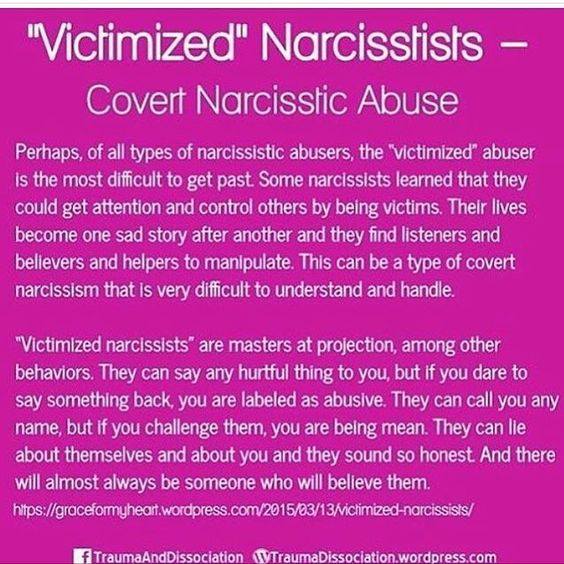
People with strong narcissistic tendencies are known for certain destructive social patterns. Anybody who has had the misfortune of dealing with these types of people may notice that whenever there’s a conflict or any type of disagreement, they tend to act in an abhorrent yet predictable manner. In this article we will explore the common behaviors and scenarios where narcissistic and otherwise toxic people (hereafter narcissists) play the victim and manipulate the narrative.
People with strong narcissistic tendencies are known for certain destructive social patterns. Anybody who has had the misfortune of dealing with these types of people may notice that whenever there’s a conflict or any type of disagreement, they tend to act in an abhorrent yet predictable manner.
In this article we will explore the common behaviors and scenarios where narcissistic and otherwise toxic people (hereafter narcissists) play the victim and manipulate the narrative.
Delusion and denial
Narcissists can’t deal with reality because it contradicts what they want to be true, and this creates painful emotions. As a coping mechanism, they learn to delude themselves that what is real is actually not real, and however they see the situation is real, even though it isn’t.
Sometimes they truly see it that way. Other times it’s just a story they tell themselves and others. And often the longer you tell a story, the more you believe it, even if initially you know it’s not true. And so eventually they may start truly believing it.
Either way, the first step is to create a version of events that is an alternative to what actually happened or what’s going on.
Lying
While delusion is more of an internal process, lying and denial is often in the context of other people.
Regular people deal with their problems by themselves, internally. Or they discuss it in a very private setting: in therapy or among very close, healthy people. Narcissists don’t have people like that in their life and are not really interested in actually resolving anything or being introspective.
Narcissists simply want to know that they are in the right. For that, they need other people’s false validation to regulate their shaky self-esteem. They need to find people who would agree with them. And in order for others to agree with them, these other people either need to be terribly unhealthy and unable to recognize their toxic tendencies, or the narcissist needs to lie and present a different story than what is actually true.
Here, they tend to flip the roles where they are good, noble, caring, virtuous and the other person is evil, cruel, selfish, and immoral. Which brings us to the next point….
Projection
The most common way narcissists create alternative narratives is by projecting. We’ve talked about narcissistic projection in a separate article but to extract the main point, narcissists love to project.
If they say that the other person is jealous of them, then you know that the narcissist is jealous. If they say that the other person was cruel to them, then you know that the narcissist was cruel to the other person. If they say that the other person was lying and cheating, then you know they were the one lying and cheating.
Yes, sometimes it’s not as simple and there could be unhealthy behavior on both sides, but more often than not whatever the narcissist is presenting the other person as is a much more accurate description of the narcissist.
Whatever the case may be, the mechanism here is that in the narcissist’s mind they try to attribute their own unhealthy behavior, perspective, and character traits to the other person because it shifts attention and responsibility from them. And if the other person “is” all these bad things then it can’t be that I am these things—thinks the narcissist—I’m the good guy here.














 Taking The Helm