Mourning is hard. It doesn’t matter if the person has passed away, is estranged from you or has chosen not to have contact with you. It. is. hard.
Mourning can be more complicated when the person is still alive but you cannot see them, speak to them, write to them, tell them about your day, your happy moments or your big achievements in life. Or the opposite spectrum, like not being able to talk to them when things are tough, knowing they would have the perfect advice or the perfect response to how you are feeling. We get dependent on certain people and their responses to the events going on in our lives. Sometimes, when a person is abruptly cut out of your life, or you have just “lost touch” when one or both of you moved away, it can be difficult to cope. We find that we miss the smell of our mother’s cooking or the way that she smiled when she was super proud of us.
In the place of those happy memories come tears, pain, repressed feelings and sometimes anger depending on how the relationship ended. Knowing they are still out there somewhere in this big ole world makes it sometimes hard to bear. We don’t know how they are doing, how life has changed for them, we don’t get to celebrate things with them anymore.
All of these feelings are completely normal. Beating yourself up for cutting a person out of your life for your better interest is not healthy and shouldn’t be a reason to let that person back into your life.
They hurt you.
They did something to make you feel as you do now.
We each have the right to take care of our own well-being. The problem with that is it often contradicts the notion that we should “respect our elders,” “take care of our parents” or that “love conquers all.”
All of these philosophies are one-sided. They leave no space for the truth. Sometimes we just have shitty parents, friends, relatives or relationships. They don’t take into account that sometimes the abuse of said elder, parent or person we love can be toxic, overwhelming, overbearing and sometimes downright scary.
That doesn’t mean we cannot still love them! It just means we choose to love them from a distance. I found that in my case, staying in limited contact was only hurting me more because any time I received any kind of contact it was never positive. It always dragged me right back down into the toxic cesspool of despair. I was depressed because I couldn’t fix all the things wrong with their life, with mine and with our relationship, or fix our inability to see eye-to-eye on many important subjects.
I was allowing myself to wither away by trying to keep someone else alive…
That couldn’t work for me anymore. I couldn’t be the person I wanted to be by being a depressed, anxious, worried, fearful, stressed out individual. I wanted freedom from terror.
It is so weird to think that I felt that way. Because how can you feel terror towards a person you also love?
Do not beat yourself up for this.
For those of you still reading, I want to tell you this:
Your feelings are valid.
You have a right to feel them, just as they are, with no manipulation by others or by the person who is hurting you.
Do not beat yourself up for feeling your feelings.
Do not keep giving up your patience, sanity, clear-minded stability and rational perceptions for the sake of the other person’s happiness. You only have one life, don’t waste it by living for someone else.
You cannot heal someone who chooses not to heal themselves. Do not let yourself fall into this trap. There is a reason you chose to leave that person behind, but it’s OK to mourn the loss of this relationship.
What causes us to move on from traumatic experiences? Psychologists are finding it’s not always about bouncing back—sometimes we have to feel our whole world fall to pieces.
The Vietnam War veteran had enlisted when he was young, serving two combat tours and surviving multiple firefights. “To this day,” said psychologist Jack Tsai of the Yale School of Medicine, “his war memories are triggered by certain smells that remind him of Vietnam”: overgrown vegetation, the acrid stench of burning, or even sweat—like that which ran in rivulets down the faces of men fighting for their lives in the sweltering jungles—brought it all back. It was classic post-traumatic stress.
As Tsai was treating him (successfully) for PTSD, however, something unexpected emerged. The vet still described his Vietnam experiences as horrific, but he said the painful memories remind him of who he is. His experience typifies research psychologists’ new understanding of trauma: When people are least resilient—in the sense that they are knocked for a loop, do not bounce back quickly or at all, and suffer emotionally for months, if not years—they can eventually emerge from trauma stronger, more appreciative of life, more sympathetic to the suffering of others, and with different (arguably more enlightened) values and priorities.
By no stretch of the imagination would the vet be called resilient in the sense that research psychologists use the term: an ability to go on with life, essentially unchanged mentally and emotionally, in the wake of profound adversity. To the contrary, environmental triggers returned the vet’s troubled mind to the horrors of land mines and ambushes and friends blown apart. At the same time, the vet’s military experience (and his triumph over PTSD) makes him feel that he can accomplish anything. “Nothing bothers him too much, because everything pales in comparison to Vietnam,” said Tsai.
For many, post-traumatic growth brings closer relationships—as family and other loved ones are more cherished—and a stronger sense of connection to other sufferers.
This effect, post-traumatic growth, was so named in 1996 by psychologists Lawrence Calhoun and Richard Tedeschi of the University of North Carolina. It can take many forms, but all involve positive psychological changes: a greater sense of personal strength (“if I survived that, I can survive anything”), deeper spiritual awareness, greater appreciation of life, and recognition of previously unseen pathways and possibilities for one’s life. For many, post-traumatic growth brings closer relationships—as family and other loved ones are more cherished—and a stronger sense of connection to other sufferers.
Stronger Than Before
The concept that from great suffering can come great wisdom is both ancient and familiar. An oncologist friend of mine talks about patients who say cancer was one of the best things that ever happened to them, cutting through life’s usual trivia and making them value the truly important. President Jimmy Carter’s Chief of Staff, Hamilton Jordan (1944–2008), said his battle with cancer made him see that “the simple joys of life are everywhere and are boundless.”
After a car crash in which my childhood friend Joyce lost her right leg at age 20, her months-long recovery and rehab left her with hours upon empty hours to think. “Stuff that used to be a big deal, like being popular, just isn’t anymore,” I remember her saying. “I care about making a difference [she became a schoolteacher], and I think I’m more empathetic. I feel that when someone is suffering I understand in my bones what she’s experiencing. Before, it was just, oh, poor her.” However, post-traumatic growth does not mean traumas are desirable, let alone that they should be downplayed when they befall others. As bestselling author Rabbi Harold Kushner said about the spiritual growth he experienced after the death of his 14-year-old son, “I would give up all of those gains in a second if I could have him back.”
Few lives are without suffering, crisis, and traumas, from extreme or rare ones, such as becoming a war refugee or being taken hostage, to common ones, such as bereavement, accidents, house fires, combat, or your own or a loved one’s serious or chronic illness. For years, psychology has assumed that the best inoculation against post-traumatic stress—as well as responses to trauma that fall well short of mental disorder—is resilience, the ability to pick up one’s life where it was before the trauma. Now that psychology has made post-traumatic growth a focus of research, what is emerging is a new understanding of the complicated relationship between trauma, resilience, PTSD, and post-traumatic growth.
Post-traumatic Growth vs. Resilience
Although the psychological concept of resilience dates back to the 1970s, scientists are still struggling to understand its origins. Some studies find it’s fostered in childhood by a strong relationship with a parent or other adult, and the belief that your fate is in your own hands (a sense of agency). But the opposite belief, that “God is in control and everything happens for a reason,” may contribute to resilience, too, said UNC’s Calhoun. A 2016 review of people who survived atrocities and war in nine countries from South Sudan and Uganda to Bosnia and Burundi found that resilience varied by culture. Strong emotional connections to others fostered resilience among survivors in some societies but not others, and a sense of agency actually backfired among some: If you believe your fate is in your hands and then see your family cut down by a sniper in Sarajevo, you feel not only grief but also crushing guilt.
In the absence of resilience, post-traumatic growth—a very different response to trauma—might emerge instead. “Post-traumatic growth means you’ve been broken—but you put yourself back together” in a stronger, more meaningful way, Tsai said. This may come as a surprise to those who think of resilience as the ability to learn, change, and gain strength in the face of adversity. Among research psychologists, however, resilience is about bouncing back with relative ease to where you were before, not necessarily bouncing forward to a stronger place. By this understanding, without the breaking, there cannot be putting back together, so people with strong coping capacities will be less challenged by trauma and therefore less likely to experience post-traumatic growth.
In the absence of resilience, post-traumatic growth—a very different response to trauma—might emerge instead.
For post-traumatic growth to occur, the breaking need not be so extreme as to constitute PTSD, as was the case for the Vietnam War vet. Tsai and his colleagues found that among the 1,057 US military veterans they studied, the average number of lifetime traumas (such as bereavement, natural disaster, illness, and accidents, as well as military traumas) was 5.7. Only 1 in 10 had PTSD, yet 59% of the vets had experienced post-traumatic growth. And the strongest predictor of whether someone would avoid PTSD after additional trauma was whether they had experienced post-traumatic growth after an earlier one, Tsai and his colleagues reported in the Journal of Affective Disorders. It was the first study to examine whether previous post-traumatic growth can protect against PTSD if trauma strikes again. The findings suggest post-traumatic growth might in fact boost resilience.
Post-traumatic growth—unlike resilience—is not a return to baseline. It is the product of reassembling your “general set of beliefs about the world/universe and your place in it,” said Calhoun: You question the benevolence, predictability, and control ability of the world, your sense of self, the path you expected life to follow. From the shards of previous beliefs, you create wholly new worldviews, and can perhaps emerge a stronger person than you were before.
What is Trauma?
Among psychiatrists, what constitutes “trauma” is controversial. Some define trauma based on the nature of the event: Psychiatry’s diagnostic manual, for instance, says a traumatic experience must be outside the range of what humans normally encounter. Others define trauma based on how people respond to an experience: Intense fear, helplessness, horror, or distress would be symptoms of trauma.
A circular definition —“trauma is something that leaves you traumatized”—is obviously not ideal. Nor is “outside the range of normal experience” a reliable measure: Tragically, many experiences that once were outside that range no longer are, such as natural disasters, mass shootings, or wartime horrors.
Scholars are therefore trying to do better. An emerging definition holds that trauma challenges a person’s “assumptive world”: her belief in how people behave, how the world works, and how her life would unfold. By this understanding, trauma needn’t threaten life or health, nor cause post-traumatic stress disorder. But it must make you question your bedrock assumptions, such as that the world is fair, that terrible things do not befall good people, that there are limits to humans’ capacity for inhumanity, that things will always work out, or that the old die before the young. By that definition, few of us make it through this life without experiencing trauma.
(This disorder can also apply to a wife but in this article it refers to the husband)
A narcissistic husband will destroy you and destroy your life. If you are realizing that you may be married to a narcissistic husband, or you already know you are, well done! It’s not easy to recognize when you are in a mind control situation so you should give yourself a pat on the back…
So that’s the first step, being able to identify the reality of your situation. Now you have to deal with it. This means getting away from him, so that you put a stop to the abuse, and then you have to undo the damage he has done to you, and the children, if there are any.
In order to do that, you have to understand what was done to you. In fact, the more information you have about what he did and how he did it, the better for you. With this in mind, I want to explore here a very particular aspect of any relationship with a narcissistic husband. I am going to look in detail at the false personality, or pseudopersonality, that the manipulators impose on their victims and the implications of this.
You can substitute other phrases for ‘narcissistic husband’ here. You may consider that you have a ‘controlling girlfriend’, a ‘group leader’, a ‘strict boss’ or a ‘manipulative friend’. In any situation of psychological abuse the same things will apply.
Narcissistic husband – a quick summary
A narcissistic husband is all about control. He wants to control you so that you make him the purpose of your life. He wants all of your time and attention, he wants your praise and adoration and he wants to know that he has total power over you. To do this he will manipulate your beliefs, he will control your thinking and your decision making and he will manage your behaviors. He will even change how you think about the world and your place in it.
All this adds up to a change in personality for you. Friends may have commented how you are different, not yourself and so on and you may have noticed how you somehow got lost in the relationship or you may not even know who you are anymore. This is because you have had this pseudopersonality imposed on you by your narcissistic husband.
Oh, you’re back, good! In this article we will deal with the details of the pseudopersonality itself and the implications of it.
Deception from day one
From the very first encounter, the narcissist is manipulating the impressions of the victims. The narcissist makes out that they are charming, friendly and caring, as well as intelligent, wise and worldly. They understand that first impressions are important and they want to make as good a one as they can. My grandfather used to say, “Get yourself the name of an early riser and you can stay in bed all day!”
The narcissist wants people looking up to them because that creates a power imbalance in the relationship from the word go. And control and domination is what it’s all about for the narcissist. And, of course, that power means that they get their praise, compliments and adoration, their narcissistic supply, from those around them.
Using a whole range of destructive mind control techniques the narcissistic husband then imposes a collection of beliefs, ways of thinking and making decisions, ideas, emotions and behaviors on the unsuspecting wife. This is basically imposing a new personality on her, as we have outlined above.
The pseudopersonality
A good way to think of the pseudopersonality is to consider that it contains the programming that the narcissistic husband wants in place. The beliefs are aligned with the thinking of the narcissist, the thinking and decision making are designed for the benefit of the manipulator and the behaviors of the pseudopersonality make the life of the narcissist more comfortable.
Think ‘slave’, but in this case the slave does not realize it is a slave. It thinks that it is making it’s own choices, that the relationship is normal and acceptable and the slave thinks that everybody is working hard for the benefit of all.
This may seem far fetched if you have never been in a mind control environment, but it is what actually goes on.
The pseudopersonality is programmed to consider the well being of the narcissistic husband above all else. Decisions are made in order to avoid upsetting him and instead to do things that are likely to be pleasing to him. Thoughts such as ‘If I do that he will be upset so I won’t bother,’ are so common for the pseudopersonality that it becomes automatic and the pseudopersonality hardly realizes that it’s doing it.
In this way a person with a pseudopersonality believes that he or she is making their own decisions. After all, they decided whether to choose A or B, they haven’t asked anyone and no-one has a gun to their head. What the person doesn’t account for is the extensive influence the narcissist has had on them up to that point. The fact that the pseudopersonality believes it is making it’s own decisions gives it a sense of control and motivates it to continue in the relationship, trying to improve things.
Dependency
The pseudopersonality is programmed to be very dependent on the narcissistic husband. I explained how this is set up in the article on narcissistic boyfriends and also in the discussion about narcissistic abuse recovery.
This starts out with the wife needing to check with him to know what to do. If often ends up with her needing to check with him to know if she is ok and even to know who she is.
The idea is that she feels that if he is ok, then she is ok, too. If he is angry or upset, then she feels bad and she may even consider that she is bad. She has been literally trained to accept responsibility for anything that goes wrong, and if he is upset, then she is at fault, and it’s because of who she is that there are problems. This kind of thinking is very detrimental to a person’s self esteem and self confidence. It means that the pseudopersonality often has a very low opinion of itself.
But to outsiders, the pseudopersonality presents a great façade. It acts as if everything is great and the relationship is marvelous. In cases like this, when the woman separates from the narcissistic husband, people are shocked because they believe the two make the ‘perfect couple’ and there did not seem to be evidence of any problems at all. They often find it hard to believe the long suffering wife’s stories about her abusive husband.
The pseudopersonality is also programmed to defend the narcissistic husband, making excuses for him when others criticize him. Even when the woman’s family can see that he is abusive, she backs him up. This can be very distressing for her family because they can’t understand how she cannot see that he is bad and abusive.
The dependency can be such that a woman cannot imagine a future without her narcissistic husband. Many people have a phobia of leaving and they even think that they would be so alone that they could even die. This obviously keeps them locked into the relationship with no other option than to stay and try and make things work in whatever way they can.
Responsibility
Having a pseudopersonality means that a person’s decisions and actions are not their own. These things have been shaped and controlled by the narcissistic husband using influence that is outside the awareness of the victim.
The victim does not know what is going on. They do not have all the information about their situation. Not having full knowledge and awareness of what is going on means that the woman’s decisions are not fully informed. She is making decisions with only a fraction of the available information, and even much of that is distorted! For this reason, the victim is not responsible for what happened to them. (This typically takes a person months of study to fully understand how and why this is true.)
Two personalities
The pseudopersonality co-exists with the real personality but it dominates and suppresses it. This idea helps to explain the internal battle that many women experience while with a narcissistic husband.
One part of them wants one thing. Another part wants the opposite.
The real personality wants to leave the relationship. The pseudopersonality is programmed to stay. The pseudopersonality can hardly wait for him to return to the house, the real personality is disgusted at the thought of being with him again. The pseudopersonality loves him, the real personality hates the things he does. The pseudopersonality feels that it needs to look after him, the real personality logically knows the situation is not fair, bad or even detrimental.
These contradictory emotions, or contradictory thoughts and emotions, are very distressing for the woman and there is no way to resolve this situation until the pseudopersonality is removed. While it is in place, however, the woman, not understanding what is being done to her, can easily blame herself for not being able to sort things out. Many women feel that they may actually be going crazy! And at the same time they also have a sense that it’s not them that is the problem but that there is something wrong with him, but they just can’t put their finger on what it is.
Durability
A narcissistic husband installs a pseudopersonality over time using powerful influence techniques that are repeated time and time again. The pseudopersonality is forced onto the victim without their knowledge or consent. The victim is therefore not in a position to resist mentally. In fact, in the honeymoon phase of the relationship, the victim is a ‘willing’ participant, so to speak. This is the nature of mind control, the victim thinks that the abuser is actually helping them and is genuinely looking out for them. Therefore it is easy for them to go along with what is happening.
These factors, along with the fact that a person’s core beliefs are changed, mean that the pseudopersonality can be quite durable. Just because a woman leaves a narcissistic husband does not mean that the pseudopersonality disappears. It actually persists and it will last for decades unless the victim does something about it.
Some aspects of the pseudopersonality may disappear or weaken with time, but most of it does not.
First of all, the persistence of the belief system and behavior patterns, which are not designed for the benefit of the victim, causes problems of all sorts with trust, relationships, sleep, concentration, memory, decision-making, digestive issues, identity issues and emotional disturbances.
Secondly, if a person does not recognize that they were in an abusive relationship, they break up and try and put things behind them. Later, when problems arise, they do not associate these problems with the abusive relationship and the pseudopersonality. They may seek help for said problems without realizing where the problems originated. Unless the therapist recognizes the source of the problem as being the abusive relationship, the problem will be treated in isolation. This rarely gives satisfactory results.
More abusive situations
A person who has a pseudopersonality has various beliefs, attitudes and behaviors that have been installed as part of the pseudopersonality. Obviously, pseudopersonalities share many common beliefs and behaviors because each pseudopersonality is designed to be subservient, obedient, dependent and loyal.
For example, the pseudopersonality is programmed to accept responsibility whenever things go wrong so that many people blame themselves when anything around them is not working out. They do this even when there is no way that things are their fault. The behavioral manifestation of this pattern is the pseudopersonality apologizing very frequently, even for the smallest of things.
Another common trait of the pseudopersonality is expressed when somebody treats a pseudopersonality very nicely. The pseudopersonality is so used to being treated badly that when someone treats it well, it is extremely grateful. So grateful, in fact, that it wants to make sure that the person doing the nice things knows how grateful it is. What do you notice? The pseudopersonality says ‘thank you’ a lot and may be very effusive in expressing gratitude, including going over the top in returning the good behavior, buying a small gift and so on.
The excessive apologizing and expressing of gratitude are but two examples of the evidence of the presence of a pseudopersonality. There are all sorts of other beliefs and behaviors that indicate that a person has been manipulated or abused in the past, if you know what you are looking for.
Psychopaths and narcissists know exactly what they are looking for. They recognize these indicators as soon as they meet someone. After all, they are used to imposing these things on their victims!
The reason this is important is that when a psychopath, sociopath or narcissist meets a new person, if they see the signs of a pseudopersonality, they know that person will be an easy target for them. So they set their sights on them and go for it.
This is why many people end up in one abusive situation after another, or in one cult after another or have one narcissistic husband after another. People do not attract narcissists and psychopaths. These types are predators and they are attracted to people who have already been abused.
The only way to take the target off your back is to get rid of your pseudopersonality. Trying to forget your abusive situations will never work. The damage is too deep and you can’t hide it from the predators. You don’t even know what they are looking for, so how can you hide from them?!
Trying to manage narcissists and psychopaths won’t work either. They are so much more sly and devious than you could ever be, and they are way better at destroying limits and boundaries than you ever will be at putting them in place.
A further complication here is that the pseudopersonality is programmed to reveal things about itself. The narcissistic husband needs information to keep the manipulation going so he programs the pseudopersonality to reveal things to him. This pattern is insidious and often extremely strong and when a woman leaves her narcissistic husband, the pattern persists. She ends up revealing all sorts of things about herself to others, often complete strangers. If the listener or reader is a narcissist, the woman is giving them all the info they need to pick up where the narcissistic husband left off.
So what to do about a narcissistic husband
You really need to leave. While you are in the relationship, the abuse continues, the pseudopersonality is constantly reinforced and you suffer while your life is being stolen away from you. I know it’s incredibly difficult to get out and it’s still something that has to be done.
Then you have to undo the pseudopersonality. Working with an expert is worth your while. It will save you time, money and heartache. Having professional help going through a divorce from someone you know is abusive, and who is guaranteed to play dirty, is invaluable.
Until you get rid of the pseudopersonality you will have that man in your head, acting like a malignant psychiatrist. Your life won’t be your own and you will continue to be affected by him. If there are children, you owe it to them to get rid of your pseudopersonality so that you can help them to get rid of theirs. The risk of not doing that is that they grow up with a pseudopersonality and fall prey to other narcissists and end up being caught in an abusive relationship themselves as adults.
“It’s funny how sometimes the people you’d take the bullet for, are the ones behind the trigger.”
What exactly is parental alienation in the context of a narcissistic relationship?
It is the dynamic that occurs when a child is manipulated by the narcissistic parent to reject the other, healthy and empathic parent. It happens because the narcissistic parent uses a type of invisible coercion to convince the child that the other parent is no good. In essence, the narcissistic parent teaches his/her child to hate his/her other parent, and uses the child as a weapon to hurt the other, non-narcissistic parent.
Often this is done by implication and non-verbal communication, such as when a child returns home from being with the targeted parent and the narcissist acts overly concerned or alarmed by anything that may have gone on at the targeted parent’s house; by acting as if there is cause for distress, and that the child is very fortunate to be away from that “unhealthy environment…”
Why would a child be so willing to reject his/her “good” parent in exchange for the emotionally dysfunctional personality disordered parent?
This occurs because the child sees and feels the rejection and discard of the targeted parent by the abusive parent, and internalizes a deep and powerful fear that if he/she does not identify with the “favored” parent then he/she too will be rejected by the narcissist. In fact, the child will enmesh with the rejecting parent in order to ensure his/her protection from the same fateful rejection as the targeted parent.
The child is unconsciously experiencing a type of trauma bond/Stockholm syndrome phenomenon within the parental relationship. Liken it to being in a cult. In a cult, members learn to be loyal to the charismatic leader at the expense of friends, family, and society! It really is astonishing how it happens.
The narcissist, just like a charismatic cult leader, convinces his/her child that he/she is “special” and “favored” by aligning with him/her (the narcissist.) Reality gets flipped on its head and the other parent is considered to be the dangerous one, while the narcissist becomes a hero of sorts.
Typically, in a narcissistic family, there is a “golden child” and a “scapegoat.” In either case, the family has experienced viscerally the unspoken dynamics at play within the family. Often, during a divorce, the scapegoated child may all of a sudden experience the narcissistic parent paying close attention to him/her, meeting the felt needs of the child that have long been unmet within the child’s psyche.
The child has been starving for attention from the narcissistic parent, so, when all of a sudden he/she starts receiving deeply coveted attention, any sense of analysis or logic is suspended. It’s like a person dying of thirst, receiving that long overdue glass of ice sparkling water. Even if the narcissist has been abusive, hurtful, or neglectful of the child in the past, because of abuse amnesia, it doesn’t matter. The child’s needs become satisfied in an instant and all is forgiven and forgotten.
And, if the child feels secure with the parent who has always been there emotionally for the child, he/she will find it easy to be manipulated by the narcissistic parent because intrinsically, he/she knows that his bond is safe with the empathic parent. It is much easier to reject someone you know will never leave, than it is to reject someone you can barely hold on to.
For the child, the unconscious choice is an emotional survival strategy. One of the problems with abusive relationships is that they create unmet needs in those involved with the abusive person. When the narcissist starts wooing the child, it requires very little to win him/her over. Once this happens, then alienation of the targeted parent begins.
In reality, the narcissist does not love his/her child in a real way. Real love would not deprive a person from a loving, empathic relationship.
In addition to this, we must not forget that people with narcissism suffer from delusional thinking. On some warped level, the narcissist actually believes his/her own lies. He/she destroyed the relationship with the targeted parent in the first place, creating a drama in his/her mind that made the “good” parent the villain; while, the narcissist believes, erroneously, that he/she is the truly injured party.
To add more power to the dynamic, because the narcissist believes his/her own lies, he/she is VERY convincing to everyone – particularly his/her vulnerable children. He/she propagandizes his delusional narrative.
The other (empathic) parent does not see it coming and cannot compete with the lunacy of it all. Since the empathic parent is most-likely conscientious and plays fair, he/she is not equipped to even enter the battle field with the narcissist’s weaponry – seduction, manipulation, smear campaigns, delusional complexes, believed confabulation, reality twisting, and utter insanity. The targeted parent is completely out-witted.
One of the hardest things to experience is the betrayal wound that occurs when your own child grows up to hate you. I have seen this numerous times in my life, to the point that I am compelled to write about it.
Parents who have been rejected by one or more of their children experience a type of pain that is not matched by any other – even the betrayal of a spouse or parent.
If you are a parent who has been rejected by your child or children then hopefully this paper will be beneficial to you. Of course, if you were and still are an abusive parent, then perhaps your child did what was necessary in order to protect him or herself from further abuse; but, if you are a typical, “good enough” parent, then your child’s rejection is unnatural and unhealthy – for all involved.
What types of children reject their parent(s) in this respect? (Note: these options are not mutually exclusive.)
Children with Narcissistic Parental Alienation Syndrome
Children with attachment trauma
Children with personality disorders
If you are experiencing the heart ache of a child who rejected you, then you probably feel devastated, hurt, confused, angry, furious, misunderstood, shocked, invalidated, and empty. Was I a bad parent? Why did my children turn against me? What could I have done differently? Maybe I said “no” too many times. Maybe I shouldn’t have been so hard on him/her. Where did I go wrong?
Many questions enter your mind.
Usually, children, no matter what, are loyal to their parents – even very neglectful and abusive ones. When a child rejects a parent it usually has something to do with something else other than abuse or neglect. In fact, when a person cuts ties with an abusive or neglectful parent it is usually a difficult process and requires the child to set difficult boundaries, and is nearly impossible to do.
What about the parent whose child rejects them easily or with no sense of conscience or remorse, acting as if their parent were Attila the Hun, using criticism and judgment as tools of attack against the parent; using every weakness of the parent as justification for the ostracizing him/her? This type of parental rejection is not natural and is usually the result of one of the above three mentioned possibilities.
I will discuss each option here.
Children with Narcissistic Parental Alienation Syndrome:
This is the dynamic that occurs when a child is manipulated by the narcissistic parent to reject the other, healthy and empathic parent. It happens because the narcissistic parent uses a type of invisible coercion to convince the child that the other parent is no good. In essence, the narcissistic parent teaches his/her child to hate his/her other parent, and uses the child as a weapon to hurt the other, non-narcissistic parent.
Often this is done by implication and non-verbal communication, such as when a child returns home from being with the targeted parent and the narcissist acts overly concerned or alarmed by anything that may have gone on at the targeted parent’s house; by acting as if there is cause for distress, and that the child is very fortunate to be away from that “unhealthy environment…”
For further information on the topic of Narcissistic Parental Alienation, please click here.
Children with attachment trauma:
While attachment occurs all through the human lifespan, the most crucial time in a human being’s life for attachment is between the times of birth to two years. If the child experiences a breach in time, away from the mother, for any reason – be it abuse, neglect, or something else prevents the mother from being present and attuned to her child, then attachment trauma results.
Once a child has not connected properly with his/her mother, then the child did not develop the appropriate skills for having a healthy interpersonal attachment. A mother needs to provide the necessary attunement and resonance needed to learn how to love and trust another person. When a child is not given that type of relational input, he/she adjusts or copes by shutting down his/her needs. This results in later relationship problems, particularly involving the relationship with the mother, or anyone else offering intimacy and nurturing.
Children with personality disorders:
There appears to be a genetic component to personality disorders. If a child has a parent or other person in his biological family with a personality disorder, or even other mental illness, then perhaps he/she has inherited a biological propensity to have a personality disorder him/herself.
According to Google dictionary, a personality disorder is defined as: “a deeply ingrained and maladaptive pattern of behavior of a specified kind, typically manifest by the time one reaches adolescence and causing long-term difficulties in personal relationships or in functioning in society.”
As you can see by this definition that people with personality disorders are not easy to have close relationships with; this would include parent-child relationships.
What to do?
The best advice I can offer is as follows:
Ask your child what he or she needs from you in order to repair the relationship. If your child tells you something specific, just listen and determine if you can honor your child’s request. If it is reasonable and sincere, than do your best to repair what has been broken.
Don’t act on your feelings of defensiveness. If you feel defensive, learn to talk within your own head and keep your mouth shut. You should not defend yourself to your child. You can say something neutral, such as, “I have a different perspective on the story, but I’m not going to defend myself because it won’t be productive.”
Expect Respect. Realize that no matter what, everyone deserves to be treated with respect – including you.
Don’t idealize your children or your relationship with them. Yes, our children are the most important people in our lives, but they should not be idealized or enshrined. They are mere mortals just like you and I.If your child is rejecting you, it’s one thing to feel disappointed and sad, but it becomes unhealthy if you can’t focus on anything else other than that. You are best served to remind yourself that you have other relationships that are important as well, and learn to focus on the ones that work.
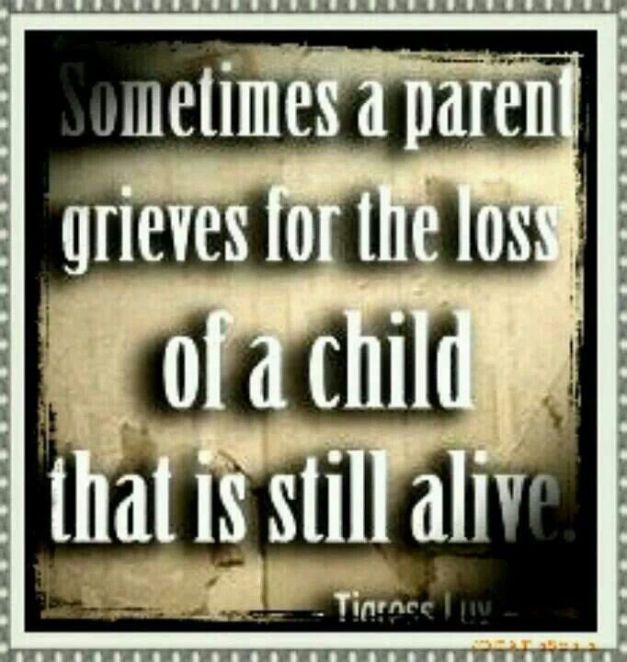
Grieve. Allow yourself to feel the sadness of being rejected by your child. Grieve over the loss of the innocence that the relationship once was. Grieve over your lost child – even though he or she is still alive. In your world, he/she is no longer part of your life. That sense of “what can I do?” keeps you yearning and longing for reconciliation; but sometimes reconciliation is not forthcoming.
Live one day at a time. Even if you have no contact with your child today, you have no way of knowing what tomorrow may bring. None of us does. The best thing we can do is to live the best way we know how today. When you can focus on one day only, you feel less hopeless and desperate. Remind yourself, “I cannot predict the future.”
Don’t beg. No matter how hurt or desperate you feel to have a relationship with your rejecting child, never stoop to the level of begging for attention or even forgiveness. You will not be respected by your child if you beg and it will demean your position as a parent.
Be empowered. Don’t let your rejecting child steal your personal power. Just because you are having difficulties in this area of your life, don’t get to the place where you feel personally defeated. Do what it takes to be good to yourself – seek therapy, join a support group, travel, go to the gym, do whatever you can to own your own power and stop giving it away to anyone else.
One thing that is certain about life is that it is about all about letting go. As parents our job is to raise our children to the best of our ability and teach them how to be independent, productive adults. If, during the process, they choose a path we don’t agree with, we must remind ourselves that we can’t live their lives for them. Learning to let go is the best way to manage any part of life that doesn’t go the way we expect, including when our children choose to reject us.
Do you know what narcissistic personality disorder is? Would you be able to spot it if you had to? For most people, their belief is that narcissism is “easy” to spot because laymen and pop psychology characterize narcissism as: selfish ambition, arrogance, cockiness, inconsideration for others, and a strong desire to be at the top of the game. But narcissism is truly difficult to spot in everyday life because some of the kindest and nicest people could be a narcissist. Narcissism doesn’t always shine through the moment you meet someone. In fact, narcissism may not fully bloom until you’ve married the person, accepted a job from a company led by a narcissist, or after many years of knowing the person. In reality, narcissistic personality traits are often hidden by the person’s ability to “act” ways they know other people like.
The psychological basis of rumours are brought to light when different examples are studied. The main ones are detailed below. They can also be said to be the causes or conditions of rumour spreading. They show why people indulge in gossip and how rumour circulates.
1 Satisfaction of Sex
Of all the rumors we hear in our lives a large number are concerned with incidents based on the sex behaviour of individuals. When four people of a particular area get together it is their invariable practice to dissect the character of another person. Many take pleasure in reading about the alleged sexual corruptions and indiscretions of other people.
Why does this happen?
From the psychological viewpoint the causes behind this are the frustrated and repressed sexual passions and desires of the individuals who ventilate and make up these stories. When the sexual passions of an individual are not satisfied in any way or they are repressed them in the extreme, they are not destroyed but in an unconscious form are trying to find expression or the opportunity for such expression.
Whenever the individual hears any true or false incident of another’ssexual corruption these unconscious desires are aroused and rumour takes shape. In making a rumour the individual also gets some satisfaction or relief indirectly. It will be found on analysis that very often at the root of these degraded tales is the satisfaction of the sexual instinct.
Sometimes this also happens when a person of the opposite sex refuses the proposal of an individual for contact, or fails to encourage the individual. They then seek satisfaction or revenge in defaming the individual who refused his or her proposal.
2 Satisfaction of the feeling of rivalry or revenge
More often than not the rumour originates in the desire of the individual to satisfy his feeling of rivalry or revenge. People who cannot supersede other individuals by fair means try to get their rivals down by defaming and degrading them.
3. Methods of Spreading Rumour
Generally speaking, no particular means are required for spreading rumors but from the scientific viewpoint the methods can be analysed. Generally in order to give currency to a rumour the people who are doing it concoct a story and tell it to the general public in which it passes from one individual to another. There are limits to this kind of rumour spreading and these limits are not very far apart.
If an incident is related to casually, people are inclined to take little, if any note and it fails to become a rumour. The person spreading the rumour has to sharpen the subject, or assimilate some interesting features which were not there originally but are necessary to raise the level above that of everyday drudgery. The better the sharpening, the greater rapidity in which the rumour spreads.
4 Assimilation
Before it can be made to form a rumour it needs to be assimilated. Any occurrence is rumoured only when the public assimilate it because then people accept it and believe it easily. It is common knowledge that rumors spread more easily when the means of transport and communications are easily available and more developed.
A lie can travel halfway around the world before the truth has got its boots on, or so the saying goes, and new research has sought to prove just how long it takes fact checking to catch up.
On average, it takes more than 12 hours for a false claim to be debunked online, according to two recent projects that compared how falsehoods and truths spread.
“On Twitter it is found that a true rumor is often resolved within two hours of first emerging. But a rumor that proves false takes closer to 14 hours to be debunked. We find that social media users generally show a tendency towards supporting rumors whose veracity is yet to be resolved”, the researchers wrote.
Why are False Allegations so popular on the Internet
The internet, not just Twitter, seems to abound with false rumors and malicious gossip, but is their popularity testament to a fundamental tendency of believing in the bogus?
Given most people already know the web is brimming with phony information (after all, who on the planet has yet to receive a scam email?) users should be naturally suspicious and sceptical of the internet. Yet hoax internet rumors and gossip continue to grow, not diminish.
This rising epidemic of falsity is therefore a psychological conundrum. Understanding how false allegations spread involves grasping the underlying mechanics of an internet rumour. Information cascades beginwith ‘propagators’. Propagators start false rumors often because they are motivated by some kind of self-serving interest, which could include getting attention. They may want to malign an individual, movement or corporation for personal reasons. Receivers and disseminators of false information those who take the baton from the ‘propagators’ and pass it on to the wider world, seem to not allow enough motivation of ‘propagators’. They don’t ‘discount’ the dodgy. Instead they often seem to falsely assume that rumours are being spread for altruistic reasons, to warn and therefore protect.
As opposed to real world conversation, perhaps the underlying vested interest of the internet ‘propagator’ remains more difficult to detect. Successful rumours are purposefully aligned with what Sunstein refers to as ‘priors’; the prior beliefs of large swathes of the population. A spreading rumour succeeds because it often confirms prior prejudices.
If you have little or no information of your own to check or compare against a rumor, the very fact a large number of other people believe, becomes evidence in itself that it must be true. This is how a rumour feeds on itself to grow in strength.
Even if a rumour starts with just the most gullible believing it, then as it spreads and this number grows, the sheer fact of such a growing consensus convinces the more sceptical. It must be true because so many believe it. This is how rumours confirm themselves.
As a rumour gathers pace, despite the possibility there are many who harbor doubts about its veracity, these doubters tend to keep misgivings to themselves. They prefer to conform, don’t desire negative attention or want to appear out of step with the group. The balancing effect of counter views get swept aside in the tsunami of a rampant rumour.
Doubts may exist but remain private, as a result they are less visible on the internet. If only those who believe a rumour are salient, because they are motivated to spread allegations, then rumours escalate because they crush any opposition before them through sheer weight of numbers. Cleverly designed rumours make anyone appearing to oppose or doubt, appear supporters of the immoral behaviour being gossiped about. So expressing doubts about the veracity of an allegation concerning someone at the centre of a paedophile accusation looks like support for pedophilia, when it’s no such thing. Doubts can also appear as lacking concern over the issue.
Sunstein cites experiments on how influenced we are by others’ behaviour, in forming our own judgement, on the internet using music downloads. Music choice was chosen because theoretically what we like is a personal preference. The research he cites found that songs which were popular or unpopular in the control group, where other’s downloads, and therefore judgments were not available, performed very differently in the sections of the experiments where others’ choices were made visible. In those conditions of the experiment, most songs could become popular or unpopular, influenced by the choices of the first downloaders. The identical song could be a hit or a failure, simply because others, at the start of the experiment, were seen to choose to download it or not.
Perhaps the most under-estimated psychological mechanism by which false allegations rapidly gain widespread support on the internet is a process Sunstein refers to as ‘group polarisation’. This process is important because the group taking part will not be aware that they are involved in spreading a false allegation, they will think instead they are dispassionately discussing it.
Group polarisation is a well known tendency for any cluster who are merely discussing something to shift in a more extreme position in the direction they were predisposed to. When individual members of a gathering tend to take risks, a ‘risky shift’ is observed when they get together to make a decision. Where members are individually cautious, even more caution emerges when in a group.
Risky and cautious shift are both examples of group polarization. Group polarization occurs in a wide range of contexts, all bearing on rumour transmission. For example Sunstein cites a study posing the question how attractive are people in photographs? Group deliberation generates more extreme judgments: If individuals think someone is good-looking, the group is likely to conclude that the same individual is devastatingly attractive. Sunstein argues movie stars benefit from this psychological process.
He contends that discussions which occur about an allegation on the internet are likely, through this process of group polarisation, to end in the rumour more believed and therefore disseminated.
Malicious gossip, if unchecked, could end up influencing who governs us. If it wasn’t for the spread of such sham information on the internet, thousands wouldn’t gossip and believe Barack Obama is an Islamist extremist, not born in the United States.
If the internet becomes what we know of the world, the rising spread of deception is particularly ominous. Checks and balances that apply elsewhere are ruled out by the very sprawling freedom of the web.
Official attempts to quash rumours often backfire and even end up lending them more credibility. Perhaps the answer is that all users of the internet need to guard against malicious gossip as opposed to relying on someone else to do it. Whoever is tasked with controlling rumour on the internet, will themselves become the subject of gossip.
A bully pretends to be a victim in order to manipulate others.
Because most people are good and compassionate, this is bullying at its worst. When a bully acts like a victim, they also gain the unwitting compliance of others into bullying you. Naïve, compassionate people will chastise you for not caring about the bully’s victimization, and not changing your behaviour to meet the bully’s desires.
Although this particularly nasty form of bullying occurs occasionally in the workplace, it is more common at home, where it represents emotional blackmail.
A bullyexaggerates the impact of your actions on them
Many clients consult us concerning family problems and this particular subject is a common problem, The following article looks at the reasons for it.
Oscar Wilde once warned that children begin their lives loving their parents, then grow up to judge them. If so, surely there is no harsher judgment of a parent than to be deliberately cut out of a child’s life for ever. Parental estrangement by adult children is a national epidemic, and it’s not always the parent’s fault.
Psychologist Dr Ludwig Lowenstein believes this generation have been empowered to judge their parents. He hears from up to six parents a day, a third of them women, asking advice because they fear estrangement from their children.
There are no official statistics to show that the problem is increasing. But numerous leading psychologists claim it is, and online chatter suggests it is.
This is another subject clients consult us about and we have had the experience and ability to help them.
The ego defense of displacement plays a role in scapegoating, in which uncomfortable feelings such as anger frustration envy and guilt are displaced and projected onto another, often the more vulnerable, person or group. The scapegoated target is then persecuted, providing the person doing the scapegoating not only with a conduit for his uncomfortable feelings, but also with pleasurable feelings of piety and self-righteous indignation. The creation of a villain necessarily implies that of a hero, even if both are purely fictional.
Some would say that Satan the Devil was used as a Scapegoat for sins and interestingly they also depict his image as half man half goat.











 Taking The Helm