A family is like all living things; it grows, develops and constantly evolves over time as the family structure changes. Sometimes changes to the family structure occur as a result of new members joining the family, through marriage and the birth of children; other times, it’s the result of losing family members as our loved ones pass away.
It can be particularly difficult to cope with the breakdown of a family, through separation or divorce. How people deal with a separation or divorce is different for each person, and there is no right or wrong way of dealing with it. However, it can be helpful to understand how separation and divorce can impact the people within a family.
What does ‘divorce’ really mean?
Divorce is the ending of a marriage – but what about the additional relationships that were tied to this marriage? These peripheral relationships include extended families, such as in-laws, whilst core relationships include children. The dissolution of a marriage through divorce, however, does not address the impact of divorce upon all of the additional relationships that were created through the marriage.
Children are often the most affected by a separation or divorce. The breakup of the parental unit brings with it many changes. Changes may be physical – the literal separation of each parent to different places of residences – as well as emotional: primarily the confusion and frustration of not understanding what is happening, or why.
This is why children sometimes protest against the situation in unusual or unexpected ways, such as unusually poor academic performance, withdrawal from friends and family, and other problematic behaviours. Typically, a child’s first reaction to divorce or separation is confusion, denial, and fear. Children may subsequently experience anger, depression, or even panic attacks, unless their feelings are assuaged early on in the separation by each parent.
The effect on the extended family
A separation or divorce can also affect the extended family of a marriage. In some cases, the family members of each spouse may feel like they have to take sides. This may be difficult, confusing and may also adversely affect the children too.
Children are good at sensing when something is wrong, and they’re especially deft at picking up on hostility – particularly if it’s being directed toward one of their parents. Post-separation, children typically struggle with knowing how to balance divided loyalties; feeling disloyal if they still love dad when mum is visibly upset, and vice versa.
When grandparents and other members of an extended family are also conflicted over whether they should take sides, kids pick up on this. If the extended family does express prejudice toward one parent, this can reinforce those feelings of confusion in children, and damage the relationship the child has with each parent.
Moving forward after a separation
Though it may be difficult to manage whilst you’re in the throes of a separation, it’s important that you communicate regularly with your loved ones – especially your children, extended family, and your in-laws. It’s important that you explain to them how you would like your family to move forward, despite the separation or divorce.
Talk about your feelings openly with your children and family, even if they are feelings of hurt or frustration. Let them see that although you’re upset, it’s okay to talk about how they are feeling, too. Doing this eliminates the sense that certain topics may be off limits, which can exacerbate each person’s feelings of confusion and frustration.
A separation is not a competition
It’s also important that you reinforce that even though you are separating from your partner, no one is to take sides, least of all the children. Even if, deep down, you don’t feel this way – which is common for people going through a separation or divorce – it’s vital for the children that you don’t make them feel compelled to take sides. This just creates inner feelings of conflict and torment, which can negatively impact their emotional and physical wellbeing.
It’s also helpful if you have these discussions with your children while your partner is present, so they can see that despite everything, you’re both remaining amicable toward each other. Try not to argue or fight in front of the children, and if you do need to have discussions with your partner that may become heated, try to have them while the children are not around.
Even though this particular chapter of your family life is ending, the family you’ve built never really breaks up or goes away – it merely evolves and moves forward, and it’s important to remember that as you negotiate this difficult time.
Mourning is hard. It doesn’t matter if the person has passed away, is estranged from you or has chosen not to have contact with you. It. is. hard.
Mourning can be more complicated when the person is still alive but you cannot see them, speak to them, write to them, tell them about your day, your happy moments or your big achievements in life. Or the opposite spectrum, like not being able to talk to them when things are tough, knowing they would have the perfect advice or the perfect response to how you are feeling. We get dependent on certain people and their responses to the events going on in our lives. Sometimes, when a person is abruptly cut out of your life, or you have just “lost touch” when one or both of you moved away, it can be difficult to cope. We find that we miss the smell of our mother’s cooking or the way that she smiled when she was super proud of us.
In the place of those happy memories come tears, pain, repressed feelings and sometimes anger depending on how the relationship ended. Knowing they are still out there somewhere in this big ole world makes it sometimes hard to bear. We don’t know how they are doing, how life has changed for them, we don’t get to celebrate things with them anymore.
All of these feelings are completely normal. Beating yourself up for cutting a person out of your life for your better interest is not healthy and shouldn’t be a reason to let that person back into your life.
They hurt you.
They did something to make you feel as you do now.
We each have the right to take care of our own well-being. The problem with that is it often contradicts the notion that we should “respect our elders,” “take care of our parents” or that “love conquers all.”
All of these philosophies are one-sided. They leave no space for the truth. Sometimes we just have shitty parents, friends, relatives or relationships. They don’t take into account that sometimes the abuse of said elder, parent or person we love can be toxic, overwhelming, overbearing and sometimes downright scary.
That doesn’t mean we cannot still love them! It just means we choose to love them from a distance. I found that in my case, staying in limited contact was only hurting me more because any time I received any kind of contact it was never positive. It always dragged me right back down into the toxic cesspool of despair. I was depressed because I couldn’t fix all the things wrong with their life, with mine and with our relationship, or fix our inability to see eye-to-eye on many important subjects.
I was allowing myself to wither away by trying to keep someone else alive…
That couldn’t work for me anymore. I couldn’t be the person I wanted to be by being a depressed, anxious, worried, fearful, stressed out individual. I wanted freedom from terror.
It is so weird to think that I felt that way. Because how can you feel terror towards a person you also love?
Do not beat yourself up for this.
For those of you still reading, I want to tell you this:
Your feelings are valid.
You have a right to feel them, just as they are, with no manipulation by others or by the person who is hurting you.
Do not beat yourself up for feeling your feelings.
Do not keep giving up your patience, sanity, clear-minded stability and rational perceptions for the sake of the other person’s happiness. You only have one life, don’t waste it by living for someone else.
You cannot heal someone who chooses not to heal themselves. Do not let yourself fall into this trap. There is a reason you chose to leave that person behind, but it’s OK to mourn the loss of this relationship.
What causes us to move on from traumatic experiences? Psychologists are finding it’s not always about bouncing back—sometimes we have to feel our whole world fall to pieces.
The Vietnam War veteran had enlisted when he was young, serving two combat tours and surviving multiple firefights. “To this day,” said psychologist Jack Tsai of the Yale School of Medicine, “his war memories are triggered by certain smells that remind him of Vietnam”: overgrown vegetation, the acrid stench of burning, or even sweat—like that which ran in rivulets down the faces of men fighting for their lives in the sweltering jungles—brought it all back. It was classic post-traumatic stress.
As Tsai was treating him (successfully) for PTSD, however, something unexpected emerged. The vet still described his Vietnam experiences as horrific, but he said the painful memories remind him of who he is. His experience typifies research psychologists’ new understanding of trauma: When people are least resilient—in the sense that they are knocked for a loop, do not bounce back quickly or at all, and suffer emotionally for months, if not years—they can eventually emerge from trauma stronger, more appreciative of life, more sympathetic to the suffering of others, and with different (arguably more enlightened) values and priorities.
By no stretch of the imagination would the vet be called resilient in the sense that research psychologists use the term: an ability to go on with life, essentially unchanged mentally and emotionally, in the wake of profound adversity. To the contrary, environmental triggers returned the vet’s troubled mind to the horrors of land mines and ambushes and friends blown apart. At the same time, the vet’s military experience (and his triumph over PTSD) makes him feel that he can accomplish anything. “Nothing bothers him too much, because everything pales in comparison to Vietnam,” said Tsai.
For many, post-traumatic growth brings closer relationships—as family and other loved ones are more cherished—and a stronger sense of connection to other sufferers.
This effect, post-traumatic growth, was so named in 1996 by psychologists Lawrence Calhoun and Richard Tedeschi of the University of North Carolina. It can take many forms, but all involve positive psychological changes: a greater sense of personal strength (“if I survived that, I can survive anything”), deeper spiritual awareness, greater appreciation of life, and recognition of previously unseen pathways and possibilities for one’s life. For many, post-traumatic growth brings closer relationships—as family and other loved ones are more cherished—and a stronger sense of connection to other sufferers.
Stronger Than Before
The concept that from great suffering can come great wisdom is both ancient and familiar. An oncologist friend of mine talks about patients who say cancer was one of the best things that ever happened to them, cutting through life’s usual trivia and making them value the truly important. President Jimmy Carter’s Chief of Staff, Hamilton Jordan (1944–2008), said his battle with cancer made him see that “the simple joys of life are everywhere and are boundless.”
After a car crash in which my childhood friend Joyce lost her right leg at age 20, her months-long recovery and rehab left her with hours upon empty hours to think. “Stuff that used to be a big deal, like being popular, just isn’t anymore,” I remember her saying. “I care about making a difference [she became a schoolteacher], and I think I’m more empathetic. I feel that when someone is suffering I understand in my bones what she’s experiencing. Before, it was just, oh, poor her.” However, post-traumatic growth does not mean traumas are desirable, let alone that they should be downplayed when they befall others. As bestselling author Rabbi Harold Kushner said about the spiritual growth he experienced after the death of his 14-year-old son, “I would give up all of those gains in a second if I could have him back.”
Few lives are without suffering, crisis, and traumas, from extreme or rare ones, such as becoming a war refugee or being taken hostage, to common ones, such as bereavement, accidents, house fires, combat, or your own or a loved one’s serious or chronic illness. For years, psychology has assumed that the best inoculation against post-traumatic stress—as well as responses to trauma that fall well short of mental disorder—is resilience, the ability to pick up one’s life where it was before the trauma. Now that psychology has made post-traumatic growth a focus of research, what is emerging is a new understanding of the complicated relationship between trauma, resilience, PTSD, and post-traumatic growth.
Post-traumatic Growth vs. Resilience
Although the psychological concept of resilience dates back to the 1970s, scientists are still struggling to understand its origins. Some studies find it’s fostered in childhood by a strong relationship with a parent or other adult, and the belief that your fate is in your own hands (a sense of agency). But the opposite belief, that “God is in control and everything happens for a reason,” may contribute to resilience, too, said UNC’s Calhoun. A 2016 review of people who survived atrocities and war in nine countries from South Sudan and Uganda to Bosnia and Burundi found that resilience varied by culture. Strong emotional connections to others fostered resilience among survivors in some societies but not others, and a sense of agency actually backfired among some: If you believe your fate is in your hands and then see your family cut down by a sniper in Sarajevo, you feel not only grief but also crushing guilt.
In the absence of resilience, post-traumatic growth—a very different response to trauma—might emerge instead. “Post-traumatic growth means you’ve been broken—but you put yourself back together” in a stronger, more meaningful way, Tsai said. This may come as a surprise to those who think of resilience as the ability to learn, change, and gain strength in the face of adversity. Among research psychologists, however, resilience is about bouncing back with relative ease to where you were before, not necessarily bouncing forward to a stronger place. By this understanding, without the breaking, there cannot be putting back together, so people with strong coping capacities will be less challenged by trauma and therefore less likely to experience post-traumatic growth.
In the absence of resilience, post-traumatic growth—a very different response to trauma—might emerge instead.
For post-traumatic growth to occur, the breaking need not be so extreme as to constitute PTSD, as was the case for the Vietnam War vet. Tsai and his colleagues found that among the 1,057 US military veterans they studied, the average number of lifetime traumas (such as bereavement, natural disaster, illness, and accidents, as well as military traumas) was 5.7. Only 1 in 10 had PTSD, yet 59% of the vets had experienced post-traumatic growth. And the strongest predictor of whether someone would avoid PTSD after additional trauma was whether they had experienced post-traumatic growth after an earlier one, Tsai and his colleagues reported in the Journal of Affective Disorders. It was the first study to examine whether previous post-traumatic growth can protect against PTSD if trauma strikes again. The findings suggest post-traumatic growth might in fact boost resilience.
Post-traumatic growth—unlike resilience—is not a return to baseline. It is the product of reassembling your “general set of beliefs about the world/universe and your place in it,” said Calhoun: You question the benevolence, predictability, and control ability of the world, your sense of self, the path you expected life to follow. From the shards of previous beliefs, you create wholly new worldviews, and can perhaps emerge a stronger person than you were before.
What is Trauma?
Among psychiatrists, what constitutes “trauma” is controversial. Some define trauma based on the nature of the event: Psychiatry’s diagnostic manual, for instance, says a traumatic experience must be outside the range of what humans normally encounter. Others define trauma based on how people respond to an experience: Intense fear, helplessness, horror, or distress would be symptoms of trauma.
A circular definition —“trauma is something that leaves you traumatized”—is obviously not ideal. Nor is “outside the range of normal experience” a reliable measure: Tragically, many experiences that once were outside that range no longer are, such as natural disasters, mass shootings, or wartime horrors.
Scholars are therefore trying to do better. An emerging definition holds that trauma challenges a person’s “assumptive world”: her belief in how people behave, how the world works, and how her life would unfold. By this understanding, trauma needn’t threaten life or health, nor cause post-traumatic stress disorder. But it must make you question your bedrock assumptions, such as that the world is fair, that terrible things do not befall good people, that there are limits to humans’ capacity for inhumanity, that things will always work out, or that the old die before the young. By that definition, few of us make it through this life without experiencing trauma.
The death of a parent is among the most emotionally difficult and universal of human experiences. If a person doesn’t know what it’s like suffer the loss of a father or the loss of a mother, they most likely will one day. The passing of a parent is inevitable, but that certainty doesn’t make losing a parent any easier to accept or understand. The death of a parent is grief-filled and traumatic, and permanently alters children of any age, both biologically and psychologically. Nothing is ever the same again — it’s a wholly transformative thing.
There’s no amount of psychological data that can capture this distinctly painful and powerful grief, as it affects each of us individually. There are, however, a number of brain-imaging and psychological studies that demonstrate the magnitude of loss of the death of a parent represents. The posterior cingulate cortex, frontal cortex, and cerebellum are all brain regions mobilized during grief processing, research shows. These regions are involved in storing memories and dwelling on the past; they’re also involved in regulating sleep and appetite.
In the short term, neurology assures us that loss will trigger physical distress. In the long-term, grief puts the entire body at risk. A handful of studies have found links between unresolved grief and cardiac events, hypertension, immune disorders, and even cancer. It is unclear why grief would trigger such dire physical conditions, but one theory is that a perpetually activated sympathetic nervous system (fight-or-flight response) can cause long-term genetic changes. These changes — dampened immune responses, less pre-programmed cell death — may be ideal when a bear is chasing you through the forest and you need all the healthy cells you can get. But, unchecked, this sort of cellular dysregulation is also how cancerous cells metastasize.
While the physical symptoms that manifest after the death of a parent are relatively consistent, the psychological impacts are all but unpredictable. In the year following the loss of a parent, the APA’s Diagnostic and Statistical Manual of Mental Disorders (DSM) considers it healthy for adults to experience a range of contradictory emotions, including but not limited to anger, rage, sadness, numbness, anxiety, guilt, emptiness, regret, and remorse. It’s normal to throw oneself into work; it’s also normal to withdraw from activities and friends.
“In the best-case scenario, the death of a parent is anticipated and there’s time for families to prepare, say their goodbyes, and surround themselves with support,” says psychiatrist Dr. Nikole Benders-Hadi. “In cases where a death is unexpected, such as with an acute illness or traumatic accident, adult children may remain in the denial and anger phases of the loss for extended periods of time … [leading to] diagnosis of major depressive disorder or even PTSD, if trauma is involved.”
Context matters. Sudden, violent death puts survivors at a higher risk of developing a grief disorder, and when an adult child has a fractured relationship with a parent, the death can be doubly painful — even if the bereaved shuts down and pretends not to feel the loss.
“Coping is less stressful when adult children have time to anticipate parental death,” says Jumoke Omojola, a therapist and clinical social worker. “Not being able to say goodbye contributes to feeling depressed and angry.” This may explain why studies have shown that young adults are more affected by parental loss than middle-aged adults. Presumably, their parents died unexpectedly, or at least earlier than average.
The gender of both the parent and child can especially influence the contours of the grief response.
Studies suggest that daughters have more intense grief responses than sons. Men who lose their parents, meanwhile, may be slower to move on. “Males tend to show emotions less and compartmentalize more,” says Carla Marie Manly, a clinical psychologist and author. “These factors do affect the ability to accept and process grief.”
Studies have also shown that loss of a father is more associated with the loss of personal mastery — vision, purpose, commitment, belief, and self-knowledge. Losing a mother, on the other hand, elicits a more raw response. “Many people report feeling a greater sense of loss when a mother dies,” Manly says. “This can be attributed to the often close, nurturing nature of the mother-child relationship.”
At the same time, the differences between losing a father and a mother represent relatively weak trends. “Complicated bereavement can exist no matter which parent is lost,” Benders-Hadi says. “More often, it is dependent on the relationship and bond that existed with the parent.”
Grief becomes pathological, according to the DSM, when the bereaved are so overcome that they are unable to carry on with their lives. Preliminary studies suggest this occurs in about 1 percent of the healthy population, and about 10 percent of the population that had previously been diagnosed with a stress disorder.
“A diagnosis of adjustment disorder is made within three months of the death if there is a ‘persistence of grief reactions’ exceeding what’s normal for the culture and the religion,” Omojola says. “In this situation, the grieving adult has severe challenges meeting social, occupational, and other expected, important life functions.”
Even adults who are able to go to work and put on a brave face may be suffering a clinical condition if they remain preoccupied with the death, deny that their parent has died, or actively avoid reminders of their parents, indefinitely. This condition, known as persistent complex bereavement disorder, is a trickier diagnosis to pin down (the DSM labeled it a “condition for further study”).
In more concrete terms, unresolved grief can spiral into anxiety and depression. This is especially true when the parent dies by suicide, according to Lyn Morris, a licensed therapist and VP at Didi Hirsch Mental Health Services. “Adults who lose a parent to suicide often struggle with complex emotions such as guilt, anger, and feelings of abandonment and vulnerability,” she told Fatherly. Indeed a 2010 study out of Johns Hopkins University confirmed that losing a parent to suicide makes children more likely to die by suicide themselves.
Elisabeth Goldberg, a relationship therapist in NYC who works with grieving adults, has seen the toll that long-term grieving can take on a marriage. Specifically, Goldberg suggests a (somewhat Freudian) link between losing a parent and cheating on a spouse. “I see many affairs as manifestations of unresolved grief about losing a parent,” she says. “The adult child stays in a state of disbelief, and rejects reality in many ways in order to feed the delusion that the parent is still alive. The grieving child needs a new attachment figure, that’s the psyche trying to reconcile the denial and grief. So rather than say, ‘My mother died,’ the grieving child can say, ‘While Mommy’s away, I will play with someone other than my spouse.’ ”
How to cope with the death of a parent in a healthy way remains an active area of scientific inquiry. Ross Grossman, a licensed therapist who specializes in adult grief, has identified several “main distorted thoughts” that infect our minds when we face adversity. Two of the most prominent are “I should be perfect” and “They should have treated me better” — and they tug in opposite directions. “These distorted thoughts,” Grossman says, “can easily arise in the wake of a loved one’s death.”
When a son or daughter reflects on how he or she should have treated a deceased parent, “I should be perfect” thoughts tend to rise to the surface. Grossman say his patients often feel that they should have done more and, “because they didn’t do any or all of these things, they are low-down, dirty, awful, terrible human beings,” he says. “These kinds of thoughts, if left undisputed, usually result in a feeling of low self-worth, low self-esteem, shame, self-judgment, self-condemnation.
On the opposite extreme, patients sometimes blame their deceased parents for not treating them properly, and never making amends. This is similarly unhealthy. “The usual result of this is deep resentment, anger, rage,” Grossman says. “They may have genuine, legitimate reasons to feel mistreated or abused. In these situations, it’s not always the death of the parent but the death of the possibility of reconciliation, of rapprochement and apology from the offending parent.”
“The possibility,” he says, “has died along with the person.”
In extreme cases, therapy may be the only way to get a grieving son or daughter back on their feet. Time, and an understanding spouse, can also go a long way toward helping adults get through this painful chapter in their lives.
“Husbands can best support their wives by listening,” Manly says. “Men often feel helpless in the face of their wives’ emotions, and they want to fix the situation. A husband can do far more good by sitting with his wife, listening to her, holding her hand, taking her for walks, and — if she desires — visiting the burial site.”
The challenges are daunting. Yes, we are vulnerable.
But each of us can find the courage room inside.
The first part of this article is a story about how frightening the current pandemic is for some of us, and how one young woman is finding her courage every day. (This client has given me permission to share some of her story, hoping her courage is contagious.)
The second part describes two different practices for courage-building. If either one resonates, grab a journal or open a fresh computer doc and WRITE IT OUT or (with bilateral stimulation) DO IT. The key is to act because action is POWER: a main ingredient of COURAGE.
Angel of a New Life.
She’s so distraught that she needs time to cry before the session can begin. “But I’m afraid of dying. I will die . . .This could be Armageddon. Couldn’t it?” Since COVID-19 has become a pandemic, Angel, a woman who recently left an apocalyptic religion, has experienced a resurgence of acute PTSD (post-traumatic stress disorder) symptoms: panic attacks, overwhelming fear, dissociation, feelings of abandonment.
I respond, into my computer screen, “No, Angel. I don’t believe it’s Armageddon. We’ve talked about this. And I know you’re scared. Before we keep going, please find your feet on the floor.”
I give her a moment. “Do your feet feel the same on either side?” At first, she can’t feel her right foot. At all: she’s dissociated—unable to feel her body fully. For Angel, this manifests first in her feet; she cannot feel the ground. This brings on a new round of panicked tears. I speak again, wishing that our two bodies were in the same room instead of on opposite sides of Toronto and opposite sides of our screens. When someone is upset, dissociating, crying, just sitting quietly with a loving witness can be a great help. Our brains and bodies are inherently social; the presence of an emotionally-regulated person brings calm to an individual or even a group in acute distress. Our emotions are contagious.
Does it work through a screen, though? Therapists all over the world are asking themselves that question right now. “Angel, I’m here. I’m with you. Keep your eyes open. Look at me. If you can’t feel the right foot, just focus on your left foot. Move your toes up and down. Lift your heel. Now touch your one hand to the opposite knee. Then the other hand. That’s it.” She shivers, sighs, touches and touches, back and forth.
After this short round of bilateral stimulation — rhythmic touches on alternating sides of the body — a wave passes through her body, top to the bottom. Though I can’t see her right foot — we’re working in separate rooms, each on our screens — I know from her and eyes face that her awareness has entered the ‘missing’ foot, connecting her back to the floor and to the present. “Back in the feet? ” I ask the familiar question.
She answers, “Yes, back in my body.”
Touching one side, then the other: it’s a deceptively simple grounding technique, but it works in profound ways. Bilateral stimulation can be tactile, visual, or auditory — gentle rhythmic stimulation to either side of the body/ears/eyes to calm and soothe the nervous system.
Eastern physical and spiritual practices like yoga, Qi Gong, Tai Chi, and all the martial arts have elaborate systems based on this technique; Western neuroscience and psychotherapy have finally joined the club. Most of the somatic trauma therapies developed in the last twenty years use some form of bilateral stimulation. Though I work a lot with visualization and mindfulness, my core practice as a therapist is OEI — Observed Experiential Integration — another bilateral stimulation therapy that changed my life twenty years ago, when I was healing from the traumas of my childhood.
We Live in a Beautiful, Traumatized World.
Many of us have extensive histories of abandonment and trauma: child abuse, including neglect, insecure attachment to caregivers, religious trauma similar to Angel’s; violent and emotionally abusive adult relationships; combat experiences; assaults of many kinds; school, academic, and workplace bullying; life-altering accidents, shootings. Many trauma victims grow into kind, productive individuals who have healed, who are healing, who want to heal. Yet many more are in prison or live in prison-like personal circumstances, trapped in the pain and disconnection of traumatic reenactment.
While life protects none of us from misfortune, with the spread of Covid-19, some people are experiencing traumatic stress as daily reality for the first time. Having never experienced anything like this before, many people are deeply confused, which often expresses itself as an inability to focus. When everything normal has changed, it is natural to feel disoriented and fearful.
Even for those of us who are relatively safe, this pandemic carries all the markers of the traumatic experience:
Powerlessness. Intense anxiety. Lack of predictability.
Fear of impending injury or death. A disordered sense of reality and time.
Disrupted social bonds.
For those who are working in essential services and healthcare, the dangers are potentially lethal. The brave work some people are doing now will leave the deep internal scars of post-traumatic stress disorder.
But the rest of us also have to contend with this frightening time. Later in the session, Angel asked, “But how can my parents not even call me? How can they not check in on me? Did they never love me at all?” Her family has disowned her for leaving ‘the truth.’ She’s had very little contact with her family or old JW friends. She already has created a small circle of new friends, but she craves contact with her ‘old world’ and her parents and siblings.
Ostracism is one of the most wounding things a group can do to an individual or family unit. Social death is truly a form of death. And with this pandemic, because we’re so cut off from each other, millions of people are experiencing a taste of social death and ostracism.Our internal and external social engagement systems have been disturbed or completely overturned. Forced isolation is painful.
Single clients tell me — on a phone or computer screen, at this time — that they think they are going “fucking crazy.” I nod and say, “Let’s work with that.” We are social creatures; our bodies and our brains are social machines. We can now see on MRI scans that our brains respond to and interact with each other all the time — right down to the level of mirror neurons. We experience our connections with each other as both emotions and physical feelings in the body.
That’s why the glance of a stranger’s eyes or the gaze of a loved one can be so powerful. It’s brain to brain contact. By reading this, you share with me a moment, a small world of thought.
I continue to work with Angel on her renewed symptoms. She feels deep grief for the loss of her family. This is part of religious and betrayal trauma: in breaking away from an abusive religion or relationship, the person often loses a community as well as an identity. Sometimes, when Angel feels like she can’t cope with this world and her fear, I remind her of the extraordinary courage she found to make her escape in the first place.
My therapy and mentorship practice is called The Courage Room. That doesn’t only indicate the name of the place; it’s also another way of saying ‘the human body’. Each of us has within a room of resilience and strength. You are the courage room. I am the courage room. We are in this together.
Below, you will find two techniques for building your courage (finding your calm is an extra benefit.)
Finding The Courage Room Inside: two basic techniques
#1. Make Courage Real: Visualize The Courage Resource
The first step in building courage is to imagine it. Never underestimate the healing power of the imagination.
Usually every one of us, even those who’ve lived through damaging experiences, can remember a time and a place where we were safe, where we experienced a sense of happiness and contentment. In therapy-speak, we call this a resource; remembering the resource place or activity is called resourcing. We summon up those places in our memories we can use for self-nourishment and stabilization.
These do not have to be fancy places. Often they are humble. One safe place in a house: for one client, it was under the dining room table of her childhood. Sometimes it’s a backyard or garden. A park you used to love as a kid (or still love as an adult). A safe relative or friend’s house.
So think of (or imagine — custom-build one) your place of courage and safety.
Meditate upon it. Daydream about it. Honour it in your mind and heart.
Courage can also be contained, like a talisman, in one small object in our mind or physical life. Imagine the space or the object.
Hold it in your hand if exists: turn it into your courage talisman.
Now, grab the journal or open the fresh document and write down the story of your courage room/object. Really DO IT: the physical act is an act of power. Accessing power through your imagination gives you courage. Courage COMES from the imagination. More on that in another blog post, and a book I’m writing . . .
My house is full of small and large rocks and stones because at different times, they’ve given me courage, or a view into another possibility. Rocks and stones especially are dense, beautiful objects of power. Their solidity is dependable. And one of my most important ‘courage’ rooms and talismans combined is a big tree in my neighbourhood. I visit it almost every day. I love that tree!
Close your eyes and think about how the courage of this space/object can grow, expand, giving you both strength and a sense of calm. When you experience distress, upset, exhaustion, fear, PTSD symptoms, go to your room/object and get in touch with your courage resource. The more you work with this, the more powerful it becomes.
Visualization can be many things, including a spiritual practice that’s part of meditation, but it’s also a form of brain exercise that translates into physical results. For decades, elite athletes have employed visualization in their training; a whole body of research shows how effective visualization is for building co-ordination, strength, and spatial memory.
#2. Bilateral Stimulation
Anyone can experiment with stimulating each side of their body in a simple alternating sensory pattern. When we touch the body, or focus our vision or hearing in a certain way, we send signals to the brain: it’s the brain that actually allows us to feel, see, hear, taste, smell. Focused, intentional bilateral stimulation has a regulating effect on the brain, the body, and the entire nervous system.
So next time you are panicking, ready to scream at someone, filled with the pressure to harm yourself or another person in any way (in reality or in your imagination) please count to ten, take a few deep conscious breaths, and give the techniques below a try. We bilaterally stimulate naturally when we walk, dance, push the pedals of our bicycle.
First and foremost, as I did with Angel above, put your feet on the floor. Feel your feet. Feel how each side might give you a slightly or a radically different sensation. Pay attention. Go back and forth. Just stay with your feet; the feeling will come into them.
Breathe into your belly. You don’t want to have the breath up in your throat; pull it all that way into the bottom of your lungs and let your belly fill with air.
Take your right hand and gently tap your left knee or thigh. (Further focus comes when we cross the midline of the body, hence the left to right sequencing.) Take your left hand and gently tap your right knee or thigh.
Repeat 20 times, paying careful attention to how this simple exercise helps to calm down your body. Keep breathing into your lower lungs and belly. Feel your feet on the floor. Repeat more if it helps.
If you want to get more active, stand up. Feel your feet on the floor. Lift your right knee up and touch it with your left hand. Repeat on the other side. Do this bilateral stimulation march for a few steps, remaining in place, to see if it works for you.
Turn these two basic, easy techniques into part of a mental health hygiene routine. Share these techniques with friends and family. Kids can also use conscious bilateral stimulation to calm down, to feel better, to focus on homework, and to self-soothe.
The Beginning, Not the End, of The World
Social distancing has brought Angel into a renewed period of mourning for the loss of her family; it’s an ongoing sorrow, especially in a time when most of us are anxious to connect, to remind ourselves that we belong, we are part of our families and of the human family. In a recent session, Angel talked at length about losing her family, her friends, feeling that she had died to them; none of the community members that she’s known her whole life have called to see how she’s doing.
“It’s like Armageddon has already come and I’m dead!” Her face seemed to be ready to crumple. I thought she might cry. But something else happened. Her expression altered and opened; her face lit up. And her voice became stronger as she said, “But I’m not dead. Obviously! I’m ALIVE. I’ve already resurrected myself. That’s what leaving was for me. Resurrection. And it’s the only kind of resurrection I will ever know. So I’m not going to waste it.” Then she did something she’s only recently started doing, after almost thirty-three years of living: she swore, with great feeling, “Fuck that!” We burst out laughing, each leaning in to get closer on either side of our computer screens.
Here’s to self-resurrection. Here’s to spring, which shows us every year how to come alive again.
(Disclaimer: Dear Reader, this article is not a substitute for therapy or counselling. If you are experiencing serious distress, please call a hotline or a trusted friend for support.!)
(This disorder can also apply to a wife but in this article it refers to the husband)
A narcissistic husband will destroy you and destroy your life. If you are realizing that you may be married to a narcissistic husband, or you already know you are, well done! It’s not easy to recognize when you are in a mind control situation so you should give yourself a pat on the back…
So that’s the first step, being able to identify the reality of your situation. Now you have to deal with it. This means getting away from him, so that you put a stop to the abuse, and then you have to undo the damage he has done to you, and the children, if there are any.
In order to do that, you have to understand what was done to you. In fact, the more information you have about what he did and how he did it, the better for you. With this in mind, I want to explore here a very particular aspect of any relationship with a narcissistic husband. I am going to look in detail at the false personality, or pseudopersonality, that the manipulators impose on their victims and the implications of this.
You can substitute other phrases for ‘narcissistic husband’ here. You may consider that you have a ‘controlling girlfriend’, a ‘group leader’, a ‘strict boss’ or a ‘manipulative friend’. In any situation of psychological abuse the same things will apply.
Narcissistic husband – a quick summary
A narcissistic husband is all about control. He wants to control you so that you make him the purpose of your life. He wants all of your time and attention, he wants your praise and adoration and he wants to know that he has total power over you. To do this he will manipulate your beliefs, he will control your thinking and your decision making and he will manage your behaviors. He will even change how you think about the world and your place in it.
All this adds up to a change in personality for you. Friends may have commented how you are different, not yourself and so on and you may have noticed how you somehow got lost in the relationship or you may not even know who you are anymore. This is because you have had this pseudopersonality imposed on you by your narcissistic husband.
Oh, you’re back, good! In this article we will deal with the details of the pseudopersonality itself and the implications of it.
Deception from day one
From the very first encounter, the narcissist is manipulating the impressions of the victims. The narcissist makes out that they are charming, friendly and caring, as well as intelligent, wise and worldly. They understand that first impressions are important and they want to make as good a one as they can. My grandfather used to say, “Get yourself the name of an early riser and you can stay in bed all day!”
The narcissist wants people looking up to them because that creates a power imbalance in the relationship from the word go. And control and domination is what it’s all about for the narcissist. And, of course, that power means that they get their praise, compliments and adoration, their narcissistic supply, from those around them.
Using a whole range of destructive mind control techniques the narcissistic husband then imposes a collection of beliefs, ways of thinking and making decisions, ideas, emotions and behaviors on the unsuspecting wife. This is basically imposing a new personality on her, as we have outlined above.
The pseudopersonality
A good way to think of the pseudopersonality is to consider that it contains the programming that the narcissistic husband wants in place. The beliefs are aligned with the thinking of the narcissist, the thinking and decision making are designed for the benefit of the manipulator and the behaviors of the pseudopersonality make the life of the narcissist more comfortable.
Think ‘slave’, but in this case the slave does not realize it is a slave. It thinks that it is making it’s own choices, that the relationship is normal and acceptable and the slave thinks that everybody is working hard for the benefit of all.
This may seem far fetched if you have never been in a mind control environment, but it is what actually goes on.
The pseudopersonality is programmed to consider the well being of the narcissistic husband above all else. Decisions are made in order to avoid upsetting him and instead to do things that are likely to be pleasing to him. Thoughts such as ‘If I do that he will be upset so I won’t bother,’ are so common for the pseudopersonality that it becomes automatic and the pseudopersonality hardly realizes that it’s doing it.
In this way a person with a pseudopersonality believes that he or she is making their own decisions. After all, they decided whether to choose A or B, they haven’t asked anyone and no-one has a gun to their head. What the person doesn’t account for is the extensive influence the narcissist has had on them up to that point. The fact that the pseudopersonality believes it is making it’s own decisions gives it a sense of control and motivates it to continue in the relationship, trying to improve things.
Dependency
The pseudopersonality is programmed to be very dependent on the narcissistic husband. I explained how this is set up in the article on narcissistic boyfriends and also in the discussion about narcissistic abuse recovery.
This starts out with the wife needing to check with him to know what to do. If often ends up with her needing to check with him to know if she is ok and even to know who she is.
The idea is that she feels that if he is ok, then she is ok, too. If he is angry or upset, then she feels bad and she may even consider that she is bad. She has been literally trained to accept responsibility for anything that goes wrong, and if he is upset, then she is at fault, and it’s because of who she is that there are problems. This kind of thinking is very detrimental to a person’s self esteem and self confidence. It means that the pseudopersonality often has a very low opinion of itself.
But to outsiders, the pseudopersonality presents a great façade. It acts as if everything is great and the relationship is marvelous. In cases like this, when the woman separates from the narcissistic husband, people are shocked because they believe the two make the ‘perfect couple’ and there did not seem to be evidence of any problems at all. They often find it hard to believe the long suffering wife’s stories about her abusive husband.
The pseudopersonality is also programmed to defend the narcissistic husband, making excuses for him when others criticize him. Even when the woman’s family can see that he is abusive, she backs him up. This can be very distressing for her family because they can’t understand how she cannot see that he is bad and abusive.
The dependency can be such that a woman cannot imagine a future without her narcissistic husband. Many people have a phobia of leaving and they even think that they would be so alone that they could even die. This obviously keeps them locked into the relationship with no other option than to stay and try and make things work in whatever way they can.
Responsibility
Having a pseudopersonality means that a person’s decisions and actions are not their own. These things have been shaped and controlled by the narcissistic husband using influence that is outside the awareness of the victim.
The victim does not know what is going on. They do not have all the information about their situation. Not having full knowledge and awareness of what is going on means that the woman’s decisions are not fully informed. She is making decisions with only a fraction of the available information, and even much of that is distorted! For this reason, the victim is not responsible for what happened to them. (This typically takes a person months of study to fully understand how and why this is true.)
Two personalities
The pseudopersonality co-exists with the real personality but it dominates and suppresses it. This idea helps to explain the internal battle that many women experience while with a narcissistic husband.
One part of them wants one thing. Another part wants the opposite.
The real personality wants to leave the relationship. The pseudopersonality is programmed to stay. The pseudopersonality can hardly wait for him to return to the house, the real personality is disgusted at the thought of being with him again. The pseudopersonality loves him, the real personality hates the things he does. The pseudopersonality feels that it needs to look after him, the real personality logically knows the situation is not fair, bad or even detrimental.
These contradictory emotions, or contradictory thoughts and emotions, are very distressing for the woman and there is no way to resolve this situation until the pseudopersonality is removed. While it is in place, however, the woman, not understanding what is being done to her, can easily blame herself for not being able to sort things out. Many women feel that they may actually be going crazy! And at the same time they also have a sense that it’s not them that is the problem but that there is something wrong with him, but they just can’t put their finger on what it is.
Durability
A narcissistic husband installs a pseudopersonality over time using powerful influence techniques that are repeated time and time again. The pseudopersonality is forced onto the victim without their knowledge or consent. The victim is therefore not in a position to resist mentally. In fact, in the honeymoon phase of the relationship, the victim is a ‘willing’ participant, so to speak. This is the nature of mind control, the victim thinks that the abuser is actually helping them and is genuinely looking out for them. Therefore it is easy for them to go along with what is happening.
These factors, along with the fact that a person’s core beliefs are changed, mean that the pseudopersonality can be quite durable. Just because a woman leaves a narcissistic husband does not mean that the pseudopersonality disappears. It actually persists and it will last for decades unless the victim does something about it.
Some aspects of the pseudopersonality may disappear or weaken with time, but most of it does not.
First of all, the persistence of the belief system and behavior patterns, which are not designed for the benefit of the victim, causes problems of all sorts with trust, relationships, sleep, concentration, memory, decision-making, digestive issues, identity issues and emotional disturbances.
Secondly, if a person does not recognize that they were in an abusive relationship, they break up and try and put things behind them. Later, when problems arise, they do not associate these problems with the abusive relationship and the pseudopersonality. They may seek help for said problems without realizing where the problems originated. Unless the therapist recognizes the source of the problem as being the abusive relationship, the problem will be treated in isolation. This rarely gives satisfactory results.
More abusive situations
A person who has a pseudopersonality has various beliefs, attitudes and behaviors that have been installed as part of the pseudopersonality. Obviously, pseudopersonalities share many common beliefs and behaviors because each pseudopersonality is designed to be subservient, obedient, dependent and loyal.
For example, the pseudopersonality is programmed to accept responsibility whenever things go wrong so that many people blame themselves when anything around them is not working out. They do this even when there is no way that things are their fault. The behavioral manifestation of this pattern is the pseudopersonality apologizing very frequently, even for the smallest of things.
Another common trait of the pseudopersonality is expressed when somebody treats a pseudopersonality very nicely. The pseudopersonality is so used to being treated badly that when someone treats it well, it is extremely grateful. So grateful, in fact, that it wants to make sure that the person doing the nice things knows how grateful it is. What do you notice? The pseudopersonality says ‘thank you’ a lot and may be very effusive in expressing gratitude, including going over the top in returning the good behavior, buying a small gift and so on.
The excessive apologizing and expressing of gratitude are but two examples of the evidence of the presence of a pseudopersonality. There are all sorts of other beliefs and behaviors that indicate that a person has been manipulated or abused in the past, if you know what you are looking for.
Psychopaths and narcissists know exactly what they are looking for. They recognize these indicators as soon as they meet someone. After all, they are used to imposing these things on their victims!
The reason this is important is that when a psychopath, sociopath or narcissist meets a new person, if they see the signs of a pseudopersonality, they know that person will be an easy target for them. So they set their sights on them and go for it.
This is why many people end up in one abusive situation after another, or in one cult after another or have one narcissistic husband after another. People do not attract narcissists and psychopaths. These types are predators and they are attracted to people who have already been abused.
The only way to take the target off your back is to get rid of your pseudopersonality. Trying to forget your abusive situations will never work. The damage is too deep and you can’t hide it from the predators. You don’t even know what they are looking for, so how can you hide from them?!
Trying to manage narcissists and psychopaths won’t work either. They are so much more sly and devious than you could ever be, and they are way better at destroying limits and boundaries than you ever will be at putting them in place.
A further complication here is that the pseudopersonality is programmed to reveal things about itself. The narcissistic husband needs information to keep the manipulation going so he programs the pseudopersonality to reveal things to him. This pattern is insidious and often extremely strong and when a woman leaves her narcissistic husband, the pattern persists. She ends up revealing all sorts of things about herself to others, often complete strangers. If the listener or reader is a narcissist, the woman is giving them all the info they need to pick up where the narcissistic husband left off.
So what to do about a narcissistic husband
You really need to leave. While you are in the relationship, the abuse continues, the pseudopersonality is constantly reinforced and you suffer while your life is being stolen away from you. I know it’s incredibly difficult to get out and it’s still something that has to be done.
Then you have to undo the pseudopersonality. Working with an expert is worth your while. It will save you time, money and heartache. Having professional help going through a divorce from someone you know is abusive, and who is guaranteed to play dirty, is invaluable.
Until you get rid of the pseudopersonality you will have that man in your head, acting like a malignant psychiatrist. Your life won’t be your own and you will continue to be affected by him. If there are children, you owe it to them to get rid of your pseudopersonality so that you can help them to get rid of theirs. The risk of not doing that is that they grow up with a pseudopersonality and fall prey to other narcissists and end up being caught in an abusive relationship themselves as adults.
One of the hardest things to experience is the betrayal wound that occurs when your own child grows up to hate you. I have seen this numerous times in my life, to the point that I am compelled to write about it.
Parents who have been rejected by one or more of their children experience a type of pain that is not matched by any other – even the betrayal of a spouse or parent.
If you are a parent who has been rejected by your child or children then hopefully this paper will be beneficial to you. Of course, if you were and still are an abusive parent, then perhaps your child did what was necessary in order to protect him or herself from further abuse; but, if you are a typical, “good enough” parent, then your child’s rejection is unnatural and unhealthy – for all involved.
What types of children reject their parent(s) in this respect? (Note: these options are not mutually exclusive.)
Children with Narcissistic Parental Alienation Syndrome
Children with attachment trauma
Children with personality disorders
If you are experiencing the heart ache of a child who rejected you, then you probably feel devastated, hurt, confused, angry, furious, misunderstood, shocked, invalidated, and empty. Was I a bad parent? Why did my children turn against me? What could I have done differently? Maybe I said “no” too many times. Maybe I shouldn’t have been so hard on him/her. Where did I go wrong?
Many questions enter your mind.
Usually, children, no matter what, are loyal to their parents – even very neglectful and abusive ones. When a child rejects a parent it usually has something to do with something else other than abuse or neglect. In fact, when a person cuts ties with an abusive or neglectful parent it is usually a difficult process and requires the child to set difficult boundaries, and is nearly impossible to do.
What about the parent whose child rejects them easily or with no sense of conscience or remorse, acting as if their parent were Attila the Hun, using criticism and judgment as tools of attack against the parent; using every weakness of the parent as justification for the ostracizing him/her? This type of parental rejection is not natural and is usually the result of one of the above three mentioned possibilities.
I will discuss each option here.
Children with Narcissistic Parental Alienation Syndrome:
This is the dynamic that occurs when a child is manipulated by the narcissistic parent to reject the other, healthy and empathic parent. It happens because the narcissistic parent uses a type of invisible coercion to convince the child that the other parent is no good. In essence, the narcissistic parent teaches his/her child to hate his/her other parent, and uses the child as a weapon to hurt the other, non-narcissistic parent.
Often this is done by implication and non-verbal communication, such as when a child returns home from being with the targeted parent and the narcissist acts overly concerned or alarmed by anything that may have gone on at the targeted parent’s house; by acting as if there is cause for distress, and that the child is very fortunate to be away from that “unhealthy environment…”
For further information on the topic of Narcissistic Parental Alienation, please click here.
Children with attachment trauma:
While attachment occurs all through the human lifespan, the most crucial time in a human being’s life for attachment is between the times of birth to two years. If the child experiences a breach in time, away from the mother, for any reason – be it abuse, neglect, or something else prevents the mother from being present and attuned to her child, then attachment trauma results.
Once a child has not connected properly with his/her mother, then the child did not develop the appropriate skills for having a healthy interpersonal attachment. A mother needs to provide the necessary attunement and resonance needed to learn how to love and trust another person. When a child is not given that type of relational input, he/she adjusts or copes by shutting down his/her needs. This results in later relationship problems, particularly involving the relationship with the mother, or anyone else offering intimacy and nurturing.
Children with personality disorders:
There appears to be a genetic component to personality disorders. If a child has a parent or other person in his biological family with a personality disorder, or even other mental illness, then perhaps he/she has inherited a biological propensity to have a personality disorder him/herself.
According to Google dictionary, a personality disorder is defined as: “a deeply ingrained and maladaptive pattern of behavior of a specified kind, typically manifest by the time one reaches adolescence and causing long-term difficulties in personal relationships or in functioning in society.”
As you can see by this definition that people with personality disorders are not easy to have close relationships with; this would include parent-child relationships.
What to do?
The best advice I can offer is as follows:
Ask your child what he or she needs from you in order to repair the relationship. If your child tells you something specific, just listen and determine if you can honor your child’s request. If it is reasonable and sincere, than do your best to repair what has been broken.
Don’t act on your feelings of defensiveness. If you feel defensive, learn to talk within your own head and keep your mouth shut. You should not defend yourself to your child. You can say something neutral, such as, “I have a different perspective on the story, but I’m not going to defend myself because it won’t be productive.”
Expect Respect. Realize that no matter what, everyone deserves to be treated with respect – including you.
Don’t idealize your children or your relationship with them. Yes, our children are the most important people in our lives, but they should not be idealized or enshrined. They are mere mortals just like you and I.If your child is rejecting you, it’s one thing to feel disappointed and sad, but it becomes unhealthy if you can’t focus on anything else other than that. You are best served to remind yourself that you have other relationships that are important as well, and learn to focus on the ones that work.
Grieve. Allow yourself to feel the sadness of being rejected by your child. Grieve over the loss of the innocence that the relationship once was. Grieve over your lost child – even though he or she is still alive. In your world, he/she is no longer part of your life. That sense of “what can I do?” keeps you yearning and longing for reconciliation; but sometimes reconciliation is not forthcoming.
Live one day at a time. Even if you have no contact with your child today, you have no way of knowing what tomorrow may bring. None of us does. The best thing we can do is to live the best way we know how today. When you can focus on one day only, you feel less hopeless and desperate. Remind yourself, “I cannot predict the future.”
Don’t beg. No matter how hurt or desperate you feel to have a relationship with your rejecting child, never stoop to the level of begging for attention or even forgiveness. You will not be respected by your child if you beg and it will demean your position as a parent.
Be empowered. Don’t let your rejecting child steal your personal power. Just because you are having difficulties in this area of your life, don’t get to the place where you feel personally defeated. Do what it takes to be good to yourself – seek therapy, join a support group, travel, go to the gym, do whatever you can to own your own power and stop giving it away to anyone else.
One thing that is certain about life is that it is about all about letting go. As parents our job is to raise our children to the best of our ability and teach them how to be independent, productive adults. If, during the process, they choose a path we don’t agree with, we must remind ourselves that we can’t live their lives for them. Learning to let go is the best way to manage any part of life that doesn’t go the way we expect, including when our children choose to reject us.
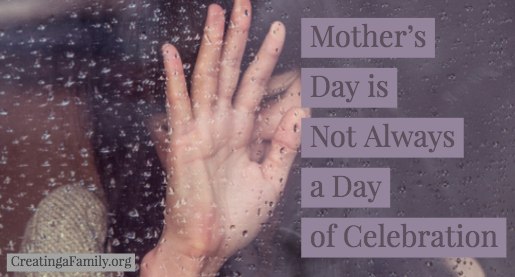
Mother’s Day is Sunday. Will you be celebrating, hibernating, or going through the motions? For so many people for so many reasons, Mother’s Day is not always a day of celebration.
A couple of years ago, about this time of year, I was talking with a pastor friend of mine. I mentioned how hard Mother’s Day is for women who are struggling with infertility and for birth mothers who have placed a child for adoption. I suppose I thought I might be helping to educate her on the complexities of this day of celebrating motherhood. It turns out that she needed no education on these complexities.
My pastor friend sighed and surprised me by saying that Mother’s Day is a nightmare for the church and that she was always thankful when it was over.
It’s not just the infertile who find this day painful, but also anyone who has lost a child or is estranged from a child.
Women whose children are struggling with addiction or are in jail often find Mother’s Day sad too since some feel like failures as a mother.
Single women who want to be a mom and feel time passing them by feel their loss more intensely on this day set aside to celebrate the joys of motherhood.
Moms who have placed their children through adoption may feel their empty arms more intensely on Mother’s Day.
And then there is the view from the other side of the mother/child relationship: women who have lost their mothers or are estranged from their mothers may dread this day that reminds them of their loss.
Suffering Silently Through Mother’s Day
I thought of how myopic I’ve been. As a daughter, I liked having a day to honor my mother. As a mom, I liked having a day where my kids and husband honor me. As someone immersed in the world of infertility and adoption, I was aware of how Mother’s Day affects the infertile and birthmothers. If I had taken the time to think it through, I would have realized of course, that they aren’t alone in their suffering, but honestly, I hadn’t taken this time.
So many who suffer through Mother’s Day are invisible. Other than your close friends, you don’t know who has had three miscarriages, or hasn’t spoken to her mother in years, or doesn’t hear from her grown son other than once a year, or who placed a child for adoption years before. But then pain is often invisible unless you’re the one feeling it, isn’t it?
So as you sit in church this Sunday or at a restaurant surrounded by your family at your celebration lunch, look around you. Really look at the people who are there and recognize that not all are celebrating. Also notice who isn’t there; who is holed up at home watching a Law & Order marathon with a gallon of Ben & Jerry’s because it is simply too painful to participate.
Shunning, one of the most abusive practice of high-pressure groups, is often the most obvious sign that a group is abusive. It tears families and communities apart, forcing many to choose between their faith and their loved ones. Whether it is called Shunning, Disconnection, Ostracism, or De-FOOing, the harsh reality of alienation ensures that those who leave the group are cut off absolutely, often losing their entire community – friends, relatives, and their complete support system.
For one woman in Michigan who had left the Jehovah’s Witnesses, the strain of losing her community was too much, and, struggling under the weight of the shame her abusers had taught her to assume, she drowned the family dog and shot her husband and two adult children, before turning the gun on herself. According to family friends, Lauren Stuart and her husband had left the organization because their children wished to attend college – something the Jehovah’s Witnesses strongly discourage – and she wished to pursue a modeling career. Because she could no longer be a member of the group in good standing, former friends ignored her, looking the other way when seeing her in town, refusing to speak with her or acknowledge her presence. In a small community, such treatment can make life intolerable, and although the Jehovah’s Witnesses have claimed in court that shunning is a “personal choice” and never absolute, their own internal convention videos show a harsh reality, where parents are coached to ignore their own children if they are disfellowshipped.
Flor Edwards was born into the apocalyptic cult Children of God. Throughout her childhood, she lived in 24 different locations preaching the cult leader’s narrative, which was: all of its members, like Flor, were “chosen” martyrs charged with saving the world from the Antichrist before a supposed apocalypse in 1993. When this date came and went and the world didn’t end, Flor went from anticipating death to facing the possibility of life.
In this eye-opening series, you’ll learn what it was like for Flor to grow up in the confines of a cult and how its narrow constructs initially shaped her beliefs about life, love, and relationships. You’ll discover what it was like to leave the only world she’d ever known after the cult disbanded, and how she navigated the tricky road of reconstructing her belief system as a teenager. Above all, you’ll understand how she faced the mental health impacts that resulted from each stage of her journey.
Unlike most media coverage of stories like Flor’s, this series doesn’t sensationalize. It educates. Flor’s journey is extraordinary, but it’s relatable. We all have obstacles to overcome and the ability to learn from them in order to create the life that we want, just like Flor has. Flor has rewritten her narrative since leaving the Children of God. This series provides real insight into this authentic narrative – not the one sensationalized by most media outlets.





 Taking The Helm