Although memories seem to be a solid, straightforward sum of who people are, strong evidence suggests that memories are much more quite complex, highly subject to change, and often simply unreliable. Memories of past events can be reconstructed as people age or as their worldview changes. People regularly recall childhood events falsely, and through effective suggestions and other methods, it’s been proven that they can even create new false memories.
Why False Memories Are Common
A person’s malleable memories often involve the mundane, such as when we second-guess whether the stove really is off or on. But they can often be far more consequential, such as unreliable eyewitness recollections of a crime.
Human memory is pliable and easy to manipulate. A distorted memory or the introduction of later, false information can affect how we recall events we experienced firsthand. A person’s existing knowledge can impede and obstructs their own memory, leading to a newly formed, cobbled-together recollection that does not accurately reflect reality. Also, under certain circumstances, a person can be given false information and be convinced to believe that an event that never occurred actually did.
Should I question my memories?
Given that our recovered memories may be genuine or false, or a combination of the two, it is legitimate to question just how much of what you remember is real and how much is a misperception.
How can I identify a false memory?
Without material evidence, it’s hard to know for sure whether a memory is real or imagined. Even if you feel high conviction that a recollection is true, there is a high chance that the memory is flawed, by a little or a lot.
How do I get rid of false memories?
Just as a recollection can be altered into a false memory, it can be reversed as well. If you return to the memory and think closely about its details, you may be able to recreate the event over time. Through such a process, you reroute the false memory to a true one.
Why Memories Matter
A malleable memory can have especially dire consequences, particularly in legal settings when children are used as eyewitnesses. Research has found that a child may be especially susceptible to the implanting of false memories by parents or other authority figures. This becomes highly problematic when a case involves alleged sexual abuse or relies on the correct identification of a suspect by a child. But adults can also be tricked into remembering events that never happened, or changing the details of things that really did happen.
Why do I remember things that never happened?
Presented with incomplete information, the brain seeks to fill in the blanks. If you see a photo of a person you have never met, for example, and mutual friends have shared descriptive details on time spent with the person, you may start to believe that you have in fact met the individual.
Why do memories change over time?
Psychologist Elizabeth Loftus of the University of California at Irvine, an influential researcher on memory who has consulted on many high-profile legal cases involving disputed memories, including the McMartin preschool sexual abuse allegations, notes that everyone embellishes or adds to their memories during recall or recounting. Over time those changes, accurate or not, become part of the memory in the mind. Loftus warns that human memory is not a recording device, but more like a Wikipedia page: You can change it, but others can, too.
Most people struggle to recall events before the age of about 3 or 4, a phenomenon called childhood amnesia. In the first few years of life, a child’s body undergoes the process of neurogenesis, or the growth and development of nervous tissue. New nerve cells develop, and old cells get recycled or reformed, taking childhood memories away with them.
How Misinformation Is Easily Spread
On the internet, almost anyone claiming objectivity or impartiality can disseminate false memories through the dissemination of specious information. Misinformation, or “fake news,” has become ubiquitous through media such as doctored videos and photoshopped images as well as fabricated text. Such misinformation is especially persuasive with audiences who already harbor biases endorsed by the inaccurate messages.
Why is misinformation so detrimental?
Several recent events have proven that memory can become weaponized, often quite effectively. Once misinformation taken hold in a target’s mind, that new, false recollection hinders his or her ability to make informed decisions about policy and politicians. Fake news drives social discord and character assassination, and even corrupts crucial personal choices about health and well-being.
Biased thinking molds the way we remember. We all employ bias when perceiving, interpreting, and remembering information and events. This effect extends to the ways in which we tap our memories for information about fake news.
Can well-known events be altered?
In a study, researchers doctored images of well-known events and found that indeed a person’s recollection of even universally known, iconic events can be altered.
How to Spot Fake News
Investigate the source of the information and whether the site is reputable.
See who is listed in the “About” section or “Contact Us” page.
Check the author and scrutinize the person’s credibility.
Is the author a real person?
Don’t fall for clickbait headlines, read the entire post.
What is the purpose of the information?
Make sure the story is current and not lifted from old information.
Check the accompanying links for references and citations.
Search for more information on the claim.
Doctored images are sometimes obvious and can be searched via image sourcing tools.
It begins small. A little boy drops a glass and blames the cat. A teenager says she studied for the test, but didn’t. A man tells a friend he’s fine, even though his heart is broken. A woman tells her boss she’s on her way—though she’s still in her pajamas.
Deception weaves its way through everyday life. We do it to avoid shame, to save face, to gain advantage, to protect others, to feel safe. Most of the time, we don’t even notice we’re doing it. But beneath the surface, each lie—no matter how tiny or towering—leaves fingerprints on the mind.
To understand deception is to peer into one of the most complex and mysterious aspects of human psychology. It is not just about falsehood. It is about strategy, memory, emotion, fear, control, and even survival.
Lying is ancient. It is wired into our evolutionary history. And though it might be easy to judge liars from the outside, the real story unfolds deep inside the brain.
The Origins of Deception: Born to Lie?
Before we explore the inner workings of a liar’s mind, we must face a startling truth: the capacity for deception begins in childhood, often earlier than most people expect.
Infants as young as six months have been observed in experimental settings to feign distress to attract caregiver attention. By age two, toddlers can deliberately mislead. At age four or five, children develop what psychologists call theory of mind—the understanding that other people have beliefs, desires, and knowledge different from one’s own. This milestone is crucial for intentional lying.
The emergence of lying coincides with cognitive development. To lie, a child must juggle multiple mental tasks: invent a story, remember what’s been said, suppress the truth, and anticipate the reaction of others. It’s a kind of mental juggling act—and not a simple one.
Ironically, a child’s first lie is often a sign not of moral decay, but of mental sophistication. It marks the point where imagination, memory, and empathy collide.
What Happens in the Brain When We Lie?
Telling the truth is easy. It’s a direct retrieval of memory. But lying? That’s mental gymnastics.
Modern neuroscience offers extraordinary tools for peering into the brain as deception unfolds. Functional MRI (fMRI) scans and EEG readings have shown that lying activates multiple brain regions, including the prefrontal cortex, anterior cingulate cortex, and parietal lobes.
The prefrontal cortex is the executive center—the brain’s CEO. It handles planning, decision-making, and impulse control. To construct a believable lie, this region must suppress the truth and generate an alternative scenario. The anterior cingulate cortex, meanwhile, manages conflict detection. It lights up when our internal moral compass clashes with dishonest behavior.
This internal conflict is critical. It’s what causes physical signs of stress—fidgeting, sweating, voice pitch changes. It’s also why lying can be mentally exhausting.
But here’s the catch: not all lies feel bad. With practice, people can become desensitized to deception. Over time, the emotional and neurological “cost” of lying diminishes. This is how compulsive liars are born—not in a single moment, but through the slow erosion of conscience.
The Sliding Scale of Lies
Not all lies are created equal.
Some are harmless, even helpful. These are the so-called white lies—the kind we tell to protect feelings or maintain social harmony. “You look great in that outfit.” “I loved your presentation.” “I’m not mad.”
Then there are strategic lies, used to gain an advantage or manipulate outcomes. Politicians, negotiators, poker players—many rely on subtle forms of deception to achieve their goals.
And, of course, there are malicious lies—intended to harm, mislead, or destroy. These lies are heavy with intention and often rooted in deeper psychological dysfunctions, including narcissism, psychopathy, or unresolved trauma.
Understanding a liar means understanding their motive. Was it fear? Gain? Habit? Compassion? Self-image? The psychology of lying cannot be painted with one brush. Every falsehood tells a story, not just about what happened, but about why someone wanted to change the version of reality they shared.
Who Lies, and How Often?
You might think you’re an honest person—and perhaps you are. But research suggests we all bend the truth more than we’d like to admit.
A groundbreaking study by psychologist Robert Feldman found that people lie in about one in every five interactions lasting more than ten minutes. That’s not to say every lie is dramatic. Most are small exaggerations or omissions. But they’re still distortions.
Interestingly, people tend to lie more in certain contexts—job interviews, dating scenarios, social media posts. These are environments where impression management is crucial. We lie to look better, smarter, kinder, more successful.
But there’s a darker truth too: a small percentage of people tell the majority of lies. In one study, just 5% of participants were responsible for nearly 50% of all lies told. These individuals, often labeled prolific liars, tend to have distinct psychological profiles. They’re often more manipulative, less empathetic, and more comfortable with risk.
The Brain’s Emotional Load of Lying
Lying isn’t just a cognitive event—it’s an emotional one.
When we lie, especially about something meaningful, our body responds. Heart rate increases. Breathing changes. Pupils dilate. The body perceives lying as a stressor because it involves fear of detection and the guilt of dishonesty.
This emotional burden is what makes polygraphs (lie detectors) possible, though far from perfect. Polygraphs measure physiological signs of stress, not deception directly. And while they can sometimes detect lies, they’re also vulnerable to false positives. Anxious truth-tellers may be flagged, while practiced liars may fly under the radar.
The emotional weight of lying is also why confessions—real ones—often come with visible relief. The brain, no longer juggling conflicting realities, breathes easier when the truth is finally spoken.
Pathological Liars: When the Truth Becomes Alien
Pathological lying, also known as pseudologia fantastica, is a rare but deeply perplexing phenomenon. These individuals lie compulsively and often without clear motive. Their fabrications are elaborate, dramatic, and sometimes fantastical.
For pathological liars, the boundary between reality and fiction blurs. In some cases, they believe their own lies. In others, they lie knowing the truth, but unable to stop.
Brain scans of compulsive liars have shown increased white matter in the prefrontal cortex. This may suggest enhanced connectivity between brain regions—giving liars an edge in crafting stories and thinking on their feet. But it also hints at a possible structural difference in moral regulation.
Pathological lying often co-occurs with personality disorders, particularly narcissistic, antisocial, and histrionic personality disorders. In these cases, lying serves deeper psychological needs—attention, control, or manipulation.
Lying to Ourselves: The Art of Self-Deception
Perhaps the most profound lies are not the ones we tell others—but the ones we tell ourselves.
Self-deception is a psychological survival mechanism. It allows us to maintain a coherent self-image in the face of conflicting truths. “He didn’t mean to hurt me.” “I’m fine on my own.” “I could quit anytime.” “They just don’t understand me.”
These lies are comforting. They soften pain, blur guilt, and bolster confidence. Evolutionary psychologists suggest self-deception may have offered an adaptive advantage. If we believe our own lies, we become more convincing to others. Confidence—true or not—can be a powerful social tool.
But self-deception is a double-edged sword. It can protect mental health in the short term but distort reality in the long run. It keeps people in toxic relationships. It blinds them to destructive habits. It delays healing.
Inside the mind of a self-deceiver is a hall of mirrors—every reflection distorted just enough to make life feel manageable.
Spotting a Lie: Myths vs. Reality
Think liars always fidget or avoid eye contact? Think again.
Popular culture has filled our minds with myths about how deception looks. But research paints a more complex picture. Good liars often maintain eye contact. They don’t sweat profusely or shift nervously. They can appear calm, charming, and utterly sincere.
What truly differentiates a lie is cognitive load—the mental effort required to fabricate a believable story. Liars may pause more to think. Their stories may lack detail or sound too rehearsed. They may have trouble recalling their lies later. Their emotional expressions may not quite match the content of their words.
But there is no universal “tell.” Lie detection is a skill honed over time, and even trained professionals like FBI agents and psychologists are only slightly better than chance in detecting deception.
Ironically, the best liars are often the ones who believe their lies—or don’t feel guilty telling them. Without emotional leakage, the lie becomes almost indistinguishable from the truth.
Digital Lies: Deception in the Age of the Internet
In the digital era, lying has taken on new forms. Social media profiles are curated façades. Online dating apps are filled with selective truths. Deepfakes and AI-generated content blur the line between reality and illusion.
Online anonymity emboldens deception. People say things behind screens they would never say face-to-face. Cyber deception includes catfishing, identity fraud, fake news, and phishing scams. The consequences range from hurt feelings to financial ruin.
What makes online deception especially insidious is its scale and speed. A lie can reach millions in minutes. False information spreads faster than corrections. Our brains, designed for face-to-face interaction, struggle to navigate these new digital landscapes.
This raises urgent ethical and psychological questions: How do we cultivate honesty in a world of filters and avatars? What happens to our trust in reality when everything can be faked?
Can Lying Be Good?
Despite its bad reputation, lying is not always morally wrong. In some cases, it is even necessary.
Consider the doctor who softens the truth to ease a dying patient’s fear. The friend who hides a surprise party. The freedom fighter who deceives a regime to protect others.
Psychologists call this prosocial lying—deception motivated by kindness, protection, or social harmony. In fact, studies show people prefer to be lied to in certain situations, especially when the truth would cause unnecessary harm.
Ethical philosophers wrestle with this dilemma. Is it better to lie and protect, or tell the truth and hurt? The answer often depends on context, intention, and consequence.
The Future of Lies: AI, Neuroethics, and Truth Engineering
As neuroscience and artificial intelligence evolve, we may soon face radical new questions about deception.
Will brain scans become advanced enough to detect lies reliably? Could we engineer honesty through brain stimulation or genetic editing? Could AI systems detect micro-signals of deception that humans miss? Should they?
The future of truth may not rest on human conscience alone. It may become technological, regulated, even commodified.
But until that day, the human mind will remain the ultimate battleground of honesty and deceit—a theatre where truth and fiction play out in equal measure.
The Mirror in the Mind
In the end, to lie is to be human. We do it out of fear, love, ambition, and pain. We do it to survive. To belong. To shape how others see us. But every lie, big or small, leaves a trace inside the mind.
It demands memory, emotional control, ethical negotiation. It shapes our character and reveals our values.
The psychology of deception is not about villains and saints. It is about the fragile, fascinating dance between truth and identity.
Because inside the mind of a liar is not just a story—but a struggle. A person wrestling with reality. A brain bending the world, hoping it won’t snap.
There’s something universally relatable about the moment when someone lies to your face, and you know the truth. Whether it’s a little white lie or something more sinister, it can be both frustrating and oddly amusing. If you’ve ever found yourself in such a situation, these “when someone is lying and you know the truth quotes” are here to help you find the right words to express that mix of exasperation, clarity, and even humour.
Below, I’ve compiled 75 unique quotes for those moments when the truth is on your side, but the person in front of you is… well, not being entirely honest.
Truth Always Prevails: Quotes for When Lies Can’t Hide
1. “The truth doesn’t change just because someone chooses not to believe it.” Even when someone is lying, the truth is like gravity—it’s always there, whether they acknowledge it or not.
2. “Lies may sprint, but truth always finishes the marathon.” Lies can give someone a head start, but the truth? It always catches up.
3. “Their words are paper-thin; the truth is ironclad.” When someone lies, it often feels flimsy compared to the solid reality you know.
4. “I might stay quiet, but that doesn’t mean I don’t see through the facade.” Sometimes the best way to handle a liar is to let them keep talking, knowing you’re steps ahead.
5. “A lie might be easier, but the truth has more endurance.” Lies may provide temporary relief, but the truth is built to last.
Busted: Quotes for When You Know They’re Lying
6. “You can tell me whatever you want, but the truth is already sitting next to me.” It’s like having an invisible friend—the truth—who’s always there, quietly shaking their head.
7. “It’s cute how they think their lie is convincing.” Sometimes, the lie is so bad, it’s almost adorable.
8. “Your story is full of plot holes, and I’ve already read the ending.” Lies are like poorly written novels—you can spot the gaps a mile away.
9. “If only they knew how obvious their lie looks from the outside.” Liars tend to underestimate how transparent they are.
10. “I’m not sure what’s funnier—the lie or the fact they think I believe it.” Let’s be honest, sometimes it’s just funny how far someone will go to try and deceive you.
The Power of Silence: Quotes for Quietly Knowing the Truth
11. “Silence is golden when the truth speaks louder than lies ever could.” Sometimes, saying nothing is the best response when you know the truth.
12. “I don’t need to argue with you; the truth already has the final word.” There’s no need for a back-and-forth when the truth is undeniable.
13. “They speak lies, I speak with my silence.” Your silence can be more powerful than their tangled web of deception.
14. “Knowing the truth but choosing not to say it is its own kind of power.” Holding onto the truth and letting the lie float around can give you a quiet strength.
15. “I’ve said nothing, but I know everything.” There’s something empowering about knowing the truth and just letting them dig deeper.
Lies Have Short Legs: Quotes About the Inevitable Exposure of Lies
16. “Lies are like snowflakes—they melt under the heat of the truth.” Lies can’t withstand the warmth of honesty.
17. “The truth might take its time, but when it arrives, it demands attention.” It might be slow, but the truth always makes a grand entrance.
18. “Your lie might be quick, but the truth has stamina.” Lies are sprinters, but truth? That’s a marathon runner.
19. “Lies fade, truth remains.” The simple fact is: the truth is always left standing after the dust of lies settles.
20. “A lie might dress itself up, but the truth doesn’t need a costume.” Lies often try to appear more than they are, but the truth is effortlessly itself.
Calling Out the Lies: Quotes for When You Want to Confront Them
21. “You can lie to me, but you can’t lie to the truth.” The truth doesn’t care if someone lies—it’s still there.
22. “I see your lie, and I raise you the truth.” If lies were a poker game, you’d be sitting there with a royal flush of truth.
23. “Lying is a short-term solution for a long-term problem called ‘truth.’” Lies may feel like quick fixes, but the truth is the permanent answer.
24. “Every time you lie, the truth grows stronger.” The more lies you tell, the bigger the truth becomes.
25. “You can keep lying, but the truth and I have all the time in the world.” No matter how long they lie, the truth is patient.
The Subtle Art of Knowing: Quotes for Quiet Confidence in the Truth
26. “I’ll let them keep lying, while I enjoy the truth in peace.” There’s a certain calm that comes with knowing the truth, even as someone tries to deceive you.
27. “They’re playing checkers while I’m sitting with the truth’s chessboard.” When you know the truth, it feels like you’re a step ahead in a more complex game.
28. “The truth gives me a kind of quiet that lies never could.” Lies create noise, but the truth brings peace.
29. “I’m not here to expose the lie—I’ll let the truth do that for me.” The truth often reveals itself without you having to lift a finger.
30. “I’ve got the truth on speed dial, and it always picks up.” When you know the truth, you’re never far from the facts.
Truth Hurts: Quotes for When the Lie Isn’t Fooling Anyone
31. “Their lie hurts less than knowing they think I’d believe it.” Sometimes, it’s the insult to your intelligence that stings the most.
32. “The truth might sting, but lies are like paper cuts—they hurt longer.” Lies often hurt in small, persistent ways.
33. “They’re lying, and I’m already cringing at their attempt.” Sometimes, you can’t help but feel secondhand embarrassment for the person lying.
34. “Lies feel like the pebbles in your shoe—annoying, but easily removed.” Once you know the truth, lies become minor irritations.
35. “I see the lie before it even leaves their lips.” It’s like watching a bad movie you’ve already seen—predictable and unimpressive.
Trust and Deception: Quotes for When You Know the Truth Hurts More Than the Lie
36. “Trust is fragile—one lie can shatter it.” The truth has a weight that lies simply can’t hold.
37. “Lies are the termites of trust—they gnaw at it until it collapses.” Lies eat away at trust, slowly but surely.
38. “The real betrayal is not the lie, but believing I wouldn’t know the truth.” It’s not just the lie itself, but the assumption you wouldn’t catch on that feels hurtful.
39. “The truth is a mirror, and your lies can’t break it.” No matter how hard someone tries to distort reality, the truth remains unbroken.
40. “Lies live in the shadows, but the truth always steps into the light.” Lies can only survive when hidden, while truth thrives in the open.
Humorous Take on Lies: Because Sometimes You Just Have to Laugh
41. “I’ve seen better acting in high school plays.” Let’s be honest—some lies are just badly delivered.
42. “If lying was an Olympic sport, you’d still lose.” Not everyone’s cut out for deception, and that’s painfully obvious sometimes.
43. “Your lie has more holes than a slice of Swiss cheese.” And they thought it was solid? Bless their heart.
44. “I’d believe your lie if it weren’t for all the facts.” Facts have a funny way of ruining a good lie, don’t they?
45. “Congratulations, you’ve just won the award for ‘Worst Lie Ever.’” Some lies are so bad, they deserve a prize. Not a good one, though.
When the Lie is Obvious: Quotes for When the Truth is Plain as Day
46. “Your lie is as clear as the sky on a sunny day.” There’s no clouding the truth.
47. “I’d pretend to believe you, but I’m a terrible actor.” No need to fake it when the truth is glaringly obvious.
48. “Their lie is a work of fiction, but I’m not buying the book.” It’s one thing to tell a tall tale, but don’t expect everyone to believe it.
49. “The only person you’re fooling is yourself.” When the lie is this obvious, it’s clear who’s really in denial.
50. “Lies are easy to spot when you’ve got a map of the truth.” Knowing the truth is like having a guidebook to spot all the detours.
Truth Wins: Quotes for When You’re Waiting for the Truth to Come Out
51. “The truth is like water—it finds a way to surface.” Even if it takes time, the truth always comes out.
52. “Lies are temporary; the truth is forever.” Lies might feel powerful in the moment, but the truth outlasts them.
53. “I don’t need to chase the truth—it’s coming for you.” The truth is on its way, and it won’t be kind to the lie.
54. “Every lie is a ticking time bomb, and the truth is the clock.” Eventually, the truth always blows up the lie.
55. “The truth doesn’t need an invitation to show up.” It’s going to make an appearance, whether someone is ready for it or not.
The Inevitable Fall of Lies: Quotes for When the Truth is Close
56. “Lies crumble under the weight of the truth.” Eventually, the truth just crushes the lie into dust.
57. “A house built on lies is destined to collapse.” Lies can’t form a solid foundation, and the truth will tear it down.
58. “Their lie is a castle made of sand—the truth is the incoming tide.” It’s only a matter of time before the truth washes it all away.
59. “The truth is the sword that cuts through the web of lies.” Lies can be intricate, but the truth slices through it all.
60. “Every lie digs a deeper hole—the truth is the ladder out.” The more they lie, the deeper they get, but only the truth can save them.
For the Smug Satisfaction of Knowing: Quotes for the Ultimate Truth Moment
61. “I’m just waiting for the truth to do its thing.” Sit back, relax, and let the truth handle it.
62. “Lies are the prelude, but the truth is the headline act.” Lies might open the show, but the truth is what everyone really came for.
63. “You can’t outrun the truth, no matter how fast you lie.” Lies might give them a head start, but the truth is catching up.
64. “The truth is patient—it waits while lies try to steal the show.” The truth doesn’t rush. It knows it’s got the final say.
65. “Lies are cheap entertainment; the truth is priceless.” Lies might be fun for a minute, but the truth is the real treasure.
The Art of Letting Them Think They’re Fooling You: Quotes for Quiet Satisfaction
66. “I’ll let them have their lie, for now.” Sometimes it’s more fun to let someone think they’re fooling you—until they aren’t.
67. “I’m not calling them out just yet; the truth will do that for me.” No need to rush—the truth always comes out in due time.
68. “They’re playing checkers, and I’m waiting for them to realize it’s chess.” When you know the truth, you’re operating on a whole different level.
69. “I’m giving them enough rope to hang their own lie.” Let them keep lying—they’re only setting themselves up for a fall.
70. “It’s funny how lies are loud, but the truth whispers in your ear.” Lies often scream for attention, while the truth is calmly waiting to be heard.
Final Moments of Truth: Quotes for the Big Reveal
71. “The truth doesn’t knock—it kicks the door down.” When the truth finally comes out, it doesn’t tiptoe.
72. “Lies unravel, and the truth wraps it all up.” When the truth finally comes out, everything else falls into place.
73. “Their lie was a detour, but the truth always brings you home.” Lies might take you off course, but the truth will get you back on track.
74. “The truth might be late, but it never no-shows.” It may take time, but the truth always arrives eventually.
75. “Lies wither in the light of the truth.” Like plants without sunlight, lies can’t survive once the truth shines through.
Conclusion: When You Know the Truth, Lies Have No Power
The satisfaction of knowing the truth when someone is lying to you is undeniable. It gives you the upper hand, the quiet confidence, and sometimes, a good laugh. These 75 quotes remind us that while lies can be annoying, the truth is always worth waiting for. Whether you choose to confront the lie or simply enjoy knowing the truth, these quotes will help you capture that moment of clarity.
1. How do you deal with someone lying to you when you know the truth? Sometimes, the best approach is to stay calm and let the truth unfold naturally. Confronting the lie head-on isn’t always necessary—patience can be powerful.
2. What should I do when someone lies to my face? You can choose to address it directly or remain silent, knowing that the truth will surface eventually. Trust your instincts on what feels right for the situation.
3. Why do people lie even when they know the truth will come out? People often lie out of fear, shame, or a desire to control a situation. In many cases, they underestimate how obvious their deception is.
4. Is it better to call out a liar or wait for them to admit it? It depends on the situation. Sometimes, letting someone lie while you know the truth can be more effective than immediate confrontation.
5. Can lies ever be justified? While small “white lies” are often seen as harmless, most lies damage trust in the long run. Honesty usually leads to stronger, more authentic relationships.
6. How can I spot when someone is lying? Pay attention to inconsistencies in their story, body language cues, and their emotional responses. Often, the truth reveals itself in the gaps of their lie. For more tips on detecting deception, check out this article on how to tell if someone is lying from Business Insider.
Mourning is hard. It doesn’t matter if the person has passed away, is estranged from you or has chosen not to have contact with you. It. is. hard.
Mourning can be more complicated when the person is still alive but you cannot see them, speak to them, write to them, tell them about your day, your happy moments or your big achievements in life. Or the opposite spectrum, like not being able to talk to them when things are tough, knowing they would have the perfect advice or the perfect response to how you are feeling. We get dependent on certain people and their responses to the events going on in our lives. Sometimes, when a person is abruptly cut out of your life, or you have just “lost touch” when one or both of you moved away, it can be difficult to cope. We find that we miss the smell of our mother’s cooking or the way that she smiled when she was super proud of us.
In the place of those happy memories come tears, pain, repressed feelings and sometimes anger depending on how the relationship ended. Knowing they are still out there somewhere in this big ole world makes it sometimes hard to bear. We don’t know how they are doing, how life has changed for them, we don’t get to celebrate things with them anymore.
All of these feelings are completely normal. Beating yourself up for cutting a person out of your life for your better interest is not healthy and shouldn’t be a reason to let that person back into your life.
They hurt you.
They did something to make you feel as you do now.
We each have the right to take care of our own well-being. The problem with that is it often contradicts the notion that we should “respect our elders,” “take care of our parents” or that “love conquers all.”
All of these philosophies are one-sided. They leave no space for the truth. Sometimes we just have shitty parents, friends, relatives or relationships. They don’t take into account that sometimes the abuse of said elder, parent or person we love can be toxic, overwhelming, overbearing and sometimes downright scary.
That doesn’t mean we cannot still love them! It just means we choose to love them from a distance. I found that in my case, staying in limited contact was only hurting me more because any time I received any kind of contact it was never positive. It always dragged me right back down into the toxic cesspool of despair. I was depressed because I couldn’t fix all the things wrong with their life, with mine and with our relationship, or fix our inability to see eye-to-eye on many important subjects.
I was allowing myself to wither away by trying to keep someone else alive…
That couldn’t work for me anymore. I couldn’t be the person I wanted to be by being a depressed, anxious, worried, fearful, stressed out individual. I wanted freedom from terror.
It is so weird to think that I felt that way. Because how can you feel terror towards a person you also love?
Do not beat yourself up for this.
For those of you still reading, I want to tell you this:
Your feelings are valid.
You have a right to feel them, just as they are, with no manipulation by others or by the person who is hurting you.
Do not beat yourself up for feeling your feelings.
Do not keep giving up your patience, sanity, clear-minded stability and rational perceptions for the sake of the other person’s happiness. You only have one life, don’t waste it by living for someone else.
You cannot heal someone who chooses not to heal themselves. Do not let yourself fall into this trap. There is a reason you chose to leave that person behind, but it’s OK to mourn the loss of this relationship.
What causes us to move on from traumatic experiences? Psychologists are finding it’s not always about bouncing back—sometimes we have to feel our whole world fall to pieces.
The Vietnam War veteran had enlisted when he was young, serving two combat tours and surviving multiple firefights. “To this day,” said psychologist Jack Tsai of the Yale School of Medicine, “his war memories are triggered by certain smells that remind him of Vietnam”: overgrown vegetation, the acrid stench of burning, or even sweat—like that which ran in rivulets down the faces of men fighting for their lives in the sweltering jungles—brought it all back. It was classic post-traumatic stress.
As Tsai was treating him (successfully) for PTSD, however, something unexpected emerged. The vet still described his Vietnam experiences as horrific, but he said the painful memories remind him of who he is. His experience typifies research psychologists’ new understanding of trauma: When people are least resilient—in the sense that they are knocked for a loop, do not bounce back quickly or at all, and suffer emotionally for months, if not years—they can eventually emerge from trauma stronger, more appreciative of life, more sympathetic to the suffering of others, and with different (arguably more enlightened) values and priorities.
By no stretch of the imagination would the vet be called resilient in the sense that research psychologists use the term: an ability to go on with life, essentially unchanged mentally and emotionally, in the wake of profound adversity. To the contrary, environmental triggers returned the vet’s troubled mind to the horrors of land mines and ambushes and friends blown apart. At the same time, the vet’s military experience (and his triumph over PTSD) makes him feel that he can accomplish anything. “Nothing bothers him too much, because everything pales in comparison to Vietnam,” said Tsai.
For many, post-traumatic growth brings closer relationships—as family and other loved ones are more cherished—and a stronger sense of connection to other sufferers.
This effect, post-traumatic growth, was so named in 1996 by psychologists Lawrence Calhoun and Richard Tedeschi of the University of North Carolina. It can take many forms, but all involve positive psychological changes: a greater sense of personal strength (“if I survived that, I can survive anything”), deeper spiritual awareness, greater appreciation of life, and recognition of previously unseen pathways and possibilities for one’s life. For many, post-traumatic growth brings closer relationships—as family and other loved ones are more cherished—and a stronger sense of connection to other sufferers.
Stronger Than Before
The concept that from great suffering can come great wisdom is both ancient and familiar. An oncologist friend of mine talks about patients who say cancer was one of the best things that ever happened to them, cutting through life’s usual trivia and making them value the truly important. President Jimmy Carter’s Chief of Staff, Hamilton Jordan (1944–2008), said his battle with cancer made him see that “the simple joys of life are everywhere and are boundless.”
After a car crash in which my childhood friend Joyce lost her right leg at age 20, her months-long recovery and rehab left her with hours upon empty hours to think. “Stuff that used to be a big deal, like being popular, just isn’t anymore,” I remember her saying. “I care about making a difference [she became a schoolteacher], and I think I’m more empathetic. I feel that when someone is suffering I understand in my bones what she’s experiencing. Before, it was just, oh, poor her.” However, post-traumatic growth does not mean traumas are desirable, let alone that they should be downplayed when they befall others. As bestselling author Rabbi Harold Kushner said about the spiritual growth he experienced after the death of his 14-year-old son, “I would give up all of those gains in a second if I could have him back.”
Few lives are without suffering, crisis, and traumas, from extreme or rare ones, such as becoming a war refugee or being taken hostage, to common ones, such as bereavement, accidents, house fires, combat, or your own or a loved one’s serious or chronic illness. For years, psychology has assumed that the best inoculation against post-traumatic stress—as well as responses to trauma that fall well short of mental disorder—is resilience, the ability to pick up one’s life where it was before the trauma. Now that psychology has made post-traumatic growth a focus of research, what is emerging is a new understanding of the complicated relationship between trauma, resilience, PTSD, and post-traumatic growth.
Post-traumatic Growth vs. Resilience
Although the psychological concept of resilience dates back to the 1970s, scientists are still struggling to understand its origins. Some studies find it’s fostered in childhood by a strong relationship with a parent or other adult, and the belief that your fate is in your own hands (a sense of agency). But the opposite belief, that “God is in control and everything happens for a reason,” may contribute to resilience, too, said UNC’s Calhoun. A 2016 review of people who survived atrocities and war in nine countries from South Sudan and Uganda to Bosnia and Burundi found that resilience varied by culture. Strong emotional connections to others fostered resilience among survivors in some societies but not others, and a sense of agency actually backfired among some: If you believe your fate is in your hands and then see your family cut down by a sniper in Sarajevo, you feel not only grief but also crushing guilt.
In the absence of resilience, post-traumatic growth—a very different response to trauma—might emerge instead. “Post-traumatic growth means you’ve been broken—but you put yourself back together” in a stronger, more meaningful way, Tsai said. This may come as a surprise to those who think of resilience as the ability to learn, change, and gain strength in the face of adversity. Among research psychologists, however, resilience is about bouncing back with relative ease to where you were before, not necessarily bouncing forward to a stronger place. By this understanding, without the breaking, there cannot be putting back together, so people with strong coping capacities will be less challenged by trauma and therefore less likely to experience post-traumatic growth.
In the absence of resilience, post-traumatic growth—a very different response to trauma—might emerge instead.
For post-traumatic growth to occur, the breaking need not be so extreme as to constitute PTSD, as was the case for the Vietnam War vet. Tsai and his colleagues found that among the 1,057 US military veterans they studied, the average number of lifetime traumas (such as bereavement, natural disaster, illness, and accidents, as well as military traumas) was 5.7. Only 1 in 10 had PTSD, yet 59% of the vets had experienced post-traumatic growth. And the strongest predictor of whether someone would avoid PTSD after additional trauma was whether they had experienced post-traumatic growth after an earlier one, Tsai and his colleagues reported in the Journal of Affective Disorders. It was the first study to examine whether previous post-traumatic growth can protect against PTSD if trauma strikes again. The findings suggest post-traumatic growth might in fact boost resilience.
Post-traumatic growth—unlike resilience—is not a return to baseline. It is the product of reassembling your “general set of beliefs about the world/universe and your place in it,” said Calhoun: You question the benevolence, predictability, and control ability of the world, your sense of self, the path you expected life to follow. From the shards of previous beliefs, you create wholly new worldviews, and can perhaps emerge a stronger person than you were before.
What is Trauma?
Among psychiatrists, what constitutes “trauma” is controversial. Some define trauma based on the nature of the event: Psychiatry’s diagnostic manual, for instance, says a traumatic experience must be outside the range of what humans normally encounter. Others define trauma based on how people respond to an experience: Intense fear, helplessness, horror, or distress would be symptoms of trauma.
A circular definition —“trauma is something that leaves you traumatized”—is obviously not ideal. Nor is “outside the range of normal experience” a reliable measure: Tragically, many experiences that once were outside that range no longer are, such as natural disasters, mass shootings, or wartime horrors.
Scholars are therefore trying to do better. An emerging definition holds that trauma challenges a person’s “assumptive world”: her belief in how people behave, how the world works, and how her life would unfold. By this understanding, trauma needn’t threaten life or health, nor cause post-traumatic stress disorder. But it must make you question your bedrock assumptions, such as that the world is fair, that terrible things do not befall good people, that there are limits to humans’ capacity for inhumanity, that things will always work out, or that the old die before the young. By that definition, few of us make it through this life without experiencing trauma.
“It’s funny how sometimes the people you’d take the bullet for, are the ones behind the trigger.”
What exactly is parental alienation in the context of a narcissistic relationship?
It is the dynamic that occurs when a child is manipulated by the narcissistic parent to reject the other, healthy and empathic parent. It happens because the narcissistic parent uses a type of invisible coercion to convince the child that the other parent is no good. In essence, the narcissistic parent teaches his/her child to hate his/her other parent, and uses the child as a weapon to hurt the other, non-narcissistic parent.
Often this is done by implication and non-verbal communication, such as when a child returns home from being with the targeted parent and the narcissist acts overly concerned or alarmed by anything that may have gone on at the targeted parent’s house; by acting as if there is cause for distress, and that the child is very fortunate to be away from that “unhealthy environment…”
Why would a child be so willing to reject his/her “good” parent in exchange for the emotionally dysfunctional personality disordered parent?
This occurs because the child sees and feels the rejection and discard of the targeted parent by the abusive parent, and internalizes a deep and powerful fear that if he/she does not identify with the “favored” parent then he/she too will be rejected by the narcissist. In fact, the child will enmesh with the rejecting parent in order to ensure his/her protection from the same fateful rejection as the targeted parent.
The child is unconsciously experiencing a type of trauma bond/Stockholm syndrome phenomenon within the parental relationship. Liken it to being in a cult. In a cult, members learn to be loyal to the charismatic leader at the expense of friends, family, and society! It really is astonishing how it happens.
The narcissist, just like a charismatic cult leader, convinces his/her child that he/she is “special” and “favored” by aligning with him/her (the narcissist.) Reality gets flipped on its head and the other parent is considered to be the dangerous one, while the narcissist becomes a hero of sorts.
Typically, in a narcissistic family, there is a “golden child” and a “scapegoat.” In either case, the family has experienced viscerally the unspoken dynamics at play within the family. Often, during a divorce, the scapegoated child may all of a sudden experience the narcissistic parent paying close attention to him/her, meeting the felt needs of the child that have long been unmet within the child’s psyche.
The child has been starving for attention from the narcissistic parent, so, when all of a sudden he/she starts receiving deeply coveted attention, any sense of analysis or logic is suspended. It’s like a person dying of thirst, receiving that long overdue glass of ice sparkling water. Even if the narcissist has been abusive, hurtful, or neglectful of the child in the past, because of abuse amnesia, it doesn’t matter. The child’s needs become satisfied in an instant and all is forgiven and forgotten.
And, if the child feels secure with the parent who has always been there emotionally for the child, he/she will find it easy to be manipulated by the narcissistic parent because intrinsically, he/she knows that his bond is safe with the empathic parent. It is much easier to reject someone you know will never leave, than it is to reject someone you can barely hold on to.
For the child, the unconscious choice is an emotional survival strategy. One of the problems with abusive relationships is that they create unmet needs in those involved with the abusive person. When the narcissist starts wooing the child, it requires very little to win him/her over. Once this happens, then alienation of the targeted parent begins.
In reality, the narcissist does not love his/her child in a real way. Real love would not deprive a person from a loving, empathic relationship.
In addition to this, we must not forget that people with narcissism suffer from delusional thinking. On some warped level, the narcissist actually believes his/her own lies. He/she destroyed the relationship with the targeted parent in the first place, creating a drama in his/her mind that made the “good” parent the villain; while, the narcissist believes, erroneously, that he/she is the truly injured party.
To add more power to the dynamic, because the narcissist believes his/her own lies, he/she is VERY convincing to everyone – particularly his/her vulnerable children. He/she propagandizes his delusional narrative.
The other (empathic) parent does not see it coming and cannot compete with the lunacy of it all. Since the empathic parent is most-likely conscientious and plays fair, he/she is not equipped to even enter the battle field with the narcissist’s weaponry – seduction, manipulation, smear campaigns, delusional complexes, believed confabulation, reality twisting, and utter insanity. The targeted parent is completely out-witted.
One of the hardest things to experience is the betrayal wound that occurs when your own child grows up to hate you. I have seen this numerous times in my life, to the point that I am compelled to write about it.
Parents who have been rejected by one or more of their children experience a type of pain that is not matched by any other – even the betrayal of a spouse or parent.
If you are a parent who has been rejected by your child or children then hopefully this paper will be beneficial to you. Of course, if you were and still are an abusive parent, then perhaps your child did what was necessary in order to protect him or herself from further abuse; but, if you are a typical, “good enough” parent, then your child’s rejection is unnatural and unhealthy – for all involved.
What types of children reject their parent(s) in this respect? (Note: these options are not mutually exclusive.)
Children with Narcissistic Parental Alienation Syndrome
Children with attachment trauma
Children with personality disorders
If you are experiencing the heart ache of a child who rejected you, then you probably feel devastated, hurt, confused, angry, furious, misunderstood, shocked, invalidated, and empty. Was I a bad parent? Why did my children turn against me? What could I have done differently? Maybe I said “no” too many times. Maybe I shouldn’t have been so hard on him/her. Where did I go wrong?
Many questions enter your mind.
Usually, children, no matter what, are loyal to their parents – even very neglectful and abusive ones. When a child rejects a parent it usually has something to do with something else other than abuse or neglect. In fact, when a person cuts ties with an abusive or neglectful parent it is usually a difficult process and requires the child to set difficult boundaries, and is nearly impossible to do.
What about the parent whose child rejects them easily or with no sense of conscience or remorse, acting as if their parent were Attila the Hun, using criticism and judgment as tools of attack against the parent; using every weakness of the parent as justification for the ostracizing him/her? This type of parental rejection is not natural and is usually the result of one of the above three mentioned possibilities.
I will discuss each option here.
Children with Narcissistic Parental Alienation Syndrome:
This is the dynamic that occurs when a child is manipulated by the narcissistic parent to reject the other, healthy and empathic parent. It happens because the narcissistic parent uses a type of invisible coercion to convince the child that the other parent is no good. In essence, the narcissistic parent teaches his/her child to hate his/her other parent, and uses the child as a weapon to hurt the other, non-narcissistic parent.
Often this is done by implication and non-verbal communication, such as when a child returns home from being with the targeted parent and the narcissist acts overly concerned or alarmed by anything that may have gone on at the targeted parent’s house; by acting as if there is cause for distress, and that the child is very fortunate to be away from that “unhealthy environment…”
For further information on the topic of Narcissistic Parental Alienation, please click here.
Children with attachment trauma:
While attachment occurs all through the human lifespan, the most crucial time in a human being’s life for attachment is between the times of birth to two years. If the child experiences a breach in time, away from the mother, for any reason – be it abuse, neglect, or something else prevents the mother from being present and attuned to her child, then attachment trauma results.
Once a child has not connected properly with his/her mother, then the child did not develop the appropriate skills for having a healthy interpersonal attachment. A mother needs to provide the necessary attunement and resonance needed to learn how to love and trust another person. When a child is not given that type of relational input, he/she adjusts or copes by shutting down his/her needs. This results in later relationship problems, particularly involving the relationship with the mother, or anyone else offering intimacy and nurturing.
Children with personality disorders:
There appears to be a genetic component to personality disorders. If a child has a parent or other person in his biological family with a personality disorder, or even other mental illness, then perhaps he/she has inherited a biological propensity to have a personality disorder him/herself.
According to Google dictionary, a personality disorder is defined as: “a deeply ingrained and maladaptive pattern of behavior of a specified kind, typically manifest by the time one reaches adolescence and causing long-term difficulties in personal relationships or in functioning in society.”
As you can see by this definition that people with personality disorders are not easy to have close relationships with; this would include parent-child relationships.
What to do?
The best advice I can offer is as follows:
Ask your child what he or she needs from you in order to repair the relationship. If your child tells you something specific, just listen and determine if you can honor your child’s request. If it is reasonable and sincere, than do your best to repair what has been broken.
Don’t act on your feelings of defensiveness. If you feel defensive, learn to talk within your own head and keep your mouth shut. You should not defend yourself to your child. You can say something neutral, such as, “I have a different perspective on the story, but I’m not going to defend myself because it won’t be productive.”
Expect Respect. Realize that no matter what, everyone deserves to be treated with respect – including you.
Don’t idealize your children or your relationship with them. Yes, our children are the most important people in our lives, but they should not be idealized or enshrined. They are mere mortals just like you and I.If your child is rejecting you, it’s one thing to feel disappointed and sad, but it becomes unhealthy if you can’t focus on anything else other than that. You are best served to remind yourself that you have other relationships that are important as well, and learn to focus on the ones that work.
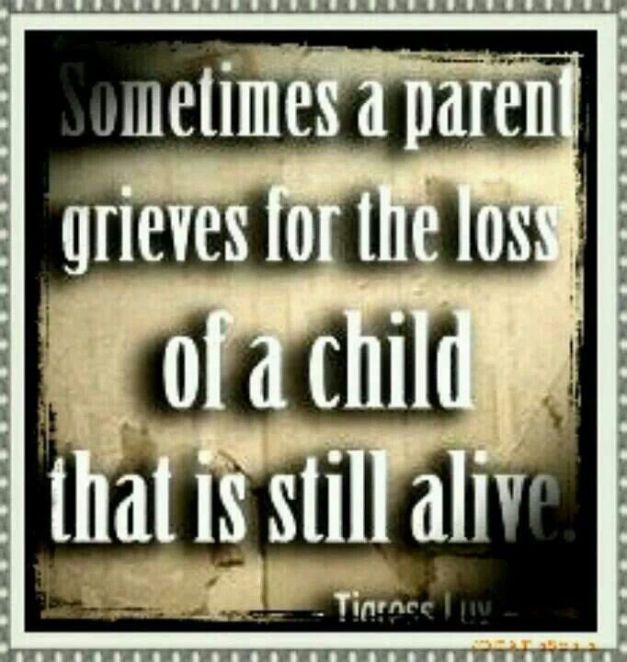
Grieve. Allow yourself to feel the sadness of being rejected by your child. Grieve over the loss of the innocence that the relationship once was. Grieve over your lost child – even though he or she is still alive. In your world, he/she is no longer part of your life. That sense of “what can I do?” keeps you yearning and longing for reconciliation; but sometimes reconciliation is not forthcoming.
Live one day at a time. Even if you have no contact with your child today, you have no way of knowing what tomorrow may bring. None of us does. The best thing we can do is to live the best way we know how today. When you can focus on one day only, you feel less hopeless and desperate. Remind yourself, “I cannot predict the future.”
Don’t beg. No matter how hurt or desperate you feel to have a relationship with your rejecting child, never stoop to the level of begging for attention or even forgiveness. You will not be respected by your child if you beg and it will demean your position as a parent.
Be empowered. Don’t let your rejecting child steal your personal power. Just because you are having difficulties in this area of your life, don’t get to the place where you feel personally defeated. Do what it takes to be good to yourself – seek therapy, join a support group, travel, go to the gym, do whatever you can to own your own power and stop giving it away to anyone else.
One thing that is certain about life is that it is about all about letting go. As parents our job is to raise our children to the best of our ability and teach them how to be independent, productive adults. If, during the process, they choose a path we don’t agree with, we must remind ourselves that we can’t live their lives for them. Learning to let go is the best way to manage any part of life that doesn’t go the way we expect, including when our children choose to reject us.
Many clients consult us concerning family problems and this particular subject is a common problem, The following article looks at the reasons for it.
Oscar Wilde once warned that children begin their lives loving their parents, then grow up to judge them. If so, surely there is no harsher judgment of a parent than to be deliberately cut out of a child’s life for ever. Parental estrangement by adult children is a national epidemic, and it’s not always the parent’s fault.
Psychologist Dr Ludwig Lowenstein believes this generation have been empowered to judge their parents. He hears from up to six parents a day, a third of them women, asking advice because they fear estrangement from their children.
There are no official statistics to show that the problem is increasing. But numerous leading psychologists claim it is, and online chatter suggests it is.
Autism is a widespread condition and I have clients, friends and family who have been affected by this condition. Researching this subject and how to deal with the individuals affected can assist in coping with difficult relationships. Read more here:
Thefollowing article is written by the mother of a son with Aspergers. High Functioning Autism and I am sure many can relate to this:
“There is a dark side to raising a child with these challenges. My son’s honest expressions can be downright mean. He will say that I am lazy. He will say that I don’t ever do anything. He will say that I am selfish or a hypocrite. Of course, he is a teenager and I am sure from his narrow perspective what he says is truth.
Meltdowns are more frequent now than in the past. The physicality associated with his meltdowns now reminds me of when he was 3, more than when he was 10. These meltdowns are more disturbing and scary in the body of a 5’11” young man than they were in a small child. The glimmers of the sweet boy I remember are few and far between.
There are a lot of aspects of life that we as humans do not include in the stories we pass down. We don’t talk about the messier and darker aspects of common life occurrences. A great example is our tendency to remain silent on the terrifying nature of postpartum depression and psychosis. We don’t want to admit that even the most joyful parts of life can come with a dark lining.
As a parent of an Aspergers child, I live in a strange world. Strangers do not understand and even from friends and family there can be a lot of judgment. I have been told that I am not consistent enough with my son. I have been told that I am not disciplined enough. Even when there is no overt comment, there is the change in body language, tone of voice and the distancing by people who are affronted by my son.
On the other hand, my son judges me as inadequate, unfair, lazy and hypocritical. He expresses hatred for the help that I sacrifice to give him. I stand in the middle making the decisions as best I know how. This is an emotionally draining position.
My NT son sees all of this and so he asks if I regret having my Aspergers Son.
“No!” I responded without hesitation, “Raising him is challenging and there are times that he can be such a jerk but I have learned so much about myself and life through this process. I have learned to look beyond the external and set aside a lot of my preconceived judgments. I have learned to make my decisions based on who I am and who I want to be, not based on what that decision will get from others in the way of approval, acceptance, etc. It has made me so much stronger. I am proud of the person I have become and if this is the road that it took to become this person, well that is fine. I love him because he is my son, not because of what he can give me and I believe that he is an amazing person traveling his own tough road.”
That statement reflects the decision I have made. I don’t always feel the feelings that would inspire that statement therefore I don’t despise the mother that said she hated her son. I am thankful that my NT son didn’t ask me 20 minutes earlier. I don’t know that I would have regained my balance enough to answer the way I did. Just because I don’t act on the dark moments doesn’t mean they don’t exist.
My Aspergers son is mismatched to the world we live in. It seemed that My son is the round peg to the outside world’s square hole. I thought I was accepting this fact.
I have realized that I my acceptance was conditional on a belief that I could fill in the gaps between the outside expectation and my son’s reality. I believed I could make the world accept my son and acknowledge his successes. I had a distorted perception of who I needed to be in my son’s life.
I can never do or be enough to make my son and the typical world’s expectations mesh. Accepting my limitations, opened a new path. Instead of seeing the world as rigid, I saw flexibility. As I expanded my view beyond the world of the public school structure, I could see the endless variations that our world allows. My role is to guide my son as he creates his path in this world and finds his purpose.
My Aspergers-son is an important part of my life, but he is not my whole life. I did not cease to exist when he was born. Additionally, there are other small lives in my care. The loudest need cannot drown out the other needs. My son and my typical children learn from how I live.How can I tell my son that I believe that he can be an independent adult and then do everything for him?
When I give my focus to the moment at hand, I honor all the parts of my life. My time with my husband is for him alone. My time with each of my children is sacred and preserved. The time I set aside for caring for myself is spent doing ONLY that. This is a practice I have yet to perfect but the practice alone has increased my self-awareness and increase the balance between the various aspects of my life.”








 Taking The Helm