
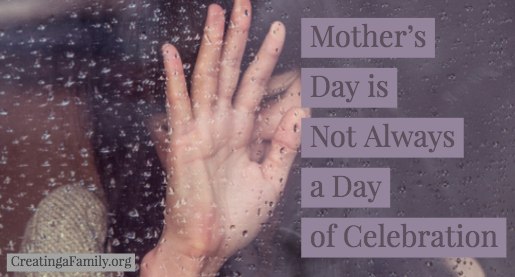
Mother’s Day is Sunday. Will you be celebrating, hibernating, or going through the motions? For so many people for so many reasons, Mother’s Day is not always a day of celebration.
A couple of years ago, about this time of year, I was talking with a pastor friend of mine. I mentioned how hard Mother’s Day is for women who are struggling with infertility and for birth mothers who have placed a child for adoption. I suppose I thought I might be helping to educate her on the complexities of this day of celebrating motherhood. It turns out that she needed no education on these complexities.
My pastor friend sighed and surprised me by saying that Mother’s Day is a nightmare for the church and that she was always thankful when it was over.
It’s not just the infertile who find this day painful, but also anyone who has lost a child or is estranged from a child.
Women whose children are struggling with addiction or are in jail often find Mother’s Day sad too since some feel like failures as a mother.
Single women who want to be a mom and feel time passing them by feel their loss more intensely on this day set aside to celebrate the joys of motherhood.
Moms who have placed their children through adoption may feel their empty arms more intensely on Mother’s Day.
And then there is the view from the other side of the mother/child relationship: women who have lost their mothers or are estranged from their mothers may dread this day that reminds them of their loss.
Suffering Silently Through Mother’s Day
I thought of how myopic I’ve been. As a daughter, I liked having a day to honor my mother. As a mom, I liked having a day where my kids and husband honor me. As someone immersed in the world of infertility and adoption, I was aware of how Mother’s Day affects the infertile and birthmothers. If I had taken the time to think it through, I would have realized of course, that they aren’t alone in their suffering, but honestly, I hadn’t taken this time.
So many who suffer through Mother’s Day are invisible. Other than your close friends, you don’t know who has had three miscarriages, or hasn’t spoken to her mother in years, or doesn’t hear from her grown son other than once a year, or who placed a child for adoption years before. But then pain is often invisible unless you’re the one feeling it, isn’t it?
So as you sit in church this Sunday or at a restaurant surrounded by your family at your celebration lunch, look around you. Really look at the people who are there and recognize that not all are celebrating. Also notice who isn’t there; who is holed up at home watching a Law & Order marathon with a gallon of Ben & Jerry’s because it is simply too painful to participate.
Read more here: Creating a Family


 Taking The Helm