The Cultural Story Behind Family Estrangement

by Rachel Haack MA MFTI
1. Postmodernism and Critical Theory in the Family System

Postmodernism taught us to question authority and dismantle universal truths. Critical theory taught us to look for oppression and power in every relationship. Both were useful lenses at first, until they became the only lenses.

Today, these frameworks have trickled all the way down into the family, where dynamics are no longer just relational but political.
Parents are recast as oppressors. Children as liberators. Love becomes suspect, and forgiveness looks like betrayal of the self.

Books like Adult Children of Emotionally Immature Parents and online influencers preaching “go no contact” have popularized this moral framework of hierarchy and harm. Once you interpret ordinary imperfection through a lens of oppression, the only moral response becomes disconnection.

2. Social Contagion and the Amplification of Ideas

Before smartphones, ideas spread through communities slowly: by conversation, print, and lived experience. Now they spread virally, without friction or context.

We’ve seen social contagions before: diagnostic trends like “multiple personality disorder” in the 1980s or the surge of “recovered memories.” Today, similar dynamics are playing out around “toxic parents,” “narcissistic mothers,” and “cutoff as healing.”

On TikTok and Instagram, creators share stories of liberation from their families, often rewarded with validation and applause. The more sensational the story, the more viral it becomes. And soon, estrangement itself, especially “no contact”, becomes not just a coping choice but a cultural script.

3. The Portable, Always-Connected World

In 1960, a college student might have called home once a month (collect!).
Letters were the norm. Distance was assumed. Love wasn’t measured in response time.

Now, the digital tether has changed our expectations entirely. Parents and adult children can be in contact multiple times a day, and when they’re not, it feels like something’s wrong.

This 24/7 accessibility has raised the relational temperature for everyone. We’re over-connected, overstimulated, and overwhelmed. Most adults are managing hundreds of micro-relationships through text, email, and social media. The guilt of not keeping up, of failing to “stay in touch”, becomes exhausting. And sometimes, that guilt turns into avoidance or conflict.

We’re living in what I call the age of too much para-connection, where everyone feels both crowded and lonely.

4. Concept Creep, Safetyism, and the Pathologizing of Discomfort

Over the past decade, psychological language has exploded into everyday conversation. Words that once had clinical meaning: trauma, abuse, narcissism, gaslighting, boundaries – are now used casually to describe any form of emotional pain or frustration. Psychologists Nick Haslam and Jonathan Haidt have called this phenomenon concept creep: when the definitions of harm and trauma expand to include ordinary stress, discomfort, and disagreement.

At the same time, a new cultural ideal has emerged, what Haidt and Greg Lukianoff call safetyism. Safety, once meaning freedom from physical danger, now includes freedom from emotional discomfort. To be “safe” means to never feel hurt, anxious, or misunderstood.

This shift sounds compassionate, but it has quietly redefined what we consider harmful. Normal friction in relationships: differences in temperament, misunderstanding, conflict, even the enduring “perpetual problems” that exist in every long-term bond – are now reinterpreted as forms of emotional danger.

When discomfort itself is seen as harm, repair begins to look like self-betrayal. Rather than learning tolerance for relational tension, we pathologize it. And soon, the ordinary pain of loving another imperfect human being starts to feel like something we must protect ourselves from, rather than something we can grow through.

5. The Reinforcement Loop: How Therapy Culture Confirms the Cutoff

This new sensitivity to harm is reinforced by the professionals and influencers shaping our public conversations about relationships. The dominant narrative says that no one cuts off contact with a parent without perfectly good reasons. The logic goes like this: because estrangement feels so unthinkable, it must also be justified.

Therapists and creators often tell their audiences, “You’ve done everything you could,” or “No one goes no contact lightly.” The implicit message is that disconnection is the only rational or healthy conclusion to a long-standing relationship problem.

In clinical spaces, this message is amplified by a moral pressure that runs deep in the helping professions. To challenge a client’s decision to cut off contact is framed as “causing harm.” To explore reconciliation is seen as enabling abuse. Therapists are warned that if we don’t affirm a client’s self-protective decisions, we risk becoming “excusers of abusers.” I receive messages such as “Yikes. This is dangerous.” to an instagram post addressing the nuance of estrangement.

Naturally, that strikes fear into the heart of any well-meaning clinician who wants to do right by their client. To imagine that our empathy could itself cause harm is paralyzing. And so, out of caution, many practitioners stop short of exploring repair or differentiation, even when disconnection may be premature or unnecessary.

What results is a therapeutic culture that affirms estrangement as inherently empowering: but rarely asks whether empowerment might also come from growth, dialogue, or courage in the face of discomfort.

6. The “Pure Relationship” and the Consumer Self

Sociologist Anthony Giddens coined the term the pure relationship—the belief that a relationship’s legitimacy depends on emotional satisfaction alone. It should be warm, mutually beneficial, and affirming at all times.

That idea, combined with our culture’s obsession with optimization, has quietly reshaped our relational ethics. We now evaluate our relationships the way we evaluate products: Does this still serve me? Does this make me happy?

When something feels hard, the impulse isn’t to repair, it’s to replace.
We live in a hyper-individualistic, portable, meritocratic, consumer world. We can move cities, change jobs, and find new communities with a swipe. The result is a growing inability to tolerate the inevitable discomforts of enduring relationships: the very tensions that make us grow up, soften, and mature. We don’t have to learn to live within our village: we can find a new one instead.

Estrangement, in this context, isn’t just a breakdown of love; it’s the logical conclusion of a culture that has made comfort and self-expression the highest virtues.

7. Luxury Beliefs and the New Village of One

Sociologist Rob Henderson coined the term luxury beliefs to describe ideas that signal social status but often carry hidden costs for others. In this context, the belief that cutting off “toxic” family members is always healthy functions like a luxury belief: it’s most easily embraced by those who can afford to lose their families and replace them (often with paid support networks).

Many modern cutoffs occur in families with greater resources, where autonomy is financially feasible. Our standard of living has made it possible to outsource almost every form of relational interdependence. We no longer need the messy village of extended family to survive; we can simply hire one.

If our in-law is irritating, we can pay for childcare.
If our mother’s help feels overwhelming, we can hire a postpartum doula.
If a relationship feels complicated, we can opt for convenience.

In this way, affluence enables avoidance. It allows us to curate our social lives around comfort and control rather than tolerance and reciprocity. The more economically independent we become, the less dependent we are on the people who stretch us.

And sometimes, that independence itself is a gift handed down from the very family being rejected. Many of the young adults now severing ties with parents do so after those same parents helped fund their education, co-signed their first lease, or quietly absorbed the cost of early adulthood. The support that made autonomy possible is later reinterpreted as control. Once financial reliance ends, the relationship can be rewritten through the language of freedom: They can’t control me anymore.

It’s a striking irony of privilege—the estrangement enabled by security. When you no longer need your family to survive, you also lose the incentive to work through what makes them difficult. And so, we drift further into what might be called the luxury of disconnection—a life where we can meet nearly all our needs without ever having to practice forgiveness, patience, or repair.

8. So What Do We Do With All This?

It’s easy to feel overwhelmed by all of this, to feel like you’re standing in the tide of something too large to resist. You can’t fight the world. You can’t change a culture on your own. You can’t go to battle against the zeitgeist without burning out in despair.

So here’s what I suggest: When things feel big, focus on the small.

You don’t have to fix the world. What we can do is adapt: by creating small, consistent acts of connection with those closest to us. Reorient to your values and live them out in the relationships right in front of you.

If you’re disheartened by the fact that we live in an individualistic, portable, meritocratic, consumer world, start by noticing where that shows up in your own relationships. Begin to reclaim the village around you.

  • Can you stay in relationship when it’s hard?
  • Can you practice forgiveness even when it isn’t reciprocated?
  • Who are you quick to write off—and who might you reach out to instead?

Nobody changes by being lectured into connection. We learn by observation and osmosis. Culture shifts not through argument, but through example.

So ask yourself:

  • Am I making it easier or harder for people to connect with me?
  • Do people feel seen in my presence?
  • Is there one small thing I can do differently in this relationship today?

That’s how change happens—not through revolution, but through micro-shifts. We don’t have to fix a generation or a cultural moment. We just need to live our values with quiet conviction in a world that spins around us.

Because while you can’t stop the tide, you can build something steady enough to stand in it.

 If this resonated with you, share it with someone who’s also trying to make sense of our disconnected age. The more we talk about it—and live differently inside it—the more repair becomes possible. Also, please consider becoming a paid subscriber, as it allows me to keep offering my articles for free to those in need. Thank you!

Substack.com

Emotional Blackmail of Parents

by Carl E Pickhardt

By expressing strong emotion, adolescents can manipulate their parents.

Children do it all the time. Powerless when refused what they want by a parent, they may signify displeasure by communicating disappointment, hurt, or outrage. What happens next is formatively important, and in most parent/child relationships this response occurs some of the time.

Faced with the child’s sulking, crying, or tantrum, the parent feels regret or remorse for saying “no,” or simply seeks relief from the emotional intensity and so relents. “All right, just this once, you can have it (or do it), since it matters so much to you. Just stop making such a fuss!”

Now the child brightens up, and learns how there is persuasive power in the strong expression of emotion, particularly unhappiness. It can be used to get his way.

In fact, one psychologist, John Narciso (see his book “Declare Yourself,” 1975) called this category of behaviors “get my way techniques.” Another psychologist, Susan Forward, wrote a book about this emotional manipulation (“Emotional Blackmail,” 1997.) In one of my early books, “Keys to Single Parenting” (1996) I called it “emotional extortion.” In counselling, I still call it by that name.

During adolescence, when getting freedom from parents becomes increasingly important, manipulation of parental authority through lying, pretence, and pressuring becomes more common. Emotional extortion can combine all three.

Thus when pleading and argument fail to win a parent over or back a parent down, the tactics of emotional extortion can come into play. The particular emotions exploited vary according to the emotional susceptibility of the parents, but the objective is always the same—to get parents to give in or change their mind.

Remember, from closely observing these adults who have so much power over their lives, children know their parents far better than parents know their children. Children, and particularly adolescents, are expert in the “pushing the buttons” of emotional susceptibility in parents, often using this knowledge in conflict to win their ways. Many children growing up with a parent who is not safe to be around learn this manipulative behavior to survive and must then unlearn it later on, or else they will afflict a significant adult relationship with emotional extortion to their cost. Consider a few of the forms emotional extortion can take.

If a parent is sensitive to approval, then the teenager will express love through appreciation, affection, or pleasing to soften the mother or father up. This emotional extortion works when the parent feels, “How can I refuse when my teenager, who is usually so hard to get along with, is now acting so nice?”

If a parent is sensitive to rejection, the teenager, loudly or quietly, will express anger through acting offended, injured, or wronged to soften the mother or father up. This emotional extortion works when the parent feels, “I can’t stand it when my teenager acts like she doesn’t like me.”

If a parent is sensitive to inadequacy, the teenager will express criticism through attacking the parent’s character, caring, or competence to soften the mother or father up. This emotional extortion works when the parent feels, “I can’t stand being judged a failure in my teenager’s eyes.”

If a parent is sensitive to guilt, the teenager will express suffering through acting unhappy, hurt, or sad to soften the mother or father up. This emotional extortion works when the parent feels, “I can’t stand feeling responsible for my teenager’s unhappiness.”

If a parent is sensitive to pity, the teenager will express helplessness through acting hapless or resigned to soften the mother or father up. This emotional extortion works when the parent feels, “I can’t stand feeling sorry for my teenager when she just gives up and acts victimized by whatever decision I’ve made.”

If a parent is sensitive to abandonment, the teenager will express apathy through acting like the relationship doesn’t matter anymore and doesn’t care in order to soften the mother or father up. This emotional extortion works when the parent feels, “I can’t stand the loneliness when my child acts like there’s no caring for our relationship.”

If a parent is sensitive to intimidation, the teenager may express explosiveness, loudly talking or acting like he’s going to lose physical control and threaten harm to soften the mother or father up. This emotional extortion works when the parent feels, “I can’t stand being frightened of getting hurt.”

To discourage these manipulations, parents must refuse to play along with the extortion. After all, your adolescent cannot emotionally manipulate you without your permission. You must resist your own susceptibilities to rejection, guilt, intimidation and the like and refuse to let these emotional vulnerabilities influence your decisions.

Give in to these tactics, and you will feel badly about yourself, your teenager, and your relationship, and more important may reluctantly allow what you know is unwise that could cause your adolescent to come to harm. “I know I shouldn’t have let her go. I didn’t want to. But she was so unhappy with me for refusing, I just couldn’t say ‘no.’ And now look at what has happened!”

Parents must not only hold firm in the face of this emotional manipulation, they must hold the teenager to declarative account. Thus when the teenager uses intense anger or suffering to overcome a parental refusal, the parent needs to be able to say and mean: “Acting emotionally upset is not going to change my mind. However, if you want to tell me specifically about why you are feeling so upset, I certainly want to listen to what you have to say.”

Declaration creates understanding, but emotional manipulation creates distrust. At worst, when feelings are expressed for extortionate effect, then the authentic value of those feelings can become corrupted.

Declare what you want or do not want to have happen in specific terms, then discuss and negotiate the disagreement. Do not use the strong expression of emotion to get your way, or you will encourage that extortion from your teenager by your own bad example.

This article does not only apply to children and teenagers, adult children can also behave this way.

Psychology Today

Estranged Families and Christmas

Christmas is the hardest time of year for those estranged from close family

Image – CBS

With Christmas just around the corner, many will be finalising plans to see their families over the festive period. Yet for others, family relationships are challenging, distant and a source of pain. In some cases, relationships break down entirely leaving people estranged from close relatives.

Results from a new online survey of people estranged from family members conducted with the charity Stand Alone, has shown how difficult Christmas can be. The survey was completed by 807 people who identified as being estranged from a parent, sibling or an adult child.

Almost all identified the holiday season as the most challenging time of year, describing feelings of loneliness, isolation and sadness. These feelings and experiences are in direct contrast to the idealised images of happy families around the dinner table that feature in Christmas advertising and the media at this time of year. One respondent said:

Everyone always says ‘what family plans do you have for holidays?’ and look at you funny when you say none. It’s hard to explain to people why you don’t want to be with your own parents.

Two-thirds of the respondents felt there was a stigma about family estrangement. They described feeling judged or blamed – and feeling that estrangement was a taboo subject about which there is little understanding or acknowledgement.

No two estranged relationships looked alike. Yet common factors often led to estrangement, such as having mismatched expectations about family roles and relationships, clashes in personality and values, and emotional abuse.

Estrangement was found to be more complex than simply a lack of contact or communication between family members. Although most of the respondents who were estranged from a parent, sibling or an adult child had no contact whatsoever with this individual, approximately 25% had contact that was minimal in nature. These results are similar to those of Australian social worker Kylie Aglias, who has distinguished between family members who have no contact at all (physical estrangement) and those whose contact is infrequent, perfunctory, and often uncomfortable (emotional estrangement).

We also found that estranged relationships change over time and that cycles in and out of estrangement are common. Of those who said they wished that their estranged relationship was different, most wanted a relationship that was more loving, warm and emotionally close.

What can be done to help?

When it came to getting support, respondents said those friends and support services which offered them emotional and practical support and took the time to listen to them and show them understanding were the most helpful. They found it unhelpful when they felt friends or counsellors dismissed them or when they felt they had been judged and blamed for the estrangement.

It would be wrong to assume that all those experiencing estrangement wish for there to be reconciliation in the future. Feelings about the future of estranged relationships were varied. Of those who were estranged from a mother or father, most felt that there would never be a functional relationship between them in the future. Yet for those who were estranged from an adult son or daughter, most felt that there could be a functional relationship in the future or were unsure of the future direction of the relationship.

Four out of five respondents also reported that there had been a positive outcome from their experience of estrangement. These included feeling more free and independent, feeling happier and less stressed, and having gained a greater insight or understanding of themselves and relationships more broadly.

By listening to the hidden voices of people who are estranged from close relatives, we can begin to move beyond assumptions about what families could or should look like and begin conversations about families and family relationships as they really are.

The Conversation.com

When Mothers Day is Painful

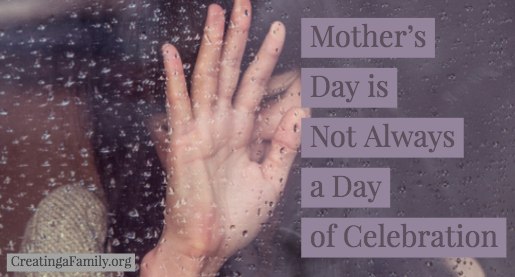
Mother’s Day is Sunday. Will you be celebrating, hibernating, or going through the motions? For so many people for so many reasons, Mother’s Day is not always a day of celebration.

A couple of years ago, about this time of year, I was talking with a pastor friend of mine.  I mentioned how hard Mother’s Day is for women who are struggling with infertility and for birth mothers who have placed a child for adoption.  I suppose I thought I might be helping to educate her on the complexities of this day of celebrating motherhood.  It turns out that she needed no education on these complexities.

My pastor friend sighed and surprised me by saying that Mother’s Day is a nightmare for the church and that she was always thankful when it was over.

It’s not just the infertile who find this day painful, but also anyone who has lost a child or is estranged from a child.

Women whose children are struggling with addiction or are in jail often find Mother’s Day sad too since some feel like failures as a mother.

Single women who want to be a mom and feel time passing them by feel their loss more intensely on this day set aside to celebrate the joys of motherhood.

Moms who have placed their children through adoption may feel their empty arms more intensely on Mother’s Day.

And then there is the view from the other side of the mother/child relationship: women who have lost their mothers or are estranged from their mothers may dread this day that reminds them of their loss.

Suffering Silently Through Mother’s Day

I thought of how myopic I’ve been. As a daughter, I liked having a day to honor my mother. As a mom, I liked having a day where my kids and husband honor me. As someone immersed in the world of infertility and adoption, I was aware of how Mother’s Day affects the infertile and birthmothers. If I had taken the time to think it through, I would have realized of course, that they aren’t alone in their suffering, but honestly, I hadn’t taken this time.

So many who suffer through Mother’s Day are invisible. Other than your close friends, you don’t know who has had three miscarriages, or hasn’t spoken to her mother in years, or doesn’t hear from her grown son other than once a year, or who placed a child for adoption years before.  But then pain is often invisible unless you’re the one feeling it, isn’t it?

So as you sit in church this Sunday or at a restaurant surrounded by your family at your celebration lunch, look around you.  Really look at the people who are there and recognize that not all are celebrating.  Also notice who isn’t there; who is holed up at home watching a Law & Order marathon with a gallon of Ben & Jerry’s because it is simply too painful to participate.

Read more here: Creating a Family