Although memories seem to be a solid, straightforward sum of who people are, strong evidence suggests that memories are much more quite complex, highly subject to change, and often simply unreliable. Memories of past events can be reconstructed as people age or as their worldview changes. People regularly recall childhood events falsely, and through effective suggestions and other methods, it’s been proven that they can even create new false memories.
Why False Memories Are Common
A person’s malleable memories often involve the mundane, such as when we second-guess whether the stove really is off or on. But they can often be far more consequential, such as unreliable eyewitness recollections of a crime.
Human memory is pliable and easy to manipulate. A distorted memory or the introduction of later, false information can affect how we recall events we experienced firsthand. A person’s existing knowledge can impede and obstructs their own memory, leading to a newly formed, cobbled-together recollection that does not accurately reflect reality. Also, under certain circumstances, a person can be given false information and be convinced to believe that an event that never occurred actually did.
Should I question my memories?
Given that our recovered memories may be genuine or false, or a combination of the two, it is legitimate to question just how much of what you remember is real and how much is a misperception.
How can I identify a false memory?
Without material evidence, it’s hard to know for sure whether a memory is real or imagined. Even if you feel high conviction that a recollection is true, there is a high chance that the memory is flawed, by a little or a lot.
How do I get rid of false memories?
Just as a recollection can be altered into a false memory, it can be reversed as well. If you return to the memory and think closely about its details, you may be able to recreate the event over time. Through such a process, you reroute the false memory to a true one.
Why Memories Matter
A malleable memory can have especially dire consequences, particularly in legal settings when children are used as eyewitnesses. Research has found that a child may be especially susceptible to the implanting of false memories by parents or other authority figures. This becomes highly problematic when a case involves alleged sexual abuse or relies on the correct identification of a suspect by a child. But adults can also be tricked into remembering events that never happened, or changing the details of things that really did happen.
Why do I remember things that never happened?
Presented with incomplete information, the brain seeks to fill in the blanks. If you see a photo of a person you have never met, for example, and mutual friends have shared descriptive details on time spent with the person, you may start to believe that you have in fact met the individual.
Why do memories change over time?
Psychologist Elizabeth Loftus of the University of California at Irvine, an influential researcher on memory who has consulted on many high-profile legal cases involving disputed memories, including the McMartin preschool sexual abuse allegations, notes that everyone embellishes or adds to their memories during recall or recounting. Over time those changes, accurate or not, become part of the memory in the mind. Loftus warns that human memory is not a recording device, but more like a Wikipedia page: You can change it, but others can, too.
Most people struggle to recall events before the age of about 3 or 4, a phenomenon called childhood amnesia. In the first few years of life, a child’s body undergoes the process of neurogenesis, or the growth and development of nervous tissue. New nerve cells develop, and old cells get recycled or reformed, taking childhood memories away with them.
How Misinformation Is Easily Spread
On the internet, almost anyone claiming objectivity or impartiality can disseminate false memories through the dissemination of specious information. Misinformation, or “fake news,” has become ubiquitous through media such as doctored videos and photoshopped images as well as fabricated text. Such misinformation is especially persuasive with audiences who already harbor biases endorsed by the inaccurate messages.
Why is misinformation so detrimental?
Several recent events have proven that memory can become weaponized, often quite effectively. Once misinformation taken hold in a target’s mind, that new, false recollection hinders his or her ability to make informed decisions about policy and politicians. Fake news drives social discord and character assassination, and even corrupts crucial personal choices about health and well-being.
Biased thinking molds the way we remember. We all employ bias when perceiving, interpreting, and remembering information and events. This effect extends to the ways in which we tap our memories for information about fake news.
Can well-known events be altered?
In a study, researchers doctored images of well-known events and found that indeed a person’s recollection of even universally known, iconic events can be altered.
How to Spot Fake News
Investigate the source of the information and whether the site is reputable.
See who is listed in the “About” section or “Contact Us” page.
Check the author and scrutinize the person’s credibility.
Is the author a real person?
Don’t fall for clickbait headlines, read the entire post.
What is the purpose of the information?
Make sure the story is current and not lifted from old information.
Check the accompanying links for references and citations.
Search for more information on the claim.
Doctored images are sometimes obvious and can be searched via image sourcing tools.
It begins small. A little boy drops a glass and blames the cat. A teenager says she studied for the test, but didn’t. A man tells a friend he’s fine, even though his heart is broken. A woman tells her boss she’s on her way—though she’s still in her pajamas.
Deception weaves its way through everyday life. We do it to avoid shame, to save face, to gain advantage, to protect others, to feel safe. Most of the time, we don’t even notice we’re doing it. But beneath the surface, each lie—no matter how tiny or towering—leaves fingerprints on the mind.
To understand deception is to peer into one of the most complex and mysterious aspects of human psychology. It is not just about falsehood. It is about strategy, memory, emotion, fear, control, and even survival.
Lying is ancient. It is wired into our evolutionary history. And though it might be easy to judge liars from the outside, the real story unfolds deep inside the brain.
The Origins of Deception: Born to Lie?
Before we explore the inner workings of a liar’s mind, we must face a startling truth: the capacity for deception begins in childhood, often earlier than most people expect.
Infants as young as six months have been observed in experimental settings to feign distress to attract caregiver attention. By age two, toddlers can deliberately mislead. At age four or five, children develop what psychologists call theory of mind—the understanding that other people have beliefs, desires, and knowledge different from one’s own. This milestone is crucial for intentional lying.
The emergence of lying coincides with cognitive development. To lie, a child must juggle multiple mental tasks: invent a story, remember what’s been said, suppress the truth, and anticipate the reaction of others. It’s a kind of mental juggling act—and not a simple one.
Ironically, a child’s first lie is often a sign not of moral decay, but of mental sophistication. It marks the point where imagination, memory, and empathy collide.
What Happens in the Brain When We Lie?
Telling the truth is easy. It’s a direct retrieval of memory. But lying? That’s mental gymnastics.
Modern neuroscience offers extraordinary tools for peering into the brain as deception unfolds. Functional MRI (fMRI) scans and EEG readings have shown that lying activates multiple brain regions, including the prefrontal cortex, anterior cingulate cortex, and parietal lobes.
The prefrontal cortex is the executive center—the brain’s CEO. It handles planning, decision-making, and impulse control. To construct a believable lie, this region must suppress the truth and generate an alternative scenario. The anterior cingulate cortex, meanwhile, manages conflict detection. It lights up when our internal moral compass clashes with dishonest behavior.
This internal conflict is critical. It’s what causes physical signs of stress—fidgeting, sweating, voice pitch changes. It’s also why lying can be mentally exhausting.
But here’s the catch: not all lies feel bad. With practice, people can become desensitized to deception. Over time, the emotional and neurological “cost” of lying diminishes. This is how compulsive liars are born—not in a single moment, but through the slow erosion of conscience.
The Sliding Scale of Lies
Not all lies are created equal.
Some are harmless, even helpful. These are the so-called white lies—the kind we tell to protect feelings or maintain social harmony. “You look great in that outfit.” “I loved your presentation.” “I’m not mad.”
Then there are strategic lies, used to gain an advantage or manipulate outcomes. Politicians, negotiators, poker players—many rely on subtle forms of deception to achieve their goals.
And, of course, there are malicious lies—intended to harm, mislead, or destroy. These lies are heavy with intention and often rooted in deeper psychological dysfunctions, including narcissism, psychopathy, or unresolved trauma.
Understanding a liar means understanding their motive. Was it fear? Gain? Habit? Compassion? Self-image? The psychology of lying cannot be painted with one brush. Every falsehood tells a story, not just about what happened, but about why someone wanted to change the version of reality they shared.
Who Lies, and How Often?
You might think you’re an honest person—and perhaps you are. But research suggests we all bend the truth more than we’d like to admit.
A groundbreaking study by psychologist Robert Feldman found that people lie in about one in every five interactions lasting more than ten minutes. That’s not to say every lie is dramatic. Most are small exaggerations or omissions. But they’re still distortions.
Interestingly, people tend to lie more in certain contexts—job interviews, dating scenarios, social media posts. These are environments where impression management is crucial. We lie to look better, smarter, kinder, more successful.
But there’s a darker truth too: a small percentage of people tell the majority of lies. In one study, just 5% of participants were responsible for nearly 50% of all lies told. These individuals, often labeled prolific liars, tend to have distinct psychological profiles. They’re often more manipulative, less empathetic, and more comfortable with risk.
The Brain’s Emotional Load of Lying
Lying isn’t just a cognitive event—it’s an emotional one.
When we lie, especially about something meaningful, our body responds. Heart rate increases. Breathing changes. Pupils dilate. The body perceives lying as a stressor because it involves fear of detection and the guilt of dishonesty.
This emotional burden is what makes polygraphs (lie detectors) possible, though far from perfect. Polygraphs measure physiological signs of stress, not deception directly. And while they can sometimes detect lies, they’re also vulnerable to false positives. Anxious truth-tellers may be flagged, while practiced liars may fly under the radar.
The emotional weight of lying is also why confessions—real ones—often come with visible relief. The brain, no longer juggling conflicting realities, breathes easier when the truth is finally spoken.
Pathological Liars: When the Truth Becomes Alien
Pathological lying, also known as pseudologia fantastica, is a rare but deeply perplexing phenomenon. These individuals lie compulsively and often without clear motive. Their fabrications are elaborate, dramatic, and sometimes fantastical.
For pathological liars, the boundary between reality and fiction blurs. In some cases, they believe their own lies. In others, they lie knowing the truth, but unable to stop.
Brain scans of compulsive liars have shown increased white matter in the prefrontal cortex. This may suggest enhanced connectivity between brain regions—giving liars an edge in crafting stories and thinking on their feet. But it also hints at a possible structural difference in moral regulation.
Pathological lying often co-occurs with personality disorders, particularly narcissistic, antisocial, and histrionic personality disorders. In these cases, lying serves deeper psychological needs—attention, control, or manipulation.
Lying to Ourselves: The Art of Self-Deception
Perhaps the most profound lies are not the ones we tell others—but the ones we tell ourselves.
Self-deception is a psychological survival mechanism. It allows us to maintain a coherent self-image in the face of conflicting truths. “He didn’t mean to hurt me.” “I’m fine on my own.” “I could quit anytime.” “They just don’t understand me.”
These lies are comforting. They soften pain, blur guilt, and bolster confidence. Evolutionary psychologists suggest self-deception may have offered an adaptive advantage. If we believe our own lies, we become more convincing to others. Confidence—true or not—can be a powerful social tool.
But self-deception is a double-edged sword. It can protect mental health in the short term but distort reality in the long run. It keeps people in toxic relationships. It blinds them to destructive habits. It delays healing.
Inside the mind of a self-deceiver is a hall of mirrors—every reflection distorted just enough to make life feel manageable.
Spotting a Lie: Myths vs. Reality
Think liars always fidget or avoid eye contact? Think again.
Popular culture has filled our minds with myths about how deception looks. But research paints a more complex picture. Good liars often maintain eye contact. They don’t sweat profusely or shift nervously. They can appear calm, charming, and utterly sincere.
What truly differentiates a lie is cognitive load—the mental effort required to fabricate a believable story. Liars may pause more to think. Their stories may lack detail or sound too rehearsed. They may have trouble recalling their lies later. Their emotional expressions may not quite match the content of their words.
But there is no universal “tell.” Lie detection is a skill honed over time, and even trained professionals like FBI agents and psychologists are only slightly better than chance in detecting deception.
Ironically, the best liars are often the ones who believe their lies—or don’t feel guilty telling them. Without emotional leakage, the lie becomes almost indistinguishable from the truth.
Digital Lies: Deception in the Age of the Internet
In the digital era, lying has taken on new forms. Social media profiles are curated façades. Online dating apps are filled with selective truths. Deepfakes and AI-generated content blur the line between reality and illusion.
Online anonymity emboldens deception. People say things behind screens they would never say face-to-face. Cyber deception includes catfishing, identity fraud, fake news, and phishing scams. The consequences range from hurt feelings to financial ruin.
What makes online deception especially insidious is its scale and speed. A lie can reach millions in minutes. False information spreads faster than corrections. Our brains, designed for face-to-face interaction, struggle to navigate these new digital landscapes.
This raises urgent ethical and psychological questions: How do we cultivate honesty in a world of filters and avatars? What happens to our trust in reality when everything can be faked?
Can Lying Be Good?
Despite its bad reputation, lying is not always morally wrong. In some cases, it is even necessary.
Consider the doctor who softens the truth to ease a dying patient’s fear. The friend who hides a surprise party. The freedom fighter who deceives a regime to protect others.
Psychologists call this prosocial lying—deception motivated by kindness, protection, or social harmony. In fact, studies show people prefer to be lied to in certain situations, especially when the truth would cause unnecessary harm.
Ethical philosophers wrestle with this dilemma. Is it better to lie and protect, or tell the truth and hurt? The answer often depends on context, intention, and consequence.
The Future of Lies: AI, Neuroethics, and Truth Engineering
As neuroscience and artificial intelligence evolve, we may soon face radical new questions about deception.
Will brain scans become advanced enough to detect lies reliably? Could we engineer honesty through brain stimulation or genetic editing? Could AI systems detect micro-signals of deception that humans miss? Should they?
The future of truth may not rest on human conscience alone. It may become technological, regulated, even commodified.
But until that day, the human mind will remain the ultimate battleground of honesty and deceit—a theatre where truth and fiction play out in equal measure.
The Mirror in the Mind
In the end, to lie is to be human. We do it out of fear, love, ambition, and pain. We do it to survive. To belong. To shape how others see us. But every lie, big or small, leaves a trace inside the mind.
It demands memory, emotional control, ethical negotiation. It shapes our character and reveals our values.
The psychology of deception is not about villains and saints. It is about the fragile, fascinating dance between truth and identity.
Because inside the mind of a liar is not just a story—but a struggle. A person wrestling with reality. A brain bending the world, hoping it won’t snap.
Finally getting out of a relationship with a narcissist doesn’t mean you just walk away and everything resets — if only.
The way you moved, spoke, and reacted around them wasn’t random; it was survival. And even when they’re no longer in your life, some of those habits stick around for a long time to come. These mannerisms aren’t flaws, just reminders of what you had to do to get through it. If any of these feel familiar, know that you’re not alone. Keep working through your experience and finding ways to process them so that you can truly move forward without the baggage of their abuse.
1. They say sorry way too much.
Apologising becomes second nature after constantly being made to feel like everything was their fault. Even when they haven’t done anything wrong, “sorry” just slips out, like a reflex. It’s easier to apologise first than to risk upsetting someone, even if there’s no reason to think they’re actually mad. It can be for little things, like taking up space in a room or accidentally bumping into someone. The need to smooth things over before there’s even a problem is just something they learned along the way. Over time, they start realising they don’t need to apologise for simply existing.
2. They hesitate before saying what they really think.
When every opinion was once picked apart or twisted against them, speaking up starts to feel risky. They might pause before answering simple questions, trying to figure out the “right” thing to say. Even harmless opinions like what they want for dinner can make them feel like they’re putting themselves in the line of fire. It’s not that they don’t have thoughts or preferences. It’s just that, for a long time, sharing them came with consequences. Eventually, they start realising that safe people won’t punish them for having a voice.
3. They over-explain everything.
When someone’s spent years being gaslit, they get used to having to “prove” their reality. They might give way more detail than necessary when telling a story, just to make sure they won’t be misunderstood. Even when no one is doubting them, they feel the need to justify every little thing. It’s the same with making decisions, explaining why they chose something before anyone even questions them. They’re just used to having to defend themselves, even when there’s no fight to be had. Eventually, they learn that they don’t owe anyone a 10-minute breakdown of why they picked one option over another.
4. They struggle to make decisions on their own.
When every choice was once criticised, even small decisions can feel overwhelming. They might freeze up over what movie to watch or what restaurant to pick, worrying they’ll “get it wrong.” The fear of making a mistake, even when it doesn’t matter, sticks around for a while. It’s not because they don’t care or are trying to be difficult. It’s just that they got used to someone making them second-guess every move. Learning to trust their own choices again takes time, but it happens.
5. They downplay their own feelings.
After years of being told they were “too sensitive” or “overreacting,” they start believing it. They might brush off things that actually hurt, convincing themselves it wasn’t that bad. Even when something really bothers them, their first instinct is to push it aside. They might say things like, “I don’t want to be dramatic, but…” or “It’s not a big deal.” It’s just what happens when someone’s been made to feel like their emotions are an inconvenience. Eventually, they start unlearning that and realising their feelings are valid.
6. They get tense when someone’s mood suddenly changes.
People who’ve been around narcissists know how quickly things can flip. One second everything’s fine, the next, there’s tension in the air, and they have no idea why. So they get really good at noticing tiny shifts in body language, tone, or energy. It’s like an automatic response — they pick up on the smallest signs of frustration and start preparing for what’s coming. Even when no one’s actually upset, their brain still sends out a warning. Over time, they realise that not every sigh or pause means danger, but that instinct doesn’t fade overnight.
7. They can’t accept compliments to save their lives.
When someone’s been picked apart for long enough, nice words can feel… weird. Compliments don’t quite register, or they feel the need to downplay them. “Oh, this outfit? I just threw it on,” or “I got lucky, that’s all.” It’s easier to brush off praise than accept it. It’s not that they don’t appreciate it; they just don’t know how to believe it. Being treated with kindness feels foreign after being criticised for so long. Eventually, they start letting the good words sink in instead of automatically deflecting them.
8. They’re super tuned in to other people’s emotions.
Living with a narcissist means always being on high alert for their mood swings. Over time, survivors develop a hypersensitivity to other people’s emotions. They can walk into a room and immediately sense if something feels “off.” It’s not just empathy — it’s survival. They learned to read the energy of a situation to avoid conflict. But constantly scanning for signs of trouble is exhausting, and they eventually start realising they don’t have to do that with safe people.
9. They pause before answering simple questions.
Even casual conversations can feel like a test. When you’ve been with someone who twisted your words, you learn to tread carefully. Even answering “How was your day?” might come with a pause while they run through all the possible ways their response could be taken. They’re not hiding anything; they’re just used to walking on eggshells. Eventually, they get to a place where they don’t feel the need to filter themselves so much. But at first, even harmless questions can feel loaded.
10. They hate asking for help.
When someone’s been made to feel like a burden, asking for help feels impossible. They might convince themselves they should be able to handle everything alone. Even when they’re struggling, the idea of leaning on someone feels unnatural. It’s not that they don’t need support; they just don’t want to be an inconvenience. Over time, they start learning that healthy relationships involve give and take. But breaking the habit of doing everything solo takes time.
11. They get nervous when things are going too well.
For survivors, peace can feel unfamiliar. When they’re in a stable, loving relationship or things in life are actually going smoothly, a little voice in their head whispers, “This won’t last.” They’re used to good moments being followed by chaos. Even when they want to relax and enjoy things, part of them stays on guard. They seem like they don’t trust happiness because they were trained to expect the rug to be pulled out from under them. Eventually, they realise that real, healthy love doesn’t come with hidden conditions.
12. They sometimes don’t trust their own judgement.
When someone’s spent years being told they’re wrong, they start believing it. Even after leaving, they struggle to trust their instincts. “Am I overreacting?” “Am I the problem?” “What if I’m being unfair?” Making choices without second-guessing themselves feels foreign. But the more they rebuild their confidence, the more they start recognising that they were never the issue. Learning to trust themselves again is part of the healing process.
13. They feel guilty for setting boundaries.
For so long, saying “no” or putting themselves first meant backlash. Narcissists don’t respect boundaries, so survivors learned that standing up for themselves just made things worse. Even after leaving, setting limits can make them feel selfish or anxious. They might feel like they need to over-explain why they can’t do something or worry that people will be upset with them. But after a while, they start realising that boundaries aren’t mean, they’re necessary — and the right people will respect them.
14. They’re still figuring out what safe love looks like
After being conditioned to accept toxic love, healthy relationships can feel confusing. They might not trust kindness at first or feel uneasy when there’s no drama. It takes time to rewire their brain to see love as something safe, not something they have to earn. But little by little, they start recognising what real love feels like. And when they do, they realise they never have to settle for anything less again.
When is it okay to lie to the media? by Melissa F Daly
Image – Dreamstime
The answer is: Never. Really. Lying to the press is essentially an open invitation to become an even bigger target for both journalists and the public. One of the easiest ways to give a bad story a longer shelf-life is to lie to a journalist. Equally important, lying to the press ruins your own reputation as a communications professional and that of the organization or person you are representing.
Although there are times when lying, or misleading a reporter, may seem easier and you may think it will yield a positive result, the long-term effects can be detrimental. Here, we will address three topics that may lead you down the wrong path of being dishonest with the press and how to better handle these issues.
Answering every question from the media: Depending on the whether your company is public or private, and for an individual, if you are an elected official or private citizen, every question that is asked does not have to be answered. In some cases, there are legal or regulatory reasons to choose to or not to respond. But in every instance, the answer needs to be true and consistent over the long-term. If you cannot be honest, then decline to comment. The right PR guidance and media relationship can only serve to benefit you.
You don’t want the facts to get out: The reality is that if a reporter has verifiable facts, they have the right to share what they have with the public. Facts are different than opinions or rumors and reporters work hard to adhere to the standard of presenting facts. At times, data can be manipulated to highlight a certain element of a story, but it would serve you to present your interpretation and explanation, or an updated set of facts if they are relevant. But the underlying information needs to be truthful.
A crisis or sensitive situation is gaining traction: When we get early signs that a bad story is about to come to light, it is critical that the organization’s leadership and communicators spring into action quickly. We cannot kill a story by denying the very existence of the issue or overtly downplaying what is happening. No matter the size of your organization, planning ahead with a crisis plan, including a working group, is crucial. Keep your eyes open to social media, industry events and regulatory issues that may impact your firm. Be prepared with the right messaging, supporting information and a plan of action as to how to communicate with your key stakeholders, not just the press. It is imperative to be honest and accurate with the information that you decide to divulge. Having a positive and trusting relationship with the media will go a long way in helping you and your firm.
Whether you are a spokesperson or a source working for a business, person, government entity, or non-profit, building honest and positive relationships with journalists will be the one of the best ways to ensure that your side of the story will be heard. Lying to the media will put you further under the microscope and undermine your own efforts to get a better story in the press.
The world is consuming and interacting with social media at increasingly high rates. According to 2018 data from the Pew Institute [1], the majority of U.S. adults now use YouTube (73 percent) or Facebook (68 percent); of those who use Facebook, more than half check this platform several times a day.
As we engage on social media with greater frequency, we find ourselves sifting through photos of children, commentary about food, and explosive reactions to current political events. This increased media usage and exposure poses the question: How accurate is the information we are getting? More specifically, how honest are people on social media sites?
Honesty and Lying on Social Media
The truth is that people tend to lie on these platforms. How? First, people directly lie about their lives, which is often an effort to make themselves look more desirable or positive. In a study examining 80 online daters, Hancock, Toma, and Ellison [2] found that two thirds of participants lied about their weight by five pounds or more. In a large sample of over 2,000 people in England conducted by Custard.com [3], 43 percent of men admitted to making up facts about themselves and their lives that were not true online.
Even more commonly, people “lie” by presenting an image of themselves and their lives that is imprecise or less than comprehensive, leading the viewer to believe falsehoods. For example, in the Custard.com [4] study, only 18 percent of men and 19 percent of women reported that their Facebook page displayed “a completely accurate reflection” of who they are. Most commonly, participants said that they only shared “non-boring” aspects of their lives (32 percent) and were not as “active” as their social media accounts appeared (14 percent).
How and Why Does Dishonesty on Social Media Affect Us?
Although selective self-presentation and lying about ourselves on social media may not seem like a surprise (or even a big deal), it can affect us greatly. Why? Humans are naturally social creatures—we crave relationships and social interaction. According to some of the most prominent theories of human nature (e.g., Adlerian psychotherapy) and a large body of research, social interaction and feeling a sense of belonging to a community are two of the most important predictors of psychological and physical health [5]. Given our social nature, we want to feel connected to people and “in the know” about our friends, family, and even celebrities.
In addition to being social, we appear to have a natural propensity to trust that others are being honest with us. A large body of research suggests that we are programmed to trust others [6]. Although the reasons for our tendency to trust are complex, without interpersonal connectedness and a fundamental belief that those around will support you, protect you, and treat you respectfully, we feel unsafe. In essence, trust is developmentally essential to our feelings of safety and security.
When we engage on social media and our propensity to trust is met with overt lying and less than honest presentations, it can be problematic because we internally presume that what is presented is true. That people are naturally as good-looking as their photos appear on a daily basis. That people’s daily home life is as perfect as the pictures depict. That others have very few gut-wrenching struggles. That people around us are in a habitual state of going on vacation, eating out, and parenting blissfully. This is clearly not true. But although we are less aware of the realities of other peoples’ lives, we are well aware of the ways in which our own lives are NOT ideal.
Social Comparison in Social Media
To make matters more complicated, when we internally believe that what we see in social media is true and relevant to us, we are more likely to compare ourselves to it in an internal effort to evaluate ourselves against those around us (e.g., regarding our looks, wealth, significant other, family, etc.). As we do this against the idealized images and unreasonably positive life accounts that tend to permeate social media, we are likely to feel more poorly about ourselves and our lives.
Indeed, a growing body of research suggests that social media use can negatively affect your psychological health, particularly if you compare yourself to the positive images you see online. In a study of 339 college women (Puglia, 2017), the tendency to compare oneself to others was associated with poorer body esteem. Furthermore, in a sub-sample of 58 women in the Puglia study, those with higher levels of Facebook usage displayed lower body satisfaction than those with lower Facebook usage [7]. Similarly, in an experimental study by Vogel and colleagues [8], participants who tended to compare themselves to others more regularly had lower self-esteem, more negative emotions, and a poorer view of themselves after using Facebook than participants who did not tend to compare themselves to others.
The naked truth is this: Most of us now use some form of social media. Research suggests that what people post on social media is not an accurate representation of their lives or who they are. In fact, it may be blatant lies.
Consequently, when engaging with social media, it is critical to remind yourself that what you see is not an accurate picture of reality. Don’t compare yourself to the images of friends, colleagues, or celebrities. Remind yourself that it is just a snapshot of their life—and one that they want you to see.
Why Festive Gatherings can be so Toxic by David Robson
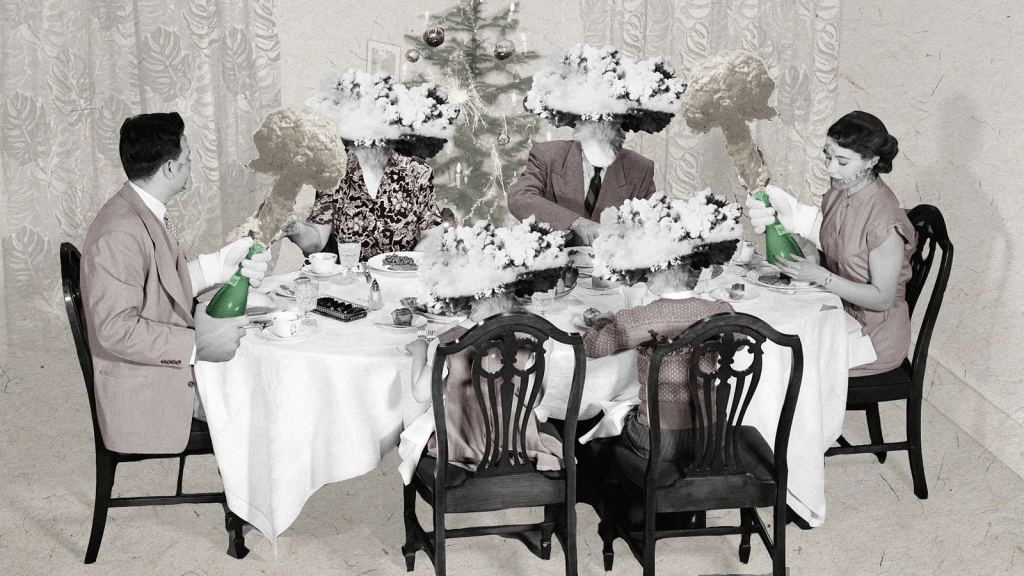
Christmas is a time of love, warmth – and often, huge family arguments. Here’s how to decode the primal forces that can cause painful rows, and enjoy a more peaceful season.
“A happy family,” so the saying goes, “is but an earlier heaven” – which must surely make an unhappy family a living hell.
As we enter the holiday season, many of us will be steeling ourselves for potential tension and argument. Whether it’s quiet disapproval over the quality of the cooking, a simmering resentment over alleged favouritism, or a fierce argument about our political and social values, family gatherings often bring out the worst in us. That’s if we choose to see our families at all – for many, there is no choice but to spend the holidays apart.
While family strife may be a source of entertainment in dramas like Succession, the real-life consequences are no joke.
“A really common consequence of estrangement is feeling isolated,” in addition to feelings of shame and being judged, says Lucy Blake, a developmental psychologist at the University of the West of England and author of the forthcoming book No Family Is Perfect: A Guide to Embracing the Messy Reality.
There is no easy cure to heal fractured relationships. But a better understanding of our family dynamics can help prepare us for the inevitable flashpoints and reveal ways to cope with the stress.
People are often reluctant to talk about unhappy gatherings and family estrangement – which can make those of us who experience it feel like we are somehow unusual. We may even assume that there is something wrong with us to have such poor relations. Social media networks can contribute to our sense of isolation, says Blake. “We often see a ‘performance’ of family, which can then make you feel more and more alone.” Few people are going to post a picture of a bust-up – you’re much more likely to see the gurning faces before a meal than the tears after a row.
Data from anonymous surveys suggests that fractious family relationships are astonishingly common, however. Blake points to one study, from the US, that questioned 633 middle-aged adults about their relationships with their own parents and their own children. In almost a third of the relationships studied, there was little ongoing contact, though most of these people felt some emotional ties – reporting both good and bad feelings about their kin. Of those who were more regularly in touch, many considered their relationships “conflicted” or “ambivalent”. Only 28% of the parent-child ties were engaged and harmonious.
Another paper, published earlier this year, examined data from a huge longitudinal study in Germany to try to identify the prevalence of estrangement. The researchers considered a parent and child to be estranged if they either had no contact, or if they had less-than-monthly contact combined with low emotional closeness. According to these criteria, around 20% of people experienced estrangement from their fathers, and 9% experienced estrangement from their mothers.
Not all clashes lead to such deep rifts, but even mild family rows can be very wounding – and tend to share some common causes.
A shared history
While any relationship has the potential for tension, family arguments often arise from clashing interpretations of the past, which even the slightest off-hand comment can then bring to the fore. And unlike friendships outside the clan, the emotional stakes are extraordinarily high.
“In families, there’s an almost primal sense that my most important loyalties are being challenged – that my love is being challenged,” says Terri Apter, a psychologist based in the UK and the author of numerous books about strained familial relationships, including Difficult Mothers and The Sister Knot. “There’s always the threat of a loss of status in the family, and a loss of connection.”
Even mild family rows can cause damage to relationships – and sometimes the effects can be longlasting (Credit: Javier Hirschfeld/Getty Images)
The triggers of those frustrations, and the ways they are expressed, will of course depend on your relative positions within the family tree. A parent may still believe that they have the authority to give guidance to an adult child – whether it’s about their appearance, career decisions, or romantic relationships. Their well-meaning comments may, however, remind their child of constant unfair criticisms from their adolescence. Among siblings, meanwhile, there may have been rivalries for who gets the most attention from the parents, or who feels most dominant. A grating comment from a big brother may give you the impression that he still thinks he knows everything, or your little sister’s bad mood may be a sign that she is “acting up” to be in the spotlight.
If you were only experiencing these events in isolation, you might see them quite differently. Your brother’s advice – in itself – may be a little irritating, but you could see that it was well-intentioned. Perhaps you might believe that your sister’s tantrum is a one-off and a sign of a bad day. With your family history, however, the slightest reminder of a previous resentment may lead you to feel like you are stuck in an unrelenting Groundhog Day, where past crimes are repeating in an endless loop.
“It doesn’t take a lot, in the present, to reawaken patterns that felt uncomfortable in the past,” says Apter. “And the fact that you don’t particularly like your own responses to the behaviour can compound the discomfort and tension.”
Clashing family cultures
Interacting with in-laws presents its own set of challenges, Apter says – since one family’s rules of behaviour can seem alien to another. Certain actions – such as who volunteers to do the dishes, or how you address the different relatives – can be taken for granted, and what passes as a friendly joke in one household may seem like an insult in another.
In some ways, stepping into another family is like learning to live in a new country; it’s going to take time to translate their behaviours and ways of expressing themselves into a language you can understand. As a result, simple gestures can be lost in translation, leading to conflicts that may escalate over time.
If the inevitable friction leads you or the in-laws to take offence, and your partner doesn’t take your side, it only adds to the hurt. It may be that, having lived the family script for so long, your partner simply cannot see your point of view, or that – because of the accepted roles within the family – they feel unable to intervene, but that doesn’t make it any easier to bear. You may feel completely abandoned in this unfamiliar territory. “Betrayal is often not too harsh a word, in these circumstances,” says Apter.
Apter emphasises that many disagreements are often unspoken. “Sometimes you feel silenced. And that leads to a sense of great discomfort and discontent – that you can’t be yourself or be spontaneous.”
Great expectations?
It may take a miracle to resolve all your family tensions this Christmas, but Apter suggests some steps to ease relations.
One positive move could be to avoid alcohol. “People sometimes drink a lot in the hope that that will make them better able to tolerate the tensions,” says Apter. “But it often makes them less able to moderate their irritation and to put it in context.”
You might also try to shift your expectations of the event. In many cases, our fear of tension, and our desire for the “perfect” day, can itself heighten our stress levels, which then makes arguments more likely.
“You have what psychologists would call high arousal, in which you’re hyper vigilant for certain dangers,” Apter explains. “And so the pressure for it to be a ‘good’ event can contribute to it being a very bad event.”
For this reason, it may be healthier to accept that some disagreement is inevitable, but that it needn’t “ruin” the event. “If you can get to that point where you can mend an argument easily, then that’s very helpful,” says Apter.
As part of this more accepting attitude, you could try to be more compassionate to yourself when you do feel irritated or upset, and make sure that you give yourself the necessary space for self-care. “You might recognise that you’ve got to have private time, maybe in another area in the house or outside the home, where you can breathe, and get back your sense of self,” says Apter.
Learning to adopt that mindset may be especially important this year, as many families around the world are reuniting after more than a year of pandemic-induced lockdowns and forced separation. “Expectations may be even higher because we missed Christmas last year, and there may be a little loss of memory for how uncomfortable it can be,” Apter says.
Ultimately, there is no perfect family, and there will be no perfect Christmas – or Diwali, Chanukah, Chinese New Year, or any other festive get-together. But a recognition of our own and each other’s flaws, and the potential for discord, may – ironically – help us all to have a more relaxed celebration.




 Taking The Helm