Mannerisms of A Person who Survived Narcissistic Abuse

by Ashley Cropper

Image – Your Life Lifter

Finally getting out of a relationship with a narcissist doesn’t mean you just walk away and everything resets — if only.

The way you moved, spoke, and reacted around them wasn’t random; it was survival. And even when they’re no longer in your life, some of those habits stick around for a long time to come. These mannerisms aren’t flaws, just reminders of what you had to do to get through it. If any of these feel familiar, know that you’re not alone. Keep working through your experience and finding ways to process them so that you can truly move forward without the baggage of their abuse.

1. They say sorry way too much.

Apologising becomes second nature after constantly being made to feel like everything was their fault. Even when they haven’t done anything wrong, “sorry” just slips out, like a reflex. It’s easier to apologise first than to risk upsetting someone, even if there’s no reason to think they’re actually mad. It can be for little things, like taking up space in a room or accidentally bumping into someone. The need to smooth things over before there’s even a problem is just something they learned along the way. Over time, they start realising they don’t need to apologise for simply existing.

2. They hesitate before saying what they really think.

When every opinion was once picked apart or twisted against them, speaking up starts to feel risky. They might pause before answering simple questions, trying to figure out the “right” thing to say. Even harmless opinions like what they want for dinner can make them feel like they’re putting themselves in the line of fire. It’s not that they don’t have thoughts or preferences. It’s just that, for a long time, sharing them came with consequences. Eventually, they start realising that safe people won’t punish them for having a voice.

3. They over-explain everything.

When someone’s spent years being gaslit, they get used to having to “prove” their reality. They might give way more detail than necessary when telling a story, just to make sure they won’t be misunderstood. Even when no one is doubting them, they feel the need to justify every little thing. It’s the same with making decisions, explaining why they chose something before anyone even questions them. They’re just used to having to defend themselves, even when there’s no fight to be had. Eventually, they learn that they don’t owe anyone a 10-minute breakdown of why they picked one option over another.

4. They struggle to make decisions on their own.

When every choice was once criticised, even small decisions can feel overwhelming. They might freeze up over what movie to watch or what restaurant to pick, worrying they’ll “get it wrong.” The fear of making a mistake, even when it doesn’t matter, sticks around for a while. It’s not because they don’t care or are trying to be difficult. It’s just that they got used to someone making them second-guess every move. Learning to trust their own choices again takes time, but it happens.

5. They downplay their own feelings.

After years of being told they were “too sensitive” or “overreacting,” they start believing it. They might brush off things that actually hurt, convincing themselves it wasn’t that bad. Even when something really bothers them, their first instinct is to push it aside. They might say things like, “I don’t want to be dramatic, but…” or “It’s not a big deal.” It’s just what happens when someone’s been made to feel like their emotions are an inconvenience. Eventually, they start unlearning that and realising their feelings are valid.

6. They get tense when someone’s mood suddenly changes.

People who’ve been around narcissists know how quickly things can flip. One second everything’s fine, the next, there’s tension in the air, and they have no idea why. So they get really good at noticing tiny shifts in body language, tone, or energy. It’s like an automatic response — they pick up on the smallest signs of frustration and start preparing for what’s coming. Even when no one’s actually upset, their brain still sends out a warning. Over time, they realise that not every sigh or pause means danger, but that instinct doesn’t fade overnight.

7. They can’t accept compliments to save their lives.

When someone’s been picked apart for long enough, nice words can feel… weird. Compliments don’t quite register, or they feel the need to downplay them. “Oh, this outfit? I just threw it on,” or “I got lucky, that’s all.” It’s easier to brush off praise than accept it. It’s not that they don’t appreciate it; they just don’t know how to believe it. Being treated with kindness feels foreign after being criticised for so long. Eventually, they start letting the good words sink in instead of automatically deflecting them.

8. They’re super tuned in to other people’s emotions.

Living with a narcissist means always being on high alert for their mood swings. Over time, survivors develop a hypersensitivity to other people’s emotions. They can walk into a room and immediately sense if something feels “off.” It’s not just empathy — it’s survival. They learned to read the energy of a situation to avoid conflict. But constantly scanning for signs of trouble is exhausting, and they eventually start realising they don’t have to do that with safe people.

9. They pause before answering simple questions.

Even casual conversations can feel like a test. When you’ve been with someone who twisted your words, you learn to tread carefully. Even answering “How was your day?” might come with a pause while they run through all the possible ways their response could be taken. They’re not hiding anything; they’re just used to walking on eggshells. Eventually, they get to a place where they don’t feel the need to filter themselves so much. But at first, even harmless questions can feel loaded.

10. They hate asking for help.

When someone’s been made to feel like a burden, asking for help feels impossible. They might convince themselves they should be able to handle everything alone. Even when they’re struggling, the idea of leaning on someone feels unnatural. It’s not that they don’t need support; they just don’t want to be an inconvenience. Over time, they start learning that healthy relationships involve give and take. But breaking the habit of doing everything solo takes time.

11. They get nervous when things are going too well.

For survivors, peace can feel unfamiliar. When they’re in a stable, loving relationship or things in life are actually going smoothly, a little voice in their head whispers, “This won’t last.” They’re used to good moments being followed by chaos. Even when they want to relax and enjoy things, part of them stays on guard. They seem like they don’t trust happiness because they were trained to expect the rug to be pulled out from under them. Eventually, they realise that real, healthy love doesn’t come with hidden conditions.

12. They sometimes don’t trust their own judgement.

When someone’s spent years being told they’re wrong, they start believing it. Even after leaving, they struggle to trust their instincts. “Am I overreacting?” “Am I the problem?” “What if I’m being unfair?” Making choices without second-guessing themselves feels foreign. But the more they rebuild their confidence, the more they start recognising that they were never the issue. Learning to trust themselves again is part of the healing process.

13. They feel guilty for setting boundaries.

For so long, saying “no” or putting themselves first meant backlash. Narcissists don’t respect boundaries, so survivors learned that standing up for themselves just made things worse. Even after leaving, setting limits can make them feel selfish or anxious. They might feel like they need to over-explain why they can’t do something or worry that people will be upset with them. But after a while, they start realising that boundaries aren’t mean, they’re necessary — and the right people will respect them.

14. They’re still figuring out what safe love looks like

After being conditioned to accept toxic love, healthy relationships can feel confusing. They might not trust kindness at first or feel uneasy when there’s no drama. It takes time to rewire their brain to see love as something safe, not something they have to earn. But little by little, they start recognising what real love feels like. And when they do, they realise they never have to settle for anything less again.


The Sense Hub

When Adult Child Turns Against you in Favour of a Narcissist Parent

Image – Quotesgram.com

Isnt it bad enough, that after you get the strength and courage to leave your narcissist, and after youve already lost your self-worth, your youth, your time, lots of your money, your sanity, and whatever else you lost because of being in a narcissistic relationship, now you have to lose your kids too? It just isnt fair; and it isnt right.

Youve watched your narcissist manage to convince joint friends and other community members and sometimes even family members that you are the crazy one and he/she is the victim, by his/her masterful manipulation strategies. People are hoodwinked and dont even realize it. Your good name is slandered. You feel alone, humiliated, discouraged, disheartened, and vengeful.

Now, your kids are subjected to the smear campaign against you and you find it is actually working. It is enough to make you either curl up in the fetal position and give up, or rage with anger like an erupting volcano. Of course, to do either would confirm the reality of the premise of the smear campaign that you are deranged and crazy.

And if you talk about the situation, others will not understand and will simply conclude on their own that the other party must be right you are psychotic. Its a no win situation. Say nothing and your name is tarnished. Say anything and your craziness is confirmed.

And if you talk to your own kids about the situation you are drawing them into the middle of your relationship problems with their other parent which is a big no no.

Does going no contact include going no contact with your own children as well?

When you seek help from a therapist, you often find that he/she is just as much at a loss as you, because those in the counseling community are often not well-equipped to handle such relationship dynamics. No one is, really.

The courts rarely help and often exacerbate the problem. And if your children are not minors, then court involvement is pointless. Besides that, you cant legally force anyone to see the truth. Denial is denial and brainwashing is not easily countered.

So, what is a parent to do under these circumstances? Here are some helpful suggestions:

Do not be defensive. I know this is hard, but it is essential for your own peace of mind. Remember, during your entire relationship with the narcissist you were always put on the defense. Dont let him/her continue to keep you on that course, even through your children. You dont have to defend yourself. You dont have to be a perfect human being, always showing others why you are worthy.

In practical terms, the way you do this is to change course whenever you have the feeling of defensiveness. If you feel defensive, then dont talk, dont try to get anyone else to see the truth. Go for a walk. Write in your journal. Call a friend and vent. Do something else until the feeling is no longer pressing you.

Be strong. Do not give into the feeling of hopelessness and defeat. You have no leverage if you give up and give in to your weakest self. Your children are best served by feeling your strength and by not seeing you being manipulated by the other parent. You are best served by remaining steadfast, stable, strong, and resolute.

Do not give in to the need for approval from your children. Hustling for the approval of any person is not healthy or wise, even if the person happens to be your offspring. Once you need your children to approve of you then you have given your power away to them (and by proxy, to the other parent.)In order to do this you must keep validating yourself and getting external validation from your safe relationships and from your spiritual resources.

Realize you are not alone. Other parents struggle too. While, being among company with other parents is not a solution to the problem, it is important for keeping a proper perspective. What I mean by this, is that other parents, even those not in narcissistic relationships, also struggle with relationship (and other) problems with their children.

Many parents have children that reject them or turn to drugs or unhealthy relationships despite their parents desires. Adult children often choose a lifestyle or belief system that is against everything their parents stood for while raising them. There will be no good end to trying to force your children to see things your way.

Many parents also struggle with other difficult parenting conditions, such as having their children face some personal problem where the parent was unable to help such as a health problem, bullying or criminal or other out of their control situation.

Keep a healthy perspective.As mentioned above, it is important to keep the proper perspective. Having a balanced perspective is necessary for keeping your sanity. The best way to do this is to not react on your feelings, but rather to think things through with balance and maturity.

In essence, don’t horriblize the situation, remain calm, and be a problem solver. Reacting with strong emotions will not help you, thinking things through unemotionally will help you in the end. Look at the big picture, and resist the urge to join, “The War of the Roses” with your ex.

State your position once and then move on. It is fair for you to state your position on a matter to your children in order to shed light on the truth. Having your own voice is important for recovery from narcissistic abuse. That being said dont be a broken record; state your position once, and move on.

Practice Acceptance. Dont dwell on the negativity of it all. Narcissists do nothing but create a vortex of drama that leads your life into a cesspool. Drag yourself out of the cesspool and land on solid ground, where peace and sunshine abound. Dont allow the narcissist to steal your joy, even if he/she manages to manipulate your children into his/her web of deception and ugliness.

Psych Central

How to Stop Enabling, Abusive, Narcissistic, Entitled Adult Children

(This person says it how it is, it may be ‘tough talking’ here, but they are right!)

(Image- Psychmechanics)

I thought I’d share this. Many of us deal with these types of not-quite-right adult children.

Narcissistic adult children demand you do what they want, try to control you, push every boundary, throw temper tantrums, blackmail you by withholding their love or your grandchildren, try to bribe you with sweetness and affection when they want something, and blame their behaviour on you.

Every time you give them what they want, they demand something else. They say your job is to make them happy. They try to stimulate your guilt and shame for every sin they say you committed when they were kids.

What a nasty and unending list. If you were an average parent or better (you didn’t need to be perfect according to them), don’t accept blame and guilt. You don’t deserve to be used and abused. You don’t owe them anything anymore. Probably, your only big mistake was giving in to them too much, hoping they’d wake up one day straightened out and loving like they were when they were infants. Don’t hold your breath waiting for that miracle.

Selfish, narcissistic, manipulative bullies misinterpret your kindness and compassion as weakness and an invitation to demand more. They think they’re entitled to whatever they want. They always have reasons, excuses and justifications for being obnoxious. They claim their problems and rotten lives are all your fault. Their justifications will last forever.

I’ve never seen parents be able to purchase respect and civility from these narcissistic adult children. There’s no hope down that path. Stop meddling and enabling them. These adult children will remain predators as long as you feed them.

The only path with hope is to stop giving them anything, to demand civil behavior or to cut off contact. Don’t debate or argue about who’s right. Tell them you know they’re strong enough to make wonderful lives for themselves. Be full of joy when you protect yourself and your future because, really, you are taking your life back. Now you can enjoy the rest of your life. You can surround yourself with people who respect and admire you, with people who are fun to be with.

Of course it’s hard and there are usually many complications. But if you continue to feed to them while they rip your heart out, you’ll be bled dry. Your life will shrivel up like a prune.

If your children are still kids, you have a chance to stop the patterns now. With a big smile, teach them that they won’t always get what they want, that they can’t always beat you into submission or bribe you into giving in. And that there are consequences for throwing temper tantrums. And they’re not destroyed when they don’t always get everything they want. And nothing is for free.

  1. Develop the strength, courage, will and determination to be and to act your best resolutely, diligently and effectively.
  2. Develop a plan and master the skills necessary to create the life your spirit has always hungered for.

By Ben at Bullies Be Gone

What Causes Children to Become Narcissists

Psychologists explain.

Image – Learning Mind

Many people believe narcissists aren’t born that way. Psychologists aren’t sure the exact cause but think children become this way due to their environment. We have a more in-depth look into what causes children to become narcissists.

WHAT IS NARCISSISTIC PERSONALITY DISORDER?

Let’s look at the clinical definition of Narcissistic Personality Disorder (NPD). This is a diagnosed mental health condition, not just a term to toss around lightly.

Mental health professionals look for signs like the following: arrogance, chronic attention-seeking, manipulation, entitlement, fascination for wealth and power, and hate for criticism.

Narcissistic Personality Disorder is hard to diagnose in children or teenagers. At younger ages, humans are always growing and changing. The personality traits of a narcissist usually worsen with age.

So just because a person feels the need always to be right or is selfish, those actions do not mean that they have a mental illness, necessarily.

THE STUDY OF NARCISSISM IN CHILDREN

There was a study in Psychological and Cognitive Sciences done by the University of Amsterdam on narcissism in children. This study helped figure out the levels of children’s self-esteem due to parental involvement. The researchers concluded that narcissism was predicted more by parental overvaluation than by the lack of parental warmth.

PSYCHOLOGISTS’ VIEW OF WHAT TRIGGERS NARCISSISM IN CHILDREN

Psychologists do agree parental behavior is a contribution to developing a narcissistic child. This doesn’t mean all narcissists are created by their parents. We’ll also examine some people are just born with that personality. Some psychologists believe children are more likely to show these traits when parents throw praise on them. Others think they show these traits because they don’t shower them with love and affection. We’ll dive into both of these views.

NEED FOR APPROVAL

There are a few things that can cause children to become narcissistic. It’s normal for children to want their parents’ approval and their attention. Sometimes when a child cannot get that attention because the family is very competitive and only values high achievement, the child gets left behind. Sometimes the child only feels loved when they win. If they don’t get recognition for second place, they feel like a disappointment.

If a child grows up in a narcissistic family, they only see these values. They set up a lifelong pattern of chasing happiness. Other times the child feels defeated as they’re told over and over again that they aren’t good enough. They decide to love themselves and make the world like them since their parents don’t show them enough love.

Sometimes they go as far as to do outlandish things because they crave attention. When they don’t get approval, they push the bar further and further until someone has to “see” them and approve them. It becomes a vicious cycle.

2 – STRIVING TO BE PERFECT

When children believe they are only loved and praised when they “win,” they start to feel insecure. They think they’re only valued when they are unique. The child begins to try to be “perfect” to be seen. They strive for perfection to prove they don’t have flaws. The parent continues to put them down when they don’t get all A’s or score goals in a game.

If the child isn’t good enough in their eyes, they are set in a hypothetical corner of the room. The problem with this is the child loses touch with themselves. They don’t even know who they are at the root. They spend their time trying to perfect every activity instead of concentrating on their development as a person. A child should be able to be imperfect at times.

They cannot always score the winning goal. If a parent doesn’t tell them it’s okay to miss a goal, they’ll feel defeated at all times.

PARENTS WHO MAKE KIDS THE CENTER OF THE UNIVERSE

Many parents make their children the center of their universe. This doesn’t mean the child will suddenly become a narcissist. Toddlers go through a stage that many call “The Terrible Twos.” If a toddler is neglected through this stage, they sometimes leave the stage without completing it. This scenario may sound like a dream to a parent, but it’s a negative thing.

They will mature into adults with this same perception of the world. During this stage, they should realize there are other people in their world. They understand they need other people, but they want to be independent. This is just a normal stage. Young children need boundaries.

If they aren’t allowed to fail and know their limits, they grow up without any expectations. They learn these limits by throwing tantrums, screaming, manipulating, and making up emotions. If they don’t learn any of these things, they might become narcissists. They expect the world does revolve around them, and they should get what they want.

The scary part is that this toddler then becomes an adult having a tantrum. They think they deserve attention.

PARENTS HEAP ON TOO MUCH PRAISE

Many parents overly praise their children. It’s the world of participation trophies we live in. You can work with your child to ensure they don’t go down this path.

As a parent, you have to help them realize they are going to fail. It’s okay to fail. Teach them empathy and kindness to others. Show them with your actions. Set boundaries for them daily. There are a million different “rules” on parenting in the world. Some say you praise too much. Some say you don’t praise enough.

The most important thing is to work with your child, so they understand you love them, but you have to set boundaries for them as well.

PARENTAL MIRROR IMAGE

Many times narcissists as children learn from their parents. When the parents treat the child as if they are perfect, the child starts to believe it. Praise is lovely to a child, but praising their every move can be detrimental to their development. When the parent shows narcissistic tendencies, the child might start to act the same way.

NATURE VS. NURTURE

Some children are born with a tendency to fell less emotional empathy than others. By nature, they are simply not as empathetic as other people. They don’t feel much emotion. This doesn’t mean they are a narcissist. It just means they don’t have this emotion as much as others.

They see the parent showing off, living like the rules don’t matter, and treating people with disrespect. Children often mirror what they see in their parents. They start to do these same things without realizing it.

Nurture is a learned habit. If narcissists have a mental illness of this sort, they usually are taught relationships aren’t as meaningful. They see people as objects at times because it is learned. They were born with the ability to love, yet don’t feel it because they aren’t shown enough love. Note that this does not mean that every child who isn’t nurtured with love will become a narcissist.

NOTICING NARCISSISTIC TRAITS IN CHILDREN

It’s important to watch out for ways the child shows narcissistic tendencies.

  • When they start to act entitled, it’s time to step in and show them who’s boss.
  • They also may become aggressive.
  • When they don’t get their way, watch out. Many times the worst parts of a narcissist will show when they are threatened. Their ego is their protection.
  • Once you push it, they sometimes crumble under stress.
  • They do not like it when their self-esteem is damaged. When they feel failure, they often lash out.
THE TOUGH TRUTH

It can be tough to see these traits in children. Narcissists don’t seem contrary to the exterior. They act how you think they should. A person might seem to have all of the right intentions but always has an angle.

They often deflect blame onto anyone around them. Furthermore, they charm you with their angelic actions, only to later show their true selves. Children and teenagers often show all sorts of these traits just because of their age. They might not have a mental health issue but are just everyday kids. It’s important to watch them closely over time to see if their personality changes in a positive way.

HELP FOR A NARCISSISTIC CHILD

The problem with narcissistic people is that there is no cure for their behavior. If it’s changed and worked within childhood, they can hopefully let the other positive parts of their personality shine. They have to want to change. Adults must work with children that have these tendencies to protect their future social relationships. Many claim it’s almost impossible for them to have intimate relationships because they see affection as a means to an end.

FINAL THOUGHTS ON WHY CHILDREN GROW UP TO BECOME NARCISSISTS

Overall, a narcissistic child can change if they get intervention at a young age. Changing an adult’s perspective is much harder. Children grow and learn by those that guide them through life. It’s great to praise their strange artwork, but only if you do it to an extent. There’s a balance between neglecting your children and overpraising them.

Narcissists create an unfavorable environment for anyone in their path. Therefore, it’s essential to work with children to ensure their future is positive and healthy.

Power of Positivity

Narcissistic Husbands

…what exactly do they do to you.

Image – Tiny Buddha

(This disorder can also apply to a wife but in this article it refers to the husband)

A narcissistic husband will destroy you and destroy your life. If you are realizing that you may be married to a narcissistic husband, or you already know you are, well done! It’s not easy to recognize when you are in a mind control situation so you should give yourself a pat on the back…

So that’s the first step, being able to identify the reality of your situation. Now you have to deal with it. This means getting away from him, so that you put a stop to the abuse, and then you have to undo the damage he has done to you, and the children, if there are any.

In order to do that, you have to understand what was done to you. In fact, the more information you have about what he did and how he did it, the better for you. With this in mind, I want to explore here a very particular aspect of any relationship with a narcissistic husband. I am going to look in detail at the false personality, or pseudopersonality, that the manipulators impose on their victims and the implications of this.

You can substitute other phrases for ‘narcissistic husband’ here. You may consider that you have a ‘controlling girlfriend’, a ‘group leader’, a ‘strict boss’ or a ‘manipulative friend’. In any situation of psychological abuse the same things will apply.

Narcissistic husband – a quick summary

A narcissistic husband is all about control. He wants to control you so that you make him the purpose of your life. He wants all of your time and attention, he wants your praise and adoration and he wants to know that he has total power over you. To do this he will manipulate your beliefs, he will control your thinking and your decision making and he will manage your behaviors. He will even change how you think about the world and your place in it.

All this adds up to a change in personality for you. Friends may have commented how you are different, not yourself and so on and you may have noticed how you somehow got lost in the relationship or you may not even know who you are anymore. This is because you have had this pseudopersonality imposed on you by your narcissistic husband.

You can read some more about the idea of the pseudopersonality here. I have written about how narcissistic abuse changes the personality of the victim in this article on narcissistic boyfriends. If you want to have a look at them, go ahead. I’ll wait!

Oh, you’re back, good! In this article we will deal with the details of the pseudopersonality itself and the implications of it.

Deception from day one

From the very first encounter, the narcissist is manipulating the impressions of the victims. The narcissist makes out that they are charming, friendly and caring, as well as intelligent, wise and worldly. They understand that first impressions are important and they want to make as good a one as they can. My grandfather used to say, “Get yourself the name of an early riser and you can stay in bed all day!”

The narcissist wants people looking up to them because that creates a power imbalance in the relationship from the word go. And control and domination is what it’s all about for the narcissist. And, of course, that power means that they get their praise, compliments and adoration, their narcissistic supply, from those around them.

Using a whole range of destructive mind control techniques the narcissistic husband then imposes a collection of beliefs, ways of thinking and making decisions, ideas, emotions and behaviors on the unsuspecting wife. This is basically imposing a new personality on her, as we have outlined above.

The pseudopersonality

A good way to think of the pseudopersonality is to consider that it contains the programming that the narcissistic husband wants in place. The beliefs are aligned with the thinking of the narcissist, the thinking and decision making are designed for the benefit of the manipulator and the behaviors of the pseudopersonality make the life of the narcissist more comfortable.

Think ‘slave’, but in this case the slave does not realize it is a slave. It thinks that it is making it’s own choices, that the relationship is normal and acceptable and the slave thinks that everybody is working hard for the benefit of all.

This may seem far fetched if you have never been in a mind control environment, but it is what actually goes on.

The pseudopersonality is programmed to consider the well being of the narcissistic husband above all else. Decisions are made in order to avoid upsetting him and instead to do things that are likely to be pleasing to him. Thoughts such as ‘If I do that he will be upset so I won’t bother,’ are so common for the pseudopersonality that it becomes automatic and the pseudopersonality hardly realizes that it’s doing it.

In this way a person with a pseudopersonality believes that he or she is making their own decisions. After all, they decided whether to choose A or B, they haven’t asked anyone and no-one has a gun to their head. What the person doesn’t account for is the extensive influence the narcissist has had on them up to that point. The fact that the pseudopersonality believes it is making it’s own decisions gives it a sense of control and motivates it to continue in the relationship, trying to improve things.

Dependency

The pseudopersonality is programmed to be very dependent on the narcissistic husband. I explained how this is set up in the article on narcissistic boyfriends and also in the discussion about narcissistic abuse recovery.

This starts out with the wife needing to check with him to know what to do. If often ends up with her needing to check with him to know if she is ok and even to know who she is.

The idea is that she feels that if he is ok, then she is ok, too. If he is angry or upset, then she feels bad and she may even consider that she is bad. She has been literally trained to accept responsibility for anything that goes wrong, and if he is upset, then she is at fault, and it’s because of who she is that there are problems. This kind of thinking is very detrimental to a person’s self esteem and self confidence. It means that the pseudopersonality often has a very low opinion of itself.

But to outsiders, the pseudopersonality presents a great façade. It acts as if everything is great and the relationship is marvelous. In cases like this, when the woman separates from the narcissistic husband, people are shocked because they believe the two make the ‘perfect couple’ and there did not seem to be evidence of any problems at all. They often find it hard to believe the long suffering wife’s stories about her abusive husband.

The pseudopersonality is also programmed to defend the narcissistic husband, making excuses for him when others criticize him. Even when the woman’s family can see that he is abusive, she backs him up. This can be very distressing for her family because they can’t understand how she cannot see that he is bad and abusive.

The dependency can be such that a woman cannot imagine a future without her narcissistic husband. Many people have a phobia of leaving and they even think that they would be so alone that they could even die. This obviously keeps them locked into the relationship with no other option than to stay and try and make things work in whatever way they can.

Responsibility

Having a pseudopersonality means that a person’s decisions and actions are not their own. These things have been shaped and controlled by the narcissistic husband using influence that is outside the awareness of the victim.

The victim does not know what is going on. They do not have all the information about their situation. Not having full knowledge and awareness of what is going on means that the woman’s decisions are not fully informed. She is making decisions with only a fraction of the available information, and even much of that is distorted! For this reason, the victim is not responsible for what happened to them. (This typically takes a person months of study to fully understand how and why this is true.)

Two personalities

The pseudopersonality co-exists with the real personality but it dominates and suppresses it. This idea helps to explain the internal battle that many women experience while with a narcissistic husband.

One part of them wants one thing. Another part wants the opposite.

The real personality wants to leave the relationship. The pseudopersonality is programmed to stay. The pseudopersonality can hardly wait for him to return to the house, the real personality is disgusted at the thought of being with him again. The pseudopersonality loves him, the real personality hates the things he does. The pseudopersonality feels that it needs to look after him, the real personality logically knows the situation is not fair, bad or even detrimental.

These contradictory emotions, or contradictory thoughts and emotions, are very distressing for the woman and there is no way to resolve this situation until the pseudopersonality is removed. While it is in place, however, the woman, not understanding what is being done to her, can easily blame herself for not being able to sort things out. Many women feel that they may actually be going crazy! And at the same time they also have a sense that it’s not them that is the problem but that there is something wrong with him, but they just can’t put their finger on what it is.

Durability

A narcissistic husband installs a pseudopersonality over time using powerful influence techniques that are repeated time and time again. The pseudopersonality is forced onto the victim without their knowledge or consent. The victim is therefore not in a position to resist mentally. In fact, in the honeymoon phase of the relationship, the victim is a ‘willing’ participant, so to speak. This is the nature of mind control, the victim thinks that the abuser is actually helping them and is genuinely looking out for them. Therefore it is easy for them to go along with what is happening.

You can read more about how the pseudopersonality makes it hard to spot the signs of a controlling relationship

These factors, along with the fact that a person’s core beliefs are changed, mean that the pseudopersonality can be quite durable. Just because a woman leaves a narcissistic husband does not mean that the pseudopersonality disappears. It actually persists and it will last for decades unless the victim does something about it.

Some aspects of the pseudopersonality may disappear or weaken with time, but most of it does not.

First of all, the persistence of the belief system and behavior patterns, which are not designed for the benefit of the victim, causes problems of all sorts with trust, relationships, sleep, concentration, memory, decision-making, digestive issues, identity issues and emotional disturbances.

Secondly, if a person does not recognize that they were in an abusive relationship, they break up and try and put things behind them. Later, when problems arise, they do not associate these problems with the abusive relationship and the pseudopersonality. They may seek help for said problems without realizing where the problems originated. Unless the therapist recognizes the source of the problem as being the abusive relationship, the problem will be treated in isolation. This rarely gives satisfactory results.

More abusive situations

A person who has a pseudopersonality has various beliefs, attitudes and behaviors that have been installed as part of the pseudopersonality. Obviously, pseudopersonalities share many common beliefs and behaviors because each pseudopersonality is designed to be subservient, obedient, dependent and loyal.

For example, the pseudopersonality is programmed to accept responsibility whenever things go wrong so that many people blame themselves when anything around them is not working out. They do this even when there is no way that things are their fault. The behavioral manifestation of this pattern is the pseudopersonality apologizing very frequently, even for the smallest of things.

Another common trait of the pseudopersonality is expressed when somebody treats a pseudopersonality very nicely. The pseudopersonality is so used to being treated badly that when someone treats it well, it is extremely grateful. So grateful, in fact, that it wants to make sure that the person doing the nice things knows how grateful it is. What do you notice? The pseudopersonality says ‘thank you’ a lot and may be very effusive in expressing gratitude, including going over the top in returning the good behavior, buying a small gift and so on.

The excessive apologizing and expressing of gratitude are but two examples of the evidence of the presence of a pseudopersonality. There are all sorts of other beliefs and behaviors that indicate that a person has been manipulated or abused in the past, if you know what you are looking for.

Psychopaths and narcissists know exactly what they are looking for. They recognize these indicators as soon as they meet someone. After all, they are used to imposing these things on their victims!

The reason this is important is that when a psychopath, sociopath or narcissist meets a new person, if they see the signs of a pseudopersonality, they know that person will be an easy target for them. So they set their sights on them and go for it.

This is why many people end up in one abusive situation after another, or in one cult after another or have one narcissistic husband after another. People do not attract narcissists and psychopaths. These types are predators and they are attracted to people who have already been abused.

The only way to take the target off your back is to get rid of your pseudopersonality. Trying to forget your abusive situations will never work. The damage is too deep and you can’t hide it from the predators. You don’t even know what they are looking for, so how can you hide from them?!

Trying to manage narcissists and psychopaths won’t work either. They are so much more sly and devious than you could ever be, and they are way better at destroying limits and boundaries than you ever will be at putting them in place.

A further complication here is that the pseudopersonality is programmed to reveal things about itself. The narcissistic husband needs information to keep the manipulation going so he programs the pseudopersonality to reveal things to him. This pattern is insidious and often extremely strong and when a woman leaves her narcissistic husband, the pattern persists. She ends up revealing all sorts of things about herself to others, often complete strangers. If the listener or reader is a narcissist, the woman is giving them all the info they need to pick up where the narcissistic husband left off.

So what to do about a narcissistic husband

You really need to leave. While you are in the relationship, the abuse continues, the pseudopersonality is constantly reinforced and you suffer while your life is being stolen away from you. I know it’s incredibly difficult to get out and it’s still something that has to be done.

Then you have to undo the pseudopersonality. Working with an expert is worth your while. It will save you time, money and heartache. Having professional help going through a divorce from someone you know is abusive, and who is guaranteed to play dirty, is invaluable.

Until you get rid of the pseudopersonality you will have that man in your head, acting like a malignant psychiatrist. Your life won’t be your own and you will continue to be affected by him. If there are children, you owe it to them to get rid of your pseudopersonality so that you can help them to get rid of theirs. The risk of not doing that is that they grow up with a pseudopersonality and fall prey to other narcissists and end up being caught in an abusive relationship themselves as adults.

Read more here: Decision -Making Confidence

When Mothers Day is Painful

Mother’s Day is Sunday. Will you be celebrating, hibernating, or going through the motions? For so many people for so many reasons, Mother’s Day is not always a day of celebration.

A couple of years ago, about this time of year, I was talking with a pastor friend of mine.  I mentioned how hard Mother’s Day is for women who are struggling with infertility and for birth mothers who have placed a child for adoption.  I suppose I thought I might be helping to educate her on the complexities of this day of celebrating motherhood.  It turns out that she needed no education on these complexities.

My pastor friend sighed and surprised me by saying that Mother’s Day is a nightmare for the church and that she was always thankful when it was over.

It’s not just the infertile who find this day painful, but also anyone who has lost a child or is estranged from a child.

Women whose children are struggling with addiction or are in jail often find Mother’s Day sad too since some feel like failures as a mother.

Single women who want to be a mom and feel time passing them by feel their loss more intensely on this day set aside to celebrate the joys of motherhood.

Moms who have placed their children through adoption may feel their empty arms more intensely on Mother’s Day.

And then there is the view from the other side of the mother/child relationship: women who have lost their mothers or are estranged from their mothers may dread this day that reminds them of their loss.

Suffering Silently Through Mother’s Day

I thought of how myopic I’ve been. As a daughter, I liked having a day to honor my mother. As a mom, I liked having a day where my kids and husband honor me. As someone immersed in the world of infertility and adoption, I was aware of how Mother’s Day affects the infertile and birthmothers. If I had taken the time to think it through, I would have realized of course, that they aren’t alone in their suffering, but honestly, I hadn’t taken this time.

So many who suffer through Mother’s Day are invisible. Other than your close friends, you don’t know who has had three miscarriages, or hasn’t spoken to her mother in years, or doesn’t hear from her grown son other than once a year, or who placed a child for adoption years before.  But then pain is often invisible unless you’re the one feeling it, isn’t it?

So as you sit in church this Sunday or at a restaurant surrounded by your family at your celebration lunch, look around you.  Really look at the people who are there and recognize that not all are celebrating.  Also notice who isn’t there; who is holed up at home watching a Law & Order marathon with a gallon of Ben & Jerry’s because it is simply too painful to participate.

Read more here: Creating a Family

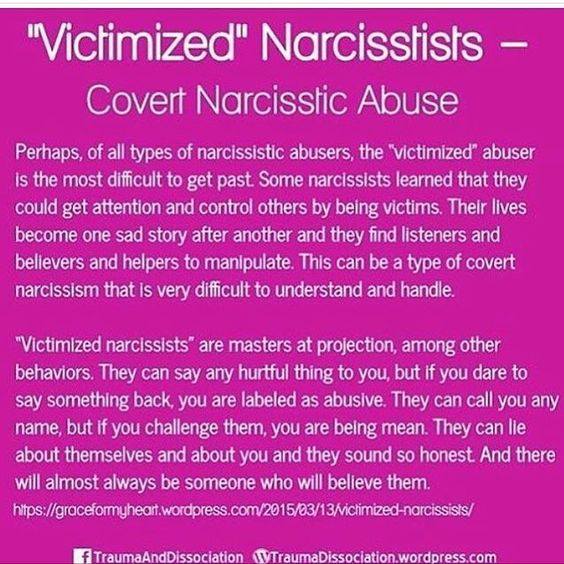
When Bullies Play the Victim Role

A bully pretends to be a victim in order to manipulate others.

Because most people are good and compassionate, this is bullying at its worst.
When a bully acts like a victim, they also gain the unwitting compliance of others into bullying you. Naïve, compassionate people will chastise you for not caring about the bully’s victimization, and not changing your behaviour to meet the bully’s desires.

Although this particularly nasty form of bullying occurs occasionally in the workplace, it is more common at home, where it represents emotional blackmail.

A bully exaggerates the impact of your actions on them

Read more here:

KickBully

How Narcissists Play Victim and Twist the Story

People with strong narcissistic tendencies are known for certain destructive social patterns. Anybody who has had the misfortune of dealing with these types of people may notice that whenever there’s a conflict or any type of disagreement, they tend to act in an abhorrent yet predictable manner.
In this article we will explore the common behaviors and scenarios where narcissistic and otherwise toxic people (hereafter narcissists) play the victim and manipulate the narrative.

People with strong narcissistic tendencies are known for certain destructive social patterns. Anybody who has had the misfortune of dealing with these types of people may notice that whenever there’s a conflict or any type of disagreement, they tend to act in an abhorrent yet predictable manner.

In this article we will explore the common behaviors and scenarios where narcissistic and otherwise toxic people (hereafter narcissists) play the victim and manipulate the narrative.

Delusion and denial

Narcissists can’t deal with reality because it contradicts what they want to be true, and this creates painful emotions. As a coping mechanism, they learn to delude themselves that what is real is actually not real, and however they see the situation is real, even though it isn’t.

Sometimes they truly see it that way. Other times it’s just a story they tell themselves and others. And often the longer you tell a story, the more you believe it, even if initially you know it’s not true. And so eventually they may start truly believing it.

Either way, the first step is to create a version of events that is an alternative to what actually happened or what’s going on.

Lying

While delusion is more of an internal process, lying and denial is often in the context of other people.

Regular people deal with their problems by themselves, internally. Or they discuss it in a very private setting: in therapy or among very close, healthy people. Narcissists don’t have people like that in their life and are not really interested in actually resolving anything or being introspective.

Narcissists simply want to know that they are in the right. For that, they need other people’s false validation to regulate their shaky self-esteem. They need to find people who would agree with them. And in order for others to agree with them, these other people either need to be terribly unhealthy and unable to recognize their toxic tendencies, or the narcissist needs to lie and present a different story than what is actually true.

Here, they tend to flip the roles where they are good, noble, caring, virtuous and the other person is evil, cruel, selfish, and immoral. Which brings us to the next point….

Projection

The most common way narcissists create alternative narratives is by projecting. We’ve talked about narcissistic projection in a separate article but to extract the main point, narcissists love to project.

If they say that the other person is jealous of them, then you know that the narcissist is jealous. If they say that the other person was cruel to them, then you know that the narcissist was cruel to the other person. If they say that the other person was lying and cheating, then you know they were the one lying and cheating.

Yes, sometimes it’s not as simple and there could be unhealthy behavior on both sides, but more often than not whatever the narcissist is presenting the other person as is a much more accurate description of the narcissist.

Whatever the case may be, the mechanism here is that in the narcissist’s mind they try to attribute their own unhealthy behavior, perspective, and character traits to the other person because it shifts attention and responsibility from them. And if the other person “is” all these bad things then it can’t be that I am these things—thinks the narcissist—I’m the good guy here.

Read more here:

Darious Cikanvicius – Psych Central