Narcissistic Parental Alienation Syndrome

Is your child being coerced into disliking you? This is known as narcissistic parental alienation syndrome.

You may have found that your once-healthy relationship with your children has become increasingly strained after your difficult divorce. Your children are now avoidant, disrespectful, or even cruel.

You may have noticed your kids have started to sound like your ex-partner when they criticize you. As a result, you might suspect that your ex is bad-mouthing you and possibly even manipulating your children into disliking you.

This phenomenon, known as narcissistic parental alienation syndrome, is a severe issue many parents worldwide have experienced.

What is narcissistic parental alienation syndrome?

Narcissistic parental alienation syndrome, or parental alienation syndrome (PAS), occurs when one parent coercively tries to alienate their child from an otherwise loving parent. This manipulation then results in the child’s dislike or rejection of the alienated parent.

The term first emerged in the 1980s when American child psychiatrist Richard Gardner began noticing this behavior during child-custody disputes.

Gardner found that one parent would purposefully program (or brainwash) the child with certain ideas and attitudes about the other parent, even when these ideas were at odds with the child’s actual experiences.

The child would then “join in” vilifying the targeted parent, often because these behaviors were highly reinforced and rewarded by the alienating parent.

Importantly, the term PAS is only applicable when the targeted person is considered a good parent and hasn’t done anything to warrant this alienation. This term does not apply if the alienated parent is truly abusive.

What is narcissistic parental brainwashing?

Narcissistic parental brainwashing occurs when a parent with narcissistic tendencies psychologically manipulates the child into thinking false narratives about the other parent. This could entail painting the other parent as dangerous, unloving, unintelligent, or somehow not good for the child.

Many PAS children respond to this programming in such a way that they seem to completely forget or suppress any positive feelings or experiences they’ve had with the targeted parent.

Warning signs of parental alienation syndrome

Signs of PAS may include the following:

  • unjustified or irrational campaign to vilify loving parent
  • chil
  • d’s extreme idealization of one parent over the other (black-and-white thinking)
  • vilification of the targeted parent’s entire family and friends
  • support of the child’s negative actions and attitudes toward the targeted parent
  • denial of guilt or lack of empathy over the cruel treatment toward the targeted parent
  • the child’s “own” opinion are highly emphasized by the manipulative parent (e.g. “Chelsea just doesn’t like her dad, and she shouldn’t be forced to see him.”
  • the child uses the same tone that the narcissistic parent uses toward the targeted parent

Examples of narcissistic parental alienation

Narcissistic parental alienation may look like the following:

The offending parent purposefully interferes with the targeted parent’s time with the child. E.g. The other parent shows up to “volunteer” in the school cafeteria when they know you will be having lunch with your child.

The offending parent tells the child that the other parent isn’t interested in their life. “Your mother probably isn’t going to show up to get you today. She abandoned you before and will probably do it again.”

The offending parent is uncompromising regarding the parenting schedule. E.g. You ask to switch custody days because you have an important doctor’s appointment on Wednesday, but the other parent refuses to compromise, causing you to miss a day with your child.

The offending parent consistently talks badly about the other parent. “Your father doesn’t have any morals.”

The offending parent rewards the child for talking badly about the other parent. “I don’t blame you for feeling that way. Let’s go get some ice cream together.”

The offending parent acts hurt when the child is kind to the targeted parent.

The child copies the offending parent’s words and tone while speaking to the targeted parent. “You can never be on time, Dad.”

The offending parent would rather harm the child than benefit the targeted parent. E.g. The parent refuses to let your child go on a fun trip with you for nonsensical reasons.

The child feels like they have to “choose” between parents.

What causes narcissistic parental alienation?

Evidence suggests that parental alienation often occurs in very tense and volatile separations or divorces, particularly when there are bitter child custody battles.

However, for PAS to even occur, one parent must be willing to act unusually cruelly and callously. These behaviours often point to narcissistic personality disorder (NPD), which is characterized by a grandiose sense of self, a strong need for admiration, and a lack of empathy.

These parents tend to value their interests over the child’s well-being and will stop at nothing to “win” against or “punish” the other parent.

How to navigate narcissistic parental alienation syndrome

It’s can be difficult for a targeted parent to navigate parenting with a co-parent showing signs of narcissistic parental alienation syndrome.

If you suspect your co-parent is trying to alienate you from your child, try your best to have a friend or family member present when you speak with them. This can help you stay grounded if the co-parent is consistently gaslighting you or using manipulation.

You may also want to work with a licensed therapist or family therapist to find ways to navigate this difficult situation. Additionally, in severe cases, you may want to consider hiring a lawyer.

Let’s recap

Narcissistic parental alienation syndrome occurs when a parent with narcissistic traits attempts to maliciously alienate their child from an otherwise loving parent. This is often accomplished by attacking the other parent’s character in front of the child.

This manipulation can then lead to the child’s own rejection and feelings of dislike toward the targeted parent.

If you are living with this situation, consider reaching out to a mental health professional to help you navigate this challenging situation.

Psych Central

What Causes Attachment Based Parental Alienation

“It’s funny how sometimes the people you’d take the bullet for, are the ones behind the trigger.”

What exactly is parental alienation in the context of a narcissistic relationship?

It is the dynamic that occurs when a child is manipulated by the narcissistic parent to reject the other, healthy and empathic parent.  It happens because the narcissistic parent uses a type of invisible coercion to convince the child that the other parent is no good. In essence, the narcissistic parent teaches his/her child to hate his/her other parent, and uses the child as a weapon to hurt the other, non-narcissistic parent.

Often this is done by implication and non-verbal communication, such as when a child returns home from being with the targeted parent and the narcissist acts overly concerned or alarmed by anything that may have gone on at the targeted parent’s house; by acting as if there is cause for distress, and that the child is very fortunate to be away from that “unhealthy environment…”

Why would a child be so willing to reject his/her “good” parent in exchange for the emotionally dysfunctional personality disordered parent?

This occurs because the child sees and feels the rejection and discard of the targeted parent by the abusive parent, and internalizes a deep and powerful fear that if he/she does not identify with the “favored” parent then he/she too will be rejected by the narcissist. In fact, the child will enmesh with the rejecting parent in order to ensure his/her protection from the same fateful rejection as the targeted parent.

The child is unconsciously experiencing a type of trauma bond/Stockholm syndrome phenomenon within the parental relationship. Liken it to being in a cult. In a cult, members learn to be loyal to the charismatic leader at the expense of friends, family, and society!  It really is astonishing how it happens.

The narcissist, just like a charismatic cult leader, convinces his/her child that he/she is “special” and “favored” by aligning with him/her (the narcissist.) Reality gets flipped on its head and the other parent is considered to be the dangerous one, while the narcissist becomes a hero of sorts.

Typically, in a narcissistic family, there is a “golden child” and a “scapegoat.”  In either case, the family has experienced viscerally the unspoken dynamics at play within the family. Often, during a divorce, the scapegoated child may all of a sudden experience the narcissistic parent paying close attention to him/her, meeting the felt needs of the child that have long been unmet within the child’s psyche.

The child has been starving for attention from the narcissistic parent, so, when all of a sudden he/she starts receiving deeply coveted attention, any sense of analysis or logic is suspended. It’s like a person dying of thirst, receiving that long overdue glass of ice sparkling water. Even if the narcissist has been abusive, hurtful, or neglectful of the child in the past, because of abuse amnesia, it doesn’t matter. The child’s needs become satisfied in an instant and all is forgiven and forgotten.

And, if the child feels secure with the parent who has always been there emotionally for the child, he/she will find it easy to be manipulated by the narcissistic parent because intrinsically, he/she knows that his bond is safe with the empathic parent. It is much easier to reject someone you know will never leave, than it is to reject someone you can barely hold on to.

For the child, the unconscious choice is an emotional survival strategy. One of the problems with abusive relationships is that they create unmet needs in those involved with the abusive person. When the narcissist starts wooing the child, it requires very little to win him/her over. Once this happens, then alienation of the targeted parent begins.

In reality, the narcissist does not love his/her child in a real way. Real love would not deprive a person from a loving, empathic relationship.

In addition to this, we must not forget that people with narcissism suffer from delusional thinking. On some warped level, the narcissist actually believes his/her own lies. He/she destroyed the relationship with the targeted parent in the first place, creating a drama in his/her mind that made the “good” parent the villain; while, the narcissist believes, erroneously, that he/she is the truly injured party.

To add more power to the dynamic, because the narcissist believes his/her own lies, he/she is VERY convincing to everyone – particularly his/her vulnerable children.  He/she propagandizes his delusional narrative.

The other (empathic) parent does not see it coming and cannot compete with the lunacy of it all. Since the empathic parent is most-likely conscientious and plays fair, he/she is not equipped to even enter the battle field with the narcissist’s weaponry – seduction, manipulation, smear campaigns, delusional complexes, believed confabulation, reality twisting, and utter insanity. The targeted parent is completely out-witted.

Psych Central https://pro.psychcentral.com/recovery-expert/2017/11/what-causes-attachment-based-parental-alienation-in-narcissistic-relationships/

Coping With The Rejection of a Child

One of the hardest things to experience is the betrayal wound that occurs when your own child grows up to hate you.  I have seen this numerous times in my life, to the point that I am compelled to write about it.

Parents who have been rejected by one or more of their children experience a type of pain that is not matched by any other – even the betrayal of a spouse or parent.

If you are a parent who has been rejected by your child or children then hopefully this paper will be beneficial to you.  Of course, if you were and still are an abusive parent, then perhaps your child did what was necessary in order to protect him or herself from further abuse; but, if you are a typical, “good enough” parent, then your child’s rejection is unnatural and unhealthy – for all involved.

What types of children reject their parent(s) in this respect? (Note: these options are not mutually exclusive.)

  • Children with Narcissistic Parental Alienation Syndrome
  • Children with attachment trauma
  • Children with personality disorders

If you are experiencing the heart ache of a child who rejected you, then you probably feel devastated, hurt, confused, angry, furious, misunderstood, shocked, invalidated, and empty.  Was I a bad parent?  Why did my children turn against me?  What could I have done differently? Maybe I said “no” too many times. Maybe I shouldn’t have been so hard on him/her. Where did I go wrong?

Many questions enter your mind.

Usually, children, no matter what, are loyal to their parents – even very neglectful and abusive ones. When a child rejects a parent it usually has something to do with something else other than abuse or neglect. In fact, when a person cuts ties with an abusive or neglectful parent it is usually a difficult process and requires the child to set difficult boundaries, and is nearly impossible to do.

What about the parent whose child rejects them easily or with no sense of conscience or remorse, acting as if their parent were Attila the Hun, using criticism and judgment as tools of attack against the parent; using every weakness of the parent as justification for the ostracizing him/her? This type of parental rejection is not natural and is usually the result of one of the above three mentioned possibilities.

I will discuss each option here.

Children with Narcissistic Parental Alienation Syndrome:

This is the dynamic that occurs when a child is manipulated by the narcissistic parent to reject the other, healthy and empathic parent.  It happens because the narcissistic parent uses a type of invisible coercion to convince the child that the other parent is no good. In essence, the narcissistic parent teaches his/her child to hate his/her other parent, and uses the child as a weapon to hurt the other, non-narcissistic parent.

Often this is done by implication and non-verbal communication, such as when a child returns home from being with the targeted parent and the narcissist acts overly concerned or alarmed by anything that may have gone on at the targeted parent’s house; by acting as if there is cause for distress, and that the child is very fortunate to be away from that “unhealthy environment…”

For further information on the topic of Narcissistic Parental Alienation, please click here.

Children with attachment trauma:

While attachment occurs all through the human lifespan, the most crucial time in a human being’s life for attachment is between the times of birth to two years. If the child experiences a breach in time, away from the mother, for any reason – be it abuse, neglect, or something else prevents the mother from being present and attuned to her child, then attachment trauma results.

Once a child has not connected properly with his/her mother, then the child did not develop the appropriate skills for having a healthy interpersonal attachment. A mother needs to provide the necessary attunement and resonance needed to learn how to love and trust another person. When a child is not given that type of relational input, he/she adjusts or copes by shutting down his/her needs. This results in later relationship problems, particularly involving the relationship with the mother, or anyone else offering intimacy and nurturing.

Children with personality disorders:

There appears to be a genetic component to personality disorders. If a child has a parent or other person in his biological family with a personality disorder, or even other mental illness, then perhaps he/she has inherited a biological propensity to have a personality disorder him/herself.

According to Google dictionary, a personality disorder is defined as:  “a deeply ingrained and maladaptive pattern of behavior of a specified kind, typically manifest by the time one reaches adolescence and causing long-term difficulties in personal relationships or in functioning in society.”

As you can see by this definition that people with personality disorders are not easy to have close relationships with; this would include parent-child relationships.

What to do?

The best advice I can offer is as follows:

  1. Ask your child what he or she needs from you in order to repair the relationship. If your child tells you something specific, just listen and determine if you can honor your child’s request. If it is reasonable and sincere, than do your best to repair what has been broken.
  2. Don’t act on your feelings of defensiveness. If you feel defensive, learn to talk within your own head and keep your mouth shut. You should not defend yourself to your child. You can say something neutral, such as, “I have a different perspective on the story, but I’m not going to defend myself because it won’t be productive.”
  3. Expect Respect. Realize that no matter what, everyone deserves to be treated with respect – including you.
  4. Don’t idealize your children or your relationship with them. Yes, our children are the most important people in our lives, but they should not be idealized or enshrined. They are mere mortals just like you and I.If your child is rejecting you, it’s one thing to feel disappointed and sad, but it becomes unhealthy if you can’t focus on anything else other than that. You are best served to remind yourself that you have other relationships that are important as well, and learn to focus on the ones that work.
  5. Grieve. Allow yourself to feel the sadness of being rejected by your child. Grieve over the loss of the innocence that the relationship once was. Grieve over your lost child – even though he or she is still alive. In your world, he/she is no longer part of your life. That sense of “what can I do?” keeps you yearning and longing for reconciliation; but sometimes reconciliation is not forthcoming.
  6. Live one day at a time. Even if you have no contact with your child today, you have no way of knowing what tomorrow may bring. None of us does. The best thing we can do is to live the best way we know how today. When you can focus on one day only, you feel less hopeless and desperate. Remind yourself, “I cannot predict the future.”
  7. Don’t beg. No matter how hurt or desperate you feel to have a relationship with your rejecting child, never stoop to the level of begging for attention or even forgiveness. You will not be respected by your child if you beg and it will demean your position as a parent.
  8. Be empowered. Don’t let your rejecting child steal your personal power. Just because you are having difficulties in this area of your life, don’t get to the place where you feel personally defeated. Do what it takes to be good to yourself – seek therapy, join a support group, travel, go to the gym, do whatever you can to own your own power and stop giving it away to anyone else.

One thing that is certain about life is that it is about all about letting go. As parents our job is to raise our children to the best of our ability and teach them how to be independent, productive adults. If, during the process, they choose a path we don’t agree with, we must remind ourselves that we can’t live their lives for them. Learning to let go is the best way to manage any part of life that doesn’t go the way we expect, including when our children choose to reject us.

Psych Central

Sharie Stines, Psy.D

Family Dynamics

Understanding Family Dynamics

Can’t we all get along? That’s a tall order when your limelight has been snatched away by your adorable new little brother. Family, you love them and you hate them. There are so many things to consider when you think of family: there’s birth order, rivalries, the only child, to name a few.

So what is a functional family? How do we know if we have one? How would you define a functional family?

Read more here:

Psych Central.

Roles in Families

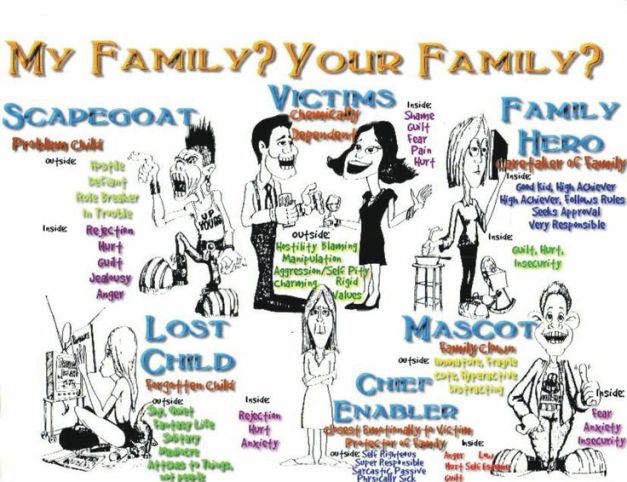
Were you considered the responsible child while your younger brother or sister was the rebel or ‘Mummy’s little one’?
According to experts as children we all played a specific role in our family, although which role was not always within our control. It may be due to gender, family culture or the order in which we were born. However the legacies of being the model child or the baby may continue to help or haunt us in our adult lives and understanding these silent family agreements can help us break behavioural patterns which could at times be disabling. Flavia Mazelin Salvi explains the four different roles:

 The Mind Journal

Image – The New Yorker

Dan Edmunds – Psychology Today