The B.I.T.E Model – Characteristics of a Cult.

Here is Steven Hassan’s B.I.T.E. model, a checklist for the characteristics of a cult. As well as religious organization’s this behaviour can be present in many groups situations, families, working life and friendships.

The Evolution of the BITE Model – Steven Hassan

There are three components to Festinger’s theory – control of behaviour, thoughts, and emotions. Each can be affected by the other two. By manipulating three elements cults gain control over a person’s identity. Through working with former cult members, a fourth important component is identified – control of information. When that is controlled as the amount a person can receive limit capacity for independent thought. These four factors are easily remembered as BITE Behaviour, Information, Thoughts, Emotions.

The Bite Model

Behaviour Control

Regulation of individuals physical reality

Where, how and with who the member lives and associates.

What clothes, colours, hairstyles the person wears.

What food the person eats, drinks, adopts and rejects.

How much sleep the person is able to have.

Financial dependence.

Little or no time spent on leisure, entertainment, and vacations.


Major time commitment required for indoctrination sessions and group rituals.

Ask permission for major decisions.

Need to report thoughts, feelings, and activities to superiors.

Rewards and punishments (behaviour modification techniques, positive and negative)

Individualism discouraged ‘group think’ prevails.

Rigid rules and regulations.


Information Control

Use of deception.

Deliberately holding back information.

Distorting information to make it more acceptable.

Outright lying.


Access to non-cult sources of information minimized or discouraged.

Books, articles, magazines, TV, radio.

Critical Information.

Former members.

Keep members so busy they do not have time to think and check things out.


Compartmentalization of information – outsider vs insider doctrines.

Information is not freely accessible.

Information varies at different levels and missions within pyramid.


Spying on other members is encouraged.

Pairing up with ‘buddy’ system to monitor and control.

Reporting deviant thoughts, feelings, and actions to leadership.

Individual behaviour monitored by whole group.

Leadership decides who needs to know what and when.


Extensive use of cult generated information and propaganda.

Newsletters, magazines, journals, audio tapes, video tapes and other media.

Misquotations, statements taken out of context from non-cult sources.


Unethical use of confession.

Information about ‘sins’ used to abolish identity boundaries.

Past sins used to manipulate and control, no forgiveness or absolution.


Need for obedience and dependency.

Thought Control

Need to internalize the groups doctrine as ‘truth’,

Adopting the groups ‘map of reality’ as Reality.

Black and white thinking.

Good vs Evil.

Us vs Them.


Use of loaded language (thought terminating cliches) words are the tools we use to think with. Those special words constrict rather than expand understanding and can even stop thoughts altogether. They function to reduce complexities of experience into trite, platitudinous ‘buzz words’.

Only good and proper thoughts are encouraged.

Use of hypnotic techniques to induce altered mental states.

Manipulation of memories and implantation of false memories.


Use of thought stopping techniques which shut down ‘reality testing’ by stopping negative thoughts and allowing only good thoughts.

Denial, rationalization, justification, wishful thinking.

Chanting.

Meditating.

Praying.

Speaking in tongues.

Singing or humming.


Rejection of rational analysis, critical thinking, constructive criticism. No critical questions about leaders, doctrine or policies seen as legitimate.

No alternative belief system viewed as legitimate, good or useful.


Emotional Control

Manipulate and narrow the range of a persons feelings.

Make the person feel that if there are any problems its always their fault, never the leaders or groups.

Excessive use of guilt.

Identity guilt.

Who you are (not living up to potential)

Your family

Your past

Your affiliations

Your thoughts, feelings, actions

Social guilt

Historical guilt


Excessive use of fear

Fear of thinking independently

Fear of the outside world

Fear of enemies

Fear of losing ones salvation

Fear of leaving the group or being shunned

Fear of disapproval


Extremes of emotional highs and lows

Ritual and often public confessions of sins


Phobia indoctrination inculcating irrational fears about ever leaving the group or questioning leaders authority. The person under mind control cannot visualize a positive fulfilled future without being in the group.

No happiness or fulfilment outside of the group.

Terrible consequences will take place if you leave, hell, demon possession, incurable diseases, accidents, suicide, insanity, 10,000 reincarnations etc.

Shunning of leave takers, fear of being rejected by peers, friends and family.

Never a legitimate reason to leave. From the groups perspective people who leave are weak, undisciplined, unspiritual, worldly, brainwashed by family or a counsellor, or seduced by money, sex or ‘rock and roll’.

It is important to understand that the Destructive Mind Control can be determined when the overall effect of the four components promote dependency and obedience to some leader or cause. It is not necessary for every single item on the list to be present. Mind control cult members can live in their own apartments, have nine to five jobs, married with children, and still be unable to think for themselves and act independently.

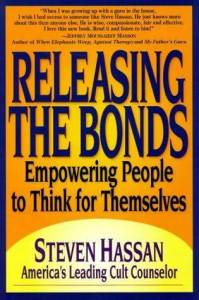
(This was taken from a book entitled: Releasing The Bonds – Empowering People to Think for Themselves by Steven Hassan).

Religious Trauma Syndrome

Religious Trauma Syndrome
by Marlene Winell
Religious Trauma Syndrome is the condition experienced by people who are struggling with leaving an authoritarian, dogmatic religion and coping with the damage of indoctrination. They may be going through the shattering of a personally meaningful faith and/or breaking away from a controlling community and lifestyle. RTS is a function of both the chronic abuses of harmful religion and the impact of severing one’s connection with one’s faith. It can be compared to a combination of PTSD and Complex PTSD (C-PTSD). This is a summary followed by a series of three articles which were published in Cognitive Behaviour Therapy Today.
Religious Trauma Syndrome has a very recognizable set of symptoms, a definitive set of causes, and a debilitating cycle of abuse. There are ways to stop the abuse and recover.
Symptoms of Religious Trauma Syndrome:
• Cognitive: Confusion, poor critical thinking ability, negative beliefs about self-ability & self-worth, black & white thinking, perfectionism, difficulty with decision-making
• Emotional: Depression, anxiety, anger, grief, loneliness, difficulty with pleasure, loss of meaning
• Social: Loss of social network, family rupture, social awkwardness, sexual difficulty, behind schedule on developmental tasks
• Cultural: Unfamiliarity with secular world; “fish out of water” feelings, difficulty belonging, information gaps (e.g. evolution, modern art, music)
Causes of Religious Trauma Syndrome:
Authoritarianism coupled with toxic theology which is received and reinforced at church, school, and home results in:
• Suppression of normal child development – cognitive, social, emotional, moral stages are arrested
• Damage to normal thinking and feeling abilities -information is limited and controlled; dysfunctional beliefs taught; independent thinking condemned; feelings condemned
• External locus of control – knowledge is revealed, not discovered; hierarchy of authority enforced; self not a reliable or good source
• Physical and sexual abuse – patriarchal power; unhealthy sexual views; punishment used as for discipline
Cycle of Abuse
The doctrines of original sin and eternal damnation cause the most psychological distress by creating the ultimate double bind. You are guilty and responsible, and face eternal punishment. Yet you have no ability to do anything about it. (These are teachings of fundamentalist Christianity; however other authoritarian religions have equally toxic doctrines.)
You must conform to a mental test of “believing” in an external, unseen source for salvation, and maintain this state of belief until death. You cannot ever stop sinning altogether, so you must continue to confess and be forgiven, hoping that you have met the criteria despite complete lack of feedback about whether you will actually make it to heaven.
Salvation is not a free gift after all.
For the sincere believer, this results in an unending cycle of shame and relief.
Stopping the Cycle
You can stop the cycle of abuse, but leaving the faith is a “mixed blessing.” Letting go of the need to conform is a huge relief. There is a sense of freedom, excitement about information and new experiences, new-found self-respect, integrity, and the sense of an emerging identity.
There are huge challenges as well. The psychological damage does not go away overnight. In fact, because the phobia indoctrination in young childhood is so powerful, the fear of hell can last a lifetime despite rational analysis. Likewise the damage to self-esteem and basic self-trust can be crippling. This is why there are so many thousands of walking wounded – people who have left fundamentalist religion and are living with Religious Trauma Syndrome.
Mistaken Identity
Religious Trauma Syndrome mimics the symptoms of many other disorders –
post-traumatic stress disorder
clinical depression
anxiety disorders
bipolar disorder
obsessive compulsive disorder
borderline personality disorder
eating disorders
social disorders
marital and sexual dysfunctions
suicide
drug and alcohol abuse
extreme antisocial behavior, including homicide
There are many extreme cases, including child abuse of all kinds, suicide, rape, and murder. Not as extreme but also tragic are all the people who are struggling to make sense of life after losing their whole basis of reality. None of the previously named diagnoses quite tells the story, and many who try to get help from the mental health profession cannot find a therapist who understands.
What’s the problem?
We have in our society an assumption that religion is for the most part benign or good for you. Therapists, like others, expect that if you stop believing, you just quit going to church, putting it in the same category as not believing in Santa Claus. Some people also consider religious beliefs childish, so you just grow out of them, simple as that. Therapists often don’t understand fundamentalism, and they even recommend spiritual practices as part of therapy. In general, people who have not survived an authoritarian fundamentalist indoctrination do not realize what a complete mind-rape it really is.
In the United States, we also treasure our bill of rights, our freedom of speech, freedom of assembly, and freedom of religion. This makes it extremely difficult to address a debilitating disorder like RTS without threatening the majority of Americans. Raising questions about toxic beliefs and abusive practices in religion seems to be violating a taboo. No one wants to be pointing fingers for fear of tampering with our precious freedoms.
But this is the problem. Sanitizing religion makes it all the more insidious when it is toxic. For example, small children are biologically dependent on their adult caretakers; built into their survival mechanisms is a need to trust authority just to stay alive. Religious teachings take hold easily in their underdeveloped brains while the adults conveniently keep control. This continues generation after generation, as the religious meme complex reproduces itself, and masses of believers learn to value self-loathing and fear apocalypse.
There is hope
Awareness is growing about the dangers of religious indoctrination. There are more and more websites to support the growing number of people leaving harmful religion. Slowly, services are growing to help people with RTS heal and grow, including Journey Free. We are discovering the means by which people can understand what they have been through and take steps to become healthy, happy human beings.

How Narcissists use Projection to Manipulate,

Psychology Explains How Narcissists Use Projection To Manipulate
PSYCHOLOGY EXPLAINS HOW NARCISSISTS USE PROJECTION TO MANIPULATE
Narcissistic Personality Disorder

Narcissists have no real self-awareness to speak of. Indeed, their very sense of value is derived from how others perceive them. As a rule, narcissists are unable to recognize their shortcomings and failures, instead choosing to cast the blame – no matter the merits of such – onto someone else. It’s called projection – a default defense mechanism of the narcissist.

In this article, we’re going to define narcissism, projection, and how those with narcissistic tendencies use projection in order to achieve their aims. As you will read, narcissists are experts at manipulation. To this end, we’ll discuss how you can spot the narcissist, along with proactive things you can do to avoid becoming a victim of narcissistic manipulation.

WHAT IS PROJECTION?

In the field of psychology, projection – or psychological projection – is the denial of subconscious impulses by the human ego. For instance, someone accusing their partner of cheating when they’re actually the one engaging in the scandalous act is projecting. A jealous co-worker who accuses everyone else in the office of being jealous is projecting; secretly, they’re jealous of just about everyone with a modicum of success. And so on.

While common among the narcissistic, projecting is something that we all do to varying degrees. We usually project onto others when we have uncomfortable, sometimes disturbing, emotions, and thoughts about ourselves. The father of psychoanalysis, Sigmund Freud, believed that we project things onto others when we don’t want to burden ourselves with our perceived flaws or feelings of inferiority.

In other words, we want others to be the vehicles for our insecurities. We don’t want to deal with them anymore.

The thing is: while we all project, we don’t make a habit out of it. Most of us wouldn’t use projection to make someone feel inferior. We certainly wouldn’t employ projection as a means of coercion. Because, well, you’re not a narcissist (we don’t think.)

Speaking of which, let’s discuss narcissistic personality disorder in a tad more detail.

THE STORY OF NARCISSUS (THE OG NARCISSIST)

The ancient Greeks and Romans promulgated a myth about a young lad a wee too obsessed with his image. The story goes that Narcissus was a handsome guy who rejected all female comers.  In fact, Narcissus rejected all of those who loved him, leading some of those he loved to take their own lives as a last effort to show Narcissus their devotion and love.

None of this moved the vain young man, however, which led the Goddess Nemesis to punish Narcissus for his callousness. The story ends with Narcissus getting a glimpse of himself in a lake, which reflected back an image showing him in the prime of his beauty. Narcissus fell in love with his own image, eventually realizing that nothing could love him as much as he could love himself. Nemesis takes his own life shortly after this realization.

NARCISSISTIC PERSONALITY DISORDER

In the late 1800s, psychologists decided that the vain Narcissus was an apt representation of some of their clients. A sexologist by the name of Havelock Ellis coined the term “narcissus-like” to describe his patients engaging in excessive masturbation.

In 1911, an Austrian psychiatrist by the name of Otto Rank published the first academic paper proposing narcissism as a potential psychological disorder. Rank described narcissism in the context of excessive self-admiration and vanity. Three years later, Freud published the paper On Narcissism: An Introduction.

“…a personality disorder with a long-term pattern of abnormal behavior characterized by exaggerated feelings of self-importance, excessive need for admiration, and a lack of empathy.”

Clinical treatment of NPD is not well-studied but is thought to be difficult – as those with NPD are unable to see their condition as a problem. NPD occurs more often in males, affects roughly one percent of the population, and is far more common in younger people than older.

The Diagnostic and Statistical Manual of Mental Health Disorders, Fifth Edition (DSM-5) – the diagnostic literature published by the American Psychological Association (APA) – lists ten recognized symptoms of NPD:https://imasdk.googleapis.com/js/core/bridge3.432.0_en.html#goog_154395631000:00 of 09:01Volume 90%This video will resume in 4 seconds 

  1. A sense of grandiosity
  2. Expecting superior treatment from others
  3. Exploiting others for personal gain without feelings of guilt
  4. An inability to understand the thoughts and feelings of others
  5. Strong feelings of envy towards others
  6. Constantly engaging in the bullying, belittling, and demeaning of others
  7. A sense of entitlement and the need to be treated special
  8. The need to be perceived as superior and unique
  9. Obsession over desired traits such as attractiveness, intelligence, power, and success
  10. The need to be constant admiration from other people
NARCISSISTS + PROJECTION = MANIPULATION

“When the [narcissistic] individual is in the superior position, defending against shame, the grandiose self aligns with the inner critic and devalues others through projection.” – Darlene Lancer, JD, LMFT (source)

HERE’S HOW NARCISSISTS USE PROJECTION TO MANIPULATE YOU (AND WHAT TO DO ABOUT IT):
1. THEY “CALL YOU OUT”

Perhaps the most straightforward way to project is to call someone out. When a narcissist calls you out, you can bet they’re doing so for one of two reasons: (a) to get you to do something, (b) to attack you, or both. Guilt-tripping is among the most common methods narcissists use. If that doesn’t work, they may get frustrated and verbally attack you.

What to do: In any case, don’t take the bait. Recognize the behavior for what it is: a shameless, insulting attempt to manipulate your thoughts and feelings. You have something they want – don’t give it to them!

2. THEY MIMIC

While narcissists have the emotional depth of a puddle, they’re smart enough (many are highly intelligent) to know that emotionality matters to people. For this reason, narcissists will often mimic the emotional behaviors that they see elsewhere to convince someone of their genuine nature.

For the narcissist, the problem with this tactic is that mimicry goes against the grain of innate human behavior. Assuming that they’re not some CIA-trained spy, the entire façade will become apparent sooner or later.

What to do: Be observant. Someone’s core personality will always make itself known. You just have to keep your eyes and ears open.

3. THEY USE CHARACTER ASSASSINATION

If you’ve ever been the victim of character assassination, then you may know the far-reaching effects. Targeting someone’s character is the ultimate “go for the jugular” act. When a narcissist engages in character assassination, it’s often out of vengeance, or for the purpose of winning people over for some reason.

What to do: The most important thing here is not to panic. Most have pretty good sense when it comes to getting a feel for someone’s character. For this reason, we’re naturally cautious when someone verbally attacks another’s person. If these things are occurring in a work environment, it may be necessary to speak with your manager, human resources, or the legal department.

4. THEY PLAY THE VICTIM

Narcissists love to play the victim. At first, anyway. Why? Because they realize that most of us have some kind of sensitive core. We don’t like to see other people suffer. We want to help alleviate that suffering. Narcissists are all too eager to take advantage of this near-universal human trait. For this reason, the narcissist will project a “Woe is me” demeanor as well.

Some less-intelligent narcissists make the critical error of playing the victim to one person. If this is the case, it’s much easier to see through the charade.

What to do: It’s important to remain observant and keep your ear to the ground. If you’re particularly sensitive (e.g., an empath), make sure that you’re offering your assistance only to people you know well.

3. THEY SHAPE SHIFT

When a narcissist feels that they’ve got the victim where they want, they’ll quickly drop the act. They do so because they’re confident that the victim will offer little if any resistance. Indeed, this is often the last opportunity that the potential – or, by this point, possibly real – the victim will have to minimize the damage.

If you catch onto the shape-shifting, don’t expect the narcissist to go quietly into the night. Remember, narcissists are experts in the art of manipulation – and they may still be able to flummox you just enough that you’ll keep them around.

FINAL BIT OF ADVICE ON DEALING WITH NARCISSISTS

At this juncture, it is critical that you not hesitate to “end it.” Unless that person has some undiagnosed mental health disorder, there’s just no rational explanation for displaying extremes along the personality spectrum. Particularly if you’re being hurt in the interim.

Power of Positivity

Estranged Families and Christmas

Christmas is the hardest time of year for those estranged from close family

Image – CBS

With Christmas just around the corner, many will be finalising plans to see their families over the festive period. Yet for others, family relationships are challenging, distant and a source of pain. In some cases, relationships break down entirely leaving people estranged from close relatives.

Results from a new online survey of people estranged from family members conducted with the charity Stand Alone, has shown how difficult Christmas can be. The survey was completed by 807 people who identified as being estranged from a parent, sibling or an adult child.

Almost all identified the holiday season as the most challenging time of year, describing feelings of loneliness, isolation and sadness. These feelings and experiences are in direct contrast to the idealised images of happy families around the dinner table that feature in Christmas advertising and the media at this time of year. One respondent said:

Everyone always says ‘what family plans do you have for holidays?’ and look at you funny when you say none. It’s hard to explain to people why you don’t want to be with your own parents.

Two-thirds of the respondents felt there was a stigma about family estrangement. They described feeling judged or blamed – and feeling that estrangement was a taboo subject about which there is little understanding or acknowledgement.

No two estranged relationships looked alike. Yet common factors often led to estrangement, such as having mismatched expectations about family roles and relationships, clashes in personality and values, and emotional abuse.

Estrangement was found to be more complex than simply a lack of contact or communication between family members. Although most of the respondents who were estranged from a parent, sibling or an adult child had no contact whatsoever with this individual, approximately 25% had contact that was minimal in nature. These results are similar to those of Australian social worker Kylie Aglias, who has distinguished between family members who have no contact at all (physical estrangement) and those whose contact is infrequent, perfunctory, and often uncomfortable (emotional estrangement).

We also found that estranged relationships change over time and that cycles in and out of estrangement are common. Of those who said they wished that their estranged relationship was different, most wanted a relationship that was more loving, warm and emotionally close.

What can be done to help?

When it came to getting support, respondents said those friends and support services which offered them emotional and practical support and took the time to listen to them and show them understanding were the most helpful. They found it unhelpful when they felt friends or counsellors dismissed them or when they felt they had been judged and blamed for the estrangement.

It would be wrong to assume that all those experiencing estrangement wish for there to be reconciliation in the future. Feelings about the future of estranged relationships were varied. Of those who were estranged from a mother or father, most felt that there would never be a functional relationship between them in the future. Yet for those who were estranged from an adult son or daughter, most felt that there could be a functional relationship in the future or were unsure of the future direction of the relationship.

Four out of five respondents also reported that there had been a positive outcome from their experience of estrangement. These included feeling more free and independent, feeling happier and less stressed, and having gained a greater insight or understanding of themselves and relationships more broadly.

By listening to the hidden voices of people who are estranged from close relatives, we can begin to move beyond assumptions about what families could or should look like and begin conversations about families and family relationships as they really are.

The Conversation.com

Death of an Estranged Parent

by Kris Peterson.

There are many articles on parents with estranged adult children.  This article however will touch on adult children with estranged parents.

When people hear about the loss or the impending loss of an estranged parent some people feel shocked and unprepared to experience the range of emotions of grief.  They may struggle with a wide variety of things that they will have to be consider in a very short period of time.  Funeral attendance, flights across the country, other people’s feelings and their own feelings.  The loss may leave them mourning not only their estranged parents death but also the loss of an imaginary, what-may-have-been relationship.

Sometimes people find out about the death of their parent in an insensitive way.  Maybe they found out after the fact in obituaries or through the “grape-vine” of other estranged family members.  Communication in estranged family relationships are sometimes non-existent. It is not unusual for major events – even a death – to not be communicated. They may assume that they were left out with evil intent when it’s possible that the family of the estranged parent has perceived the relationship to be so strained that the person wouldn’t want it communicated.

Reasons people may grieve an estranged parent:

  1. Grieving that the relationship now has no chance of mending. Often at some level there is an unspoken hope that the relationship might be restored. Death closes the door on reconciliation. Words are left unsaid and the feelings still remain, sometimes without closure.
  2. Grieving the loss of a part of heritage. Even though the relationship with the parent wasn’t strong, the death involves someone who is a part of their lineage and the chance to learn about the other half of their family may be gone.
  3. Grieve what might have been.  People reflect on a time when they loved the parent, or wanted to love them. Although there may not be a longing for things to change, there is a feeling of melancholy that things were not different. The death of the parent brings to mind ideas of how the relationship should have been.  After the loss, the dream for a better relationship remains only a dream, and in many cases people grieve the death of the dream rather than the loss of the person.

Some people experience apathy to the loss of the non-existent parent in their lives.  It is entirely possible that they dealt with the grief of loss when they were first estranged.   The length of time and purpose of the estrangement greatly affects each persons response.

Ways to help someone with the loss of an estranged parent:

  • Regardless of whatever expectations they think society has placed on them for handling the loss of an estranged parent, they have experienced a loss and they are allowed to grieve.  Giving them space to grieve without judgment is important.
  • People may express deep sadness and remorse for the wasted years.  Missed phone calls or chances to re-connect and opportunities lost.  Remind them to not waste the rest of their life looking back at what could have been.
  • Talking about the past can be cathartic and open doorways to recovery.  Though sometimes people don’t realize that reciting a general litany of of unhappiness is one of the main reasons they stay stuck.  The goal is to become emotionally complete with what happened so that they don’t need to be a current victim of what happened in the past. It’s bad enough that they were mistreated and/or harmed, but remaining stuck in the destructive mental repetition can prevent them from moving forward.
  • Remind them that forgiveness isn’t saying that the estranged child ‘accepts’ or ‘approves’ what happened. Forgiveness is the acknowledgment that what happened, happened, and that they are now ready to let go of the baggage.  Forgiveness isn’t always about the other person, it’s about moving forward.

What NOT to say to someone grieving the death of an estranged parent:

  • “They were an awful person, why do you even care?” Invalidates the feelings of the grieving person.  They are trying to figure out their own emotions in the situation.  They may be feeling confused or upset that they care about this person too. They may be upset that they care for this person at all, adding even more to their confusion and grief.  Invalidating their feelings may make them feel like they aren’t allowed to express them at all.
  • When will you feel better?” Expectation for a timeline for grieving puts unnecessary pressure on the griever to just get over it and again reinforces that they aren’t allowed to express their emotions.
  • “You didn’t even know him/her” amplifies what the griever is probably already thinking.  Knowing this doesn’t take away from the pain of being unable to connect to their estranged parent, in cases it might even be the primary cause of their grief.

Resources:

I thought we‘d never speak again: The Road from Estrangement to Reconciliation,By Laura Davis.  She weaves powerful accounts of parents reconciling with children, embittered siblings reconnecting, angry friends reunited, when war veterans and crime victims meet with their enemies, to her own experiences reconciling with her mother after a long, painful estrangement.

Healing Family Rifts: Ten Steps to Finding Peace After Being Cut Off From a Family, By Mark Sichel.  Family therapist Mark Sichel addresses the pain and shame connected with family rifts and offers a way through the crisis and on toward healing and fulfillment.

Family Estrangements: How They Begin, How to Mend Them, How to Cope with Them, By Barbara LeBey.  Working closely with two family therapists, Barbara LeBey offers a set of tested guidelines to help you approach alienated or angry family members, deal with your own issues, and mend your broken family relationships–even if you think it may already be too late.

Liberating Losses: When Death Brings Relief, By Jennifer Elison and Chris Mcgonigle.  Sometimes we are relieved that our loved one is no longer suffering; at the other end of the spectrum, a death might finally free us of an abusive or unhappy relationship.  In this groundbreaking book, the authors share their own and others’ stories, compassionate clinical analysis, and pragmatic counsel with other disenfranchised survivors.

Toxic Parents: Overcoming Their Hurtful Legacy and Reclaiming Your Life, By Susan Forward.  In this remarkable self-help guide, Dr. Susan Forward draws on case histories and the real-life voices of adult children of toxic parents to help you free yourself from the frustrating patterns of your relationship with your parents — and discover a new world of self-confidence, inner strength, and emotional independence.

Adult Children of Emotionally Immature Parents: How to Heal from Distant, Rejecting, or Self-Involved Parents, By Lindsay C. Gibson.  clinical psychologist Lindsay Gibson exposes the destructive nature of parents who are emotionally immature or unavailable. You will see how these parents create a sense of neglect, and discover ways to heal from the pain and confusion caused by your childhood.

The Bereavement Academy

An Unhappy Father’s Day

What to do when Father’s Day isnt happy – Alison James

Do Father’s Day posts on social media make you want to crawl under the covers until the day is over?

Do Father’s Day commercials make you feel sad or angry?

Do you wish Father’s Day would be over already, so you would stop being reminded about your dad?

Even though Father’s Day is a happy occasion for many people, it can bring up painful or negative feelings for others. 

Whether the day reminds you of a loving father who died, a less than loving father who wasn’t there the way you needed him to be, or if you’re a father who can’t be with your child for any reason, those are all losses that could make Father’s Day difficult. If the day brings up negative feelings then you might be experiencing unresolved grief.

Unresolved grief can have a long term negative impact on your life. Grief is cumulative and cumulatively negative. Grief not only affects current relationships, but it affects future relationships, your work, health, and even hobbies. The intensity of your feelings may lessen over time, but grief doesn’t heal on its own.

Here are some signs you might have unresolved grief around your dad:

  • Do you refuse to talk about him? 
  • Do you feel angry or sad when you think about him?
  • Do you avoid places that remind you of him?
  • Do you put your dad on a pedestal or only see his negative qualities?
  • Do you avoid watching movies, eating foods, or going to places that remind you of him?
  • Do you avoid contact with him?

Have you ever wondered what life would be like if you weren’t carrying around the pain from your relationship with your dad?

If you’re like most people, you were never taught how to heal your broken heart. Although there are plenty of articles, and well-intentioned people, who will share a list of ways to change your feelings short term, they never show you how to truly recover. Frankly, if you want to recover from grief then you must have the courage to do the work.

The first step is admitting that you want help.

  • Talk to someone you trust. Tell the truth about yourself. Ask them not to judge, criticize, or analyze (then don’t judge, criticize, or analyze yourself either).
  • Get started with The Grief Recovery Method by either getting a copy of The Grief Recovery Handbook, reading more of our blogs, looking into our 2 ½ Day Personal Workshops, Grief Support Groups, or 1-to-1 sessions.
  • If you’re already familiar with The Grief Recovery Method then remember that it’s an ongoing process. Consider diving back in.

Imagine the freedom of living without constant emotional pain. You don’t have to live that way.

Grief Recovery Method

Are You In A Cult?

Whether you are already in one, or considering joining any kind of group be it a religious group, place of work, performance group etc. the following article will enlighten you on what signs to look out for.

By Rick Ross – Expert Consultant and Intervention Therapist.

Ten warning signs of a potentially unsafe group/leader.

  1. Absolute authoritarianism without meaningful accountability.
  2. No tolerance for questions or critical inquiry.
  3. No meaningful financial disclosure regarding budget, expenses such as an independently audited financial statement.
  4. Unreasonable fear about the outside world, such as impending catastrophe, evil conspiracies and persecutions.
  5. There is no legitimate reason to leave, former followers are always wrong in leaving, negative or even evil.
  6. Former members often relate the same stories of abuse and reflect a similar pattern of grievances.
  7. There are records, books, news articles, or television programs that document the abuses of the group/leader.
  8. Followers feel they can never be “good enough”.
  9. The group/leader is always right.
  10. The group/leader is the exclusive means of knowing “truth” or receiving validation, no other process of discovery is really acceptable or credible.

Ten warning signs regarding people involved in/with a potentially unsafe group/leader.

  1. Extreme obsessiveness regarding the group/leader resulting in the exclusion of almost every practical consideration.
  2. Individual identity, the group, the leader and/or God as distinct and separate categories of existence become increasingly blurred. Instead, in the follower’s mind these identities become substantially and increasingly fused–as that person’s involvement with the group/leader continues and deepens.
  3. Whenever the group/leader is criticized or questioned it is characterized as “persecution”.
  4. Uncharacteristically stilted and seemingly programmed conversation and mannerisms, cloning of the group/leader in personal behavior.
  5. Dependency upon the group/leader for problem solving, solutions, and definitions without meaningful reflective thought. A seeming inability to think independently or analyze situations without group/leader involvement.
  6. Hyperactivity centered on the group/leader agenda, which seems to supercede any personal goals or individual interests.
  7. A dramatic loss of spontaneity and sense of humor.
  8. Increasing isolation from family and old friends unless they demonstrate an interest in the group/leader.
  9. Anything the group/leader does can be justified no matter how harsh or harmful.
  10. Former followers are at best-considered negative or worse evil and under bad influences. They can not be trusted and personal contact is avoided.

Ten signs of a safe group/leader.

  1. A safe group/leader will answer your questions without becoming judgmental and punitive.
  2. A safe group/leader will disclose information such as finances and often offer an independently audited financial statement regarding budget and expenses. Safe groups and leaders will tell you more than you want to know.
  3. A safe group/leader is often democratic, sharing decision making and encouraging accountability and oversight.
  4. A safe group/leader may have disgruntled former followers, but will not vilify, excommunicate and forbid others from associating with them.
  5. A safe group/leader will not have a paper trail of overwhelmingly negative records, books, articles and statements about them.
  6. A safe group/leader will encourage family communication, community interaction and existing friendships and not feel threatened.
  7. A safe group/leader will recognize reasonable boundaries and limitations when dealing with others.
  8. A safe group/leader will encourage critical thinking, individual autonomy and feelings of self-esteem.
  9. A safe group/leader will admit failings and mistakes and accept constructive criticism and advice.
  10. A safe group/leader will not be the only source of knowledge and learning excluding everyone else, but value dialogue and the free exchange of ideas.

Don’t be naïve, develop a good BS Detector.

You can protect yourself from unsafe groups and leaders by developing a good BS detector. Check things out, know the facts and examine the evidence. A safe group will be patient with your decision making process. If a group or leader grows angry and anxious just because you want to make an informed and careful decision before joining; beware.

Cult Education

Mourning The Loss of People You Had To Cut Off

By Harmony Yendes.

Mourning is hard. It doesn’t matter if the person has passed away, is estranged from you or has chosen not to have contact with you. It. is. hard.

Mourning can be more complicated when the person is still alive but you cannot see them, speak to them, write to them, tell them about your day, your happy moments or your big achievements in life. Or the opposite spectrum, like not being able to talk to them when things are tough, knowing they would have the perfect advice or the perfect response to how you are feeling. We get dependent on certain people and their responses to the events going on in our lives. Sometimes, when a person is abruptly cut out of your life, or you have just “lost touch” when one or both of you moved away, it can be difficult to cope. We find that we miss the smell of our mother’s cooking or the way that she smiled when she was super proud of us.

In the place of those happy memories come tears, pain, repressed feelings and sometimes anger depending on how the relationship ended. Knowing they are still out there somewhere in this big ole world makes it sometimes hard to bear. We don’t know how they are doing, how life has changed for them, we don’t get to celebrate things with them anymore.

All of these feelings are completely normal. Beating yourself up for cutting a person out of your life for your better interest is not healthy and shouldn’t be a reason to let that person back into your life.

They hurt you.

They did something to make you feel as you do now.

We each have the right to take care of our own well-being. The problem with that is it often contradicts the notion that we should “respect our elders,” “take care of our parents” or that “love conquers all.”

All of these philosophies are one-sided. They leave no space for the truth. Sometimes we just have shitty parents, friends, relatives or relationships. They don’t take into account that sometimes the abuse of said elder, parent or person we love can be toxic, overwhelming, overbearing and sometimes downright scary.

That doesn’t mean we cannot still love them! It just means we choose to love them from a distance. I found that in my case, staying in limited contact was only hurting me more because any time I received any kind of contact it was never positive. It always dragged me right back down into the toxic cesspool of despair. I was depressed because I couldn’t fix all the things wrong with their life, with mine and with our relationship, or fix our inability to see eye-to-eye on many important subjects.

I was allowing myself to wither away by trying to keep someone else alive…

That couldn’t work for me anymore. I couldn’t be the person I wanted to be by being a depressed, anxious, worried, fearful, stressed out individual. I wanted freedom from terror.

It is so weird to think that I felt that way. Because how can you feel terror towards a person you also love?

Do not beat yourself up for this.

For those of you still reading, I want to tell you this:

Your feelings are valid.

You have a right to feel them, just as they are, with no manipulation by others or by the person who is hurting you.

You are a good person even if you’ve had to cut someone out of your life. Cutting someone out of your life doesn’t make you a bad person.

Do not beat yourself up for feeling your feelings.

Do not keep giving up your patience, sanity, clear-minded stability and rational perceptions for the sake of the other person’s happiness. You only have one life, don’t waste it by living for someone else.

You cannot heal someone who chooses not to heal themselves. Do not let yourself fall into this trap. There is a reason you chose to leave that person behind, but it’s OK to mourn the loss of this relationship.

Keep shining.

Keep growing.

Keep changing.

You will get there.

The Mighty

The Science of Bouncing Back from Trauma

What causes us to move on from traumatic experiences? Psychologists are finding it’s not always about bouncing back—sometimes we have to feel our whole world fall to pieces.

The Vietnam War veteran had enlisted when he was young, serving two combat tours and surviving multiple firefights. “To this day,” said psychologist Jack Tsai of the Yale School of Medicine, “his war memories are triggered by certain smells that remind him of Vietnam”: overgrown vegetation, the acrid stench of burning, or even sweat—like that which ran in rivulets down the faces of men fighting for their lives in the sweltering jungles—brought it all back. It was classic post-traumatic stress.

As Tsai was treating him (successfully) for PTSD, however, something unexpected emerged. The vet still described his Vietnam experiences as horrific, but he said the painful memories remind him of who he is. His experience typifies research psychologists’ new understanding of trauma: When people are least resilient—in the sense that they are knocked for a loop, do not bounce back quickly or at all, and suffer emotionally for months, if not years—they can eventually emerge from trauma stronger, more appreciative of life, more sympathetic to the suffering of others, and with different (arguably more enlightened) values and priorities. 

By no stretch of the imagination would the vet be called resilient in the sense that research psychologists use the term: an ability to go on with life, essentially unchanged mentally and emotionally, in the wake of profound adversity. To the contrary, environmental triggers returned the vet’s troubled mind to the horrors of land mines and ambushes and friends blown apart. At the same time, the vet’s military experience (and his triumph over PTSD) makes him feel that he can accomplish anything. “Nothing bothers him too much, because everything pales in comparison to Vietnam,” said Tsai.

For many, post-traumatic growth brings closer relationships—as family and other loved ones are more cherished—and a stronger sense of connection to other sufferers. 

This effect, post-traumatic growth, was so named in 1996 by psychologists Lawrence Calhoun and Richard Tedeschi of the University of North Carolina. It can take many forms, but all involve positive psychological changes: a greater sense of personal strength (“if I survived that, I can survive anything”), deeper spiritual awareness, greater appreciation of life, and recognition of previously unseen pathways and possibilities for one’s life. For many, post-traumatic growth brings closer relationships—as family and other loved ones are more cherished—and a stronger sense of connection to other sufferers. 

Stronger Than Before

The concept that from great suffering can come great wisdom is both ancient and familiar. An oncologist friend of mine talks about patients who say cancer was one of the best things that ever happened to them, cutting through life’s usual trivia and making them value the truly important. President Jimmy Carter’s Chief of Staff, Hamilton Jordan (1944–2008), said his battle with cancer made him see that “the simple joys of life are everywhere and are boundless.”

After a car crash in which my childhood friend Joyce lost her right leg at age 20, her months-long recovery and rehab left her with hours upon empty hours to think. “Stuff that used to be a big deal, like being popular, just isn’t anymore,” I remember her saying. “I care about making a difference [she became a schoolteacher], and I think I’m more empathetic. I feel that when someone is suffering I understand in my bones what she’s experiencing. Before, it was just, oh, poor her.” However, post-traumatic growth does not mean traumas are desirable, let alone that they should be downplayed when they befall others. As bestselling author Rabbi Harold Kushner said about the spiritual growth he experienced after the death of his 14-year-old son, “I would give up all of those gains in a second if I could have him back.”

Few lives are without suffering, crisis, and traumas, from extreme or rare ones, such as becoming a war refugee or being taken hostage, to common ones, such as bereavement, accidents, house fires, combat, or your own or a loved one’s serious or chronic illness. For years, psychology has assumed that the best inoculation against post-traumatic stress—as well as responses to trauma that fall well short of mental disorder—is resilience, the ability to pick up one’s life where it was before the trauma. Now that psychology has made post-traumatic growth a focus of research, what is emerging is a new understanding of the complicated relationship between trauma, resilience, PTSD, and post-traumatic growth.

Post-traumatic Growth vs. Resilience

Although the psychological concept of resilience dates back to the 1970s, scientists are still struggling to understand its origins. Some studies find it’s fostered in childhood by a strong relationship with a parent or other adult, and the belief that your fate is in your own hands (a sense of agency). But the opposite belief, that “God is in control and everything happens for a reason,” may contribute to resilience, too, said UNC’s Calhoun. A 2016 review of people who survived atrocities and war in nine countries from South Sudan and Uganda to Bosnia and Burundi found that resilience varied by culture. Strong emotional connections to others fostered resilience among survivors in some societies but not others, and a sense of agency actually backfired among some: If you believe your fate is in your hands and then see your family cut down by a sniper in Sarajevo, you feel not only grief but also crushing guilt.

In the absence of resilience, post-traumatic growth—a very different response to trauma—might emerge instead. “Post-traumatic growth means you’ve been broken—but you put yourself back together” in a stronger, more meaningful way, Tsai said. This may come as a surprise to those who think of resilience as the ability to learn, change, and gain strength in the face of adversity. Among research psychologists, however, resilience is about bouncing back with relative ease to where you were before, not necessarily bouncing forward to a stronger place. By this understanding, without the breaking, there cannot be putting back together, so people with strong coping capacities will be less challenged by trauma and therefore less likely to experience post-traumatic growth. 

In the absence of resilience, post-traumatic growth—a very different response to trauma—might emerge instead.

For post-traumatic growth to occur, the breaking need not be so extreme as to constitute PTSD, as was the case for the Vietnam War vet. Tsai and his colleagues found that among the 1,057 US military veterans they studied, the average number of lifetime traumas (such as bereavement, natural disaster, illness, and accidents, as well as military traumas) was 5.7. Only 1 in 10 had PTSD, yet 59% of the vets had experienced post-traumatic growth. And the strongest predictor of whether someone would avoid PTSD after additional trauma was whether they had experienced post-traumatic growth after an earlier one, Tsai and his colleagues reported in the Journal of Affective Disorders. It was the first study to examine whether previous post-traumatic growth can protect against PTSD if trauma strikes again. The findings suggest post-traumatic growth might in fact boost resilience.

Post-traumatic growth—unlike resilience—is not a return to baseline. It is the product of reassembling your “general set of beliefs about the world/universe and your place in it,” said Calhoun: You question the benevolence, predictability, and control ability of the world, your sense of self, the path you expected life to follow. From the shards of previous beliefs, you create wholly new worldviews, and can perhaps emerge a stronger person than you were before.

What is Trauma?

Among psychiatrists, what constitutes “trauma” is controversial. Some define trauma based on the nature of the event: Psychiatry’s diagnostic manual, for instance, says a traumatic experience  must be outside the range of what humans normally encounter. Others define trauma based on how people respond to an experience: Intense fear, helplessness, horror, or distress would be symptoms of trauma.

A circular definition —“trauma is something that leaves you traumatized”—is obviously not ideal. Nor is “outside the range of normal experience” a reliable measure: Tragically, many experiences that once were outside that range no longer are, such as natural disasters, mass shootings, or wartime horrors.

Scholars are therefore trying to do better. An emerging definition holds that trauma challenges a person’s “assumptive world”: her belief in how people behave, how the world works, and how her life would unfold. By this understanding, trauma needn’t threaten life or health, nor cause post-traumatic stress disorder. But it must make you question your bedrock assumptions, such as that the world is fair, that terrible things do not befall good people, that there are limits to humans’ capacity for inhumanity, that things will always work out, or that the old die before the young. By that definition, few of us make it through this life without experiencing trauma.

Mindful.Org

Death of a Parent Affects Even Grown Children

By Joshua A Krisch

The death of a parent is among the most emotionally difficult and universal of human experiences. If a person doesn’t know what it’s like suffer the loss of a father or the loss of a mother, they most likely will one day. The passing of a parent is inevitable, but that certainty doesn’t make losing a parent any easier to accept or understand. The death of a parent is grief-filled and traumatic, and permanently alters children of any age, both biologically and psychologically. Nothing is ever the same again — it’s a wholly transformative thing.

There’s no amount of psychological data that can capture this distinctly painful and powerful grief, as it affects each of us individually. There are, however, a number of brain-imaging and psychological studies that demonstrate the magnitude of loss of the death of a parent represents. The posterior cingulate cortex, frontal cortex, and cerebellum are all brain regions mobilized during grief processing, research shows. These regions are involved in storing memories and dwelling on the past; they’re also involved in regulating sleep and appetite.

In the short term, neurology assures us that loss will trigger physical distress. In the long-term, grief puts the entire body at risk. A handful of studies have found links between unresolved grief and cardiac events, hypertension, immune disorders, and even cancer. It is unclear why grief would trigger such dire physical conditions, but one theory is that a perpetually activated sympathetic nervous system (fight-or-flight response) can cause long-term genetic changes. These changes — dampened immune responses, less pre-programmed cell death — may be ideal when a bear is chasing you through the forest and you need all the healthy cells you can get. But, unchecked, this sort of cellular dysregulation is also how cancerous cells metastasize. 

While the physical symptoms that manifest after the death of a parent are relatively consistent, the psychological impacts are all but unpredictable. In the year following the loss of a parent, the APA’s Diagnostic and Statistical Manual of Mental Disorders (DSM) considers it healthy for adults to experience a range of contradictory emotions, including but not limited to anger, rage, sadness, numbness, anxiety, guilt, emptiness, regret, and remorse. It’s normal to throw oneself into work; it’s also normal to withdraw from activities and friends. 

“In the best-case scenario, the death of a parent is anticipated and there’s time for families to prepare, say their goodbyes, and surround themselves with support,” says psychiatrist Dr. Nikole Benders-Hadi. “In cases where a death is unexpected, such as with an acute illness or traumatic accident, adult children may remain in the denial and anger phases of the loss for extended periods of time … [leading to] diagnosis of major depressive disorder or even PTSD, if trauma is involved.”

Context matters. Sudden, violent death puts survivors at a higher risk of developing a grief disorder, and when an adult child has a fractured relationship with a parent, the death can be doubly painful — even if the bereaved shuts down and pretends not to feel the loss.

“Coping is less stressful when adult children have time to anticipate parental death,” says Jumoke Omojola, a therapist and clinical social worker. “Not being able to say goodbye contributes to feeling depressed and angry.” This may explain why studies have shown that young adults are more affected by parental loss than middle-aged adults. Presumably, their parents died unexpectedly, or at least earlier than average.

The gender of both the parent and child can especially influence the contours of the grief response.

Studies suggest that daughters have more intense grief responses than sons. Men who lose their parents, meanwhile, may be slower to move on. “Males tend to show emotions less and compartmentalize more,” says Carla Marie Manly, a clinical psychologist and author. “These factors do affect the ability to accept and process grief.”

Studies have also shown that loss of a father is more associated with the loss of personal mastery — vision, purpose, commitment, belief, and self-knowledge. Losing a mother, on the other hand, elicits a more raw response. “Many people report feeling a greater sense of loss when a mother dies,” Manly says. “This can be attributed to the often close, nurturing nature of the mother-child relationship.”

At the same time, the differences between losing a father and a mother represent relatively weak trends. “Complicated bereavement can exist no matter which parent is lost,” Benders-Hadi says. “More often, it is dependent on the relationship and bond that existed with the parent.”

Grief becomes pathological, according to the DSM, when the bereaved are so overcome that they are unable to carry on with their lives. Preliminary studies suggest this occurs in about 1 percent of the healthy population, and about 10 percent of the population that had previously been diagnosed with a stress disorder.

“A diagnosis of adjustment disorder is made within three months of the death if there is a ‘persistence of grief reactions’ exceeding what’s normal for the culture and the religion,” Omojola says. “In this situation, the grieving adult has severe challenges meeting social, occupational, and other expected, important life functions.” 

Even adults who are able to go to work and put on a brave face may be suffering a clinical condition if they remain preoccupied with the death, deny that their parent has died, or actively avoid reminders of their parents, indefinitely. This condition, known as persistent complex bereavement disorder, is a trickier diagnosis to pin down (the DSM labeled it a “condition for further study”).

In more concrete terms, unresolved grief can spiral into anxiety and depression. This is especially true when the parent dies by suicide, according to Lyn Morris, a licensed therapist and VP at Didi Hirsch Mental Health Services. “Adults who lose a parent to suicide often struggle with complex emotions such as guilt, anger, and feelings of abandonment and vulnerability,” she told Fatherly. Indeed a 2010 study out of Johns Hopkins University confirmed that losing a parent to suicide makes children more likely to die by suicide themselves.

Elisabeth Goldberg, a relationship therapist in NYC who works with grieving adults, has seen the toll that long-term grieving can take on a marriage. Specifically, Goldberg suggests a (somewhat Freudian) link between losing a parent and cheating on a spouse. “I see many affairs as manifestations of unresolved grief about losing a parent,” she says. “The adult child stays in a state of disbelief, and rejects reality in many ways in order to feed the delusion that the parent is still alive. The grieving child needs a new attachment figure, that’s the psyche trying to reconcile the denial and grief. So rather than say, ‘My mother died,’ the grieving child can say, ‘While Mommy’s away, I will play with someone other than my spouse.’ ”

How to cope with the death of a parent in a healthy way remains an active area of scientific inquiry. Ross Grossman, a licensed therapist who specializes in adult grief, has identified several “main distorted thoughts” that infect our minds when we face adversity. Two of the most prominent are “I should be perfect” and “They should have treated me better” — and they tug in opposite directions. “These distorted thoughts,” Grossman says, “can easily arise in the wake of a loved one’s death.”

When a son or daughter reflects on how he or she should have treated a deceased parent, “I should be perfect” thoughts tend to rise to the surface. Grossman say his patients often feel that they should have done more and, “because they didn’t do any or all of these things, they are low-down, dirty, awful, terrible human beings,” he says. “These kinds of thoughts, if left undisputed, usually result in a feeling of low self-worth, low self-esteem, shame, self-judgment, self-condemnation.

On the opposite extreme, patients sometimes blame their deceased parents for not treating them properly, and never making amends. This is similarly unhealthy. “The usual result of this is deep resentment, anger, rage,” Grossman says. “They may have genuine, legitimate reasons to feel mistreated or abused. In these situations, it’s not always the death of the parent but the death of the possibility of reconciliation, of rapprochement and apology from the offending parent.”

“The possibility,” he says, “has died along with the person.”

In extreme cases, therapy may be the only way to get a grieving son or daughter back on their feet. Time, and an understanding spouse, can also go a long way toward helping adults get through this painful chapter in their lives.

“Husbands can best support their wives by listening,” Manly says. “Men often feel helpless in the face of their wives’ emotions, and they want to fix the situation. A husband can do far more good by sitting with his wife, listening to her, holding her hand, taking her for walks, and — if she desires — visiting the burial site.”

Fatherly.com