The B.I.T.E Model – Characteristics of a Cult.

Here is Steven Hassan’s B.I.T.E. model, a checklist for the characteristics of a cult. As well as religious organization’s this behaviour can be present in many groups situations, families, working life and friendships.

The Evolution of the BITE Model – Steven Hassan

There are three components to Festinger’s theory – control of behaviour, thoughts, and emotions. Each can be affected by the other two. By manipulating three elements cults gain control over a person’s identity. Through working with former cult members, a fourth important component is identified – control of information. When that is controlled as the amount a person can receive limit capacity for independent thought. These four factors are easily remembered as BITE Behaviour, Information, Thoughts, Emotions.

The Bite Model

Behaviour Control

Regulation of individuals physical reality

Where, how and with who the member lives and associates.

What clothes, colours, hairstyles the person wears.

What food the person eats, drinks, adopts and rejects.

How much sleep the person is able to have.

Financial dependence.

Little or no time spent on leisure, entertainment, and vacations.


Major time commitment required for indoctrination sessions and group rituals.

Ask permission for major decisions.

Need to report thoughts, feelings, and activities to superiors.

Rewards and punishments (behaviour modification techniques, positive and negative)

Individualism discouraged ‘group think’ prevails.

Rigid rules and regulations.


Information Control

Use of deception.

Deliberately holding back information.

Distorting information to make it more acceptable.

Outright lying.


Access to non-cult sources of information minimized or discouraged.

Books, articles, magazines, TV, radio.

Critical Information.

Former members.

Keep members so busy they do not have time to think and check things out.


Compartmentalization of information – outsider vs insider doctrines.

Information is not freely accessible.

Information varies at different levels and missions within pyramid.


Spying on other members is encouraged.

Pairing up with ‘buddy’ system to monitor and control.

Reporting deviant thoughts, feelings, and actions to leadership.

Individual behaviour monitored by whole group.

Leadership decides who needs to know what and when.


Extensive use of cult generated information and propaganda.

Newsletters, magazines, journals, audio tapes, video tapes and other media.

Misquotations, statements taken out of context from non-cult sources.


Unethical use of confession.

Information about ‘sins’ used to abolish identity boundaries.

Past sins used to manipulate and control, no forgiveness or absolution.


Need for obedience and dependency.

Thought Control

Need to internalize the groups doctrine as ‘truth’,

Adopting the groups ‘map of reality’ as Reality.

Black and white thinking.

Good vs Evil.

Us vs Them.


Use of loaded language (thought terminating cliches) words are the tools we use to think with. Those special words constrict rather than expand understanding and can even stop thoughts altogether. They function to reduce complexities of experience into trite, platitudinous ‘buzz words’.

Only good and proper thoughts are encouraged.

Use of hypnotic techniques to induce altered mental states.

Manipulation of memories and implantation of false memories.


Use of thought stopping techniques which shut down ‘reality testing’ by stopping negative thoughts and allowing only good thoughts.

Denial, rationalization, justification, wishful thinking.

Chanting.

Meditating.

Praying.

Speaking in tongues.

Singing or humming.


Rejection of rational analysis, critical thinking, constructive criticism. No critical questions about leaders, doctrine or policies seen as legitimate.

No alternative belief system viewed as legitimate, good or useful.


Emotional Control

Manipulate and narrow the range of a persons feelings.

Make the person feel that if there are any problems its always their fault, never the leaders or groups.

Excessive use of guilt.

Identity guilt.

Who you are (not living up to potential)

Your family

Your past

Your affiliations

Your thoughts, feelings, actions

Social guilt

Historical guilt


Excessive use of fear

Fear of thinking independently

Fear of the outside world

Fear of enemies

Fear of losing ones salvation

Fear of leaving the group or being shunned

Fear of disapproval


Extremes of emotional highs and lows

Ritual and often public confessions of sins


Phobia indoctrination inculcating irrational fears about ever leaving the group or questioning leaders authority. The person under mind control cannot visualize a positive fulfilled future without being in the group.

No happiness or fulfilment outside of the group.

Terrible consequences will take place if you leave, hell, demon possession, incurable diseases, accidents, suicide, insanity, 10,000 reincarnations etc.

Shunning of leave takers, fear of being rejected by peers, friends and family.

Never a legitimate reason to leave. From the groups perspective people who leave are weak, undisciplined, unspiritual, worldly, brainwashed by family or a counsellor, or seduced by money, sex or ‘rock and roll’.

It is important to understand that the Destructive Mind Control can be determined when the overall effect of the four components promote dependency and obedience to some leader or cause. It is not necessary for every single item on the list to be present. Mind control cult members can live in their own apartments, have nine to five jobs, married with children, and still be unable to think for themselves and act independently.

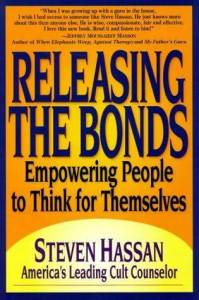
(This was taken from a book entitled: Releasing The Bonds – Empowering People to Think for Themselves by Steven Hassan).
Shunning and Suicide

Shunning, one of the most abusive practice of high-pressure groups, is often the most obvious sign that a group is abusive. It tears families and communities apart, forcing many to choose between their faith and their loved ones. Whether it is called Shunning, Disconnection, Ostracism, or De-FOOing, the harsh reality of alienation ensures that those who leave the group are cut off absolutely, often losing their entire community – friends, relatives, and their complete support system.

For one woman in Michigan who had left the Jehovah’s Witnesses, the strain of losing her community was too much, and, struggling under the weight of the shame her abusers had taught her to assume, she drowned the family dog and shot her husband and two adult children, before turning the gun on herself. According to family friends, Lauren Stuart and her husband had left the organization because their children wished to attend college – something the Jehovah’s Witnesses strongly discourage – and she wished to pursue a modeling career. Because she could no longer be a member of the group in good standing, former friends ignored her, looking the other way when seeing her in town, refusing to speak with her or acknowledge her presence. In a small community, such treatment can make life intolerable, and although the Jehovah’s Witnesses have claimed in court that shunning is a “personal choice” and never absolute, their own internal convention videos show a harsh reality, where parents are coached to ignore their own children if they are disfellowshipped.

Read more here: Open Minds Foundation

Leaving a Cult and Living with Purpose

About the Series

Flor Edwards was born into the apocalyptic cult Children of God. Throughout her childhood, she lived in 24 different locations preaching the cult leader’s narrative, which was: all of its members, like Flor, were “chosen” martyrs charged with saving the world from the Antichrist before a supposed apocalypse in 1993. When this date came and went and the world didn’t end, Flor went from anticipating death to facing the possibility of life.

In this eye-opening series, you’ll learn what it was like for Flor to grow up in the confines of a cult and how its narrow constructs initially shaped her beliefs about life, love, and relationships. You’ll discover what it was like to leave the only world she’d ever known after the cult disbanded, and how she navigated the tricky road of reconstructing her belief system as a teenager. Above all, you’ll understand how she faced the mental health impacts that resulted from each stage of her journey.

Unlike most media coverage of stories like Flor’s, this series doesn’t sensationalize. It educates. Flor’s journey is extraordinary, but it’s relatable. We all have obstacles to overcome and the ability to learn from them in order to create the life that we want, just like Flor has. Flor has rewritten her narrative since leaving the Children of God. This series provides real insight into this authentic narrative – not the one sensationalized by most media outlets.

View the video here

Cult Mentality

When the majority think of a “cult” they tend to focus more on religious orders. A cult can develop when a group of any kind is formed such as: “friends”, a performance group, a spiritual group etc.

You could happily be a member of a group and not realize you are gradually becoming more under the control of a particular person.

I found this article informative as it shows the type of personality to look out for in any group where there is a leader:

Cult members are “focused on a living leader to whom members seem to display excessively zealous, unquestioning commitment.” The leader is a strong-willed, domineering character who rules the group with tight control. He lets it be known in subtle ways that he is in charge of the movement. He makes the plans, he orchestrates the movements of the group or groups (sometimes he exercises his sway over several groups). He dispatches the workers, assigns their chores, etc.

Questioning, doubt, and dissent are discouraged,” and there can be pressure or social punishment when there is disagreement with the “boss.” Those who disagree are made to feel as though they are stupid or inept. They are brainwashed with the notion that they do not have the knowledge or experience to question the leader. Younger people are particularly vulnerable to the leader’s gift of gab, and his feigned expertise. No matter how radical the leader becomes in his decisions or actions, the cult members will not criticize him. Even if there should be mild disagreement, no specific expressions are voiced. The members reason that though he may be mistaken in some of his judgments, yet the overall good he accomplishes outweighs any minor flaws.

Members are taught to “rationalize” the conduct of the leader in matters they have always “considered unethical before,” under the guise that the “end justifies the means.”

The cult leader always takes the major credit for the movement’s accomplishments. Members become psychologically dependent upon him. “What would we ever do without our leader?,” is the cult mentality.

The cult leader generates within his members “a polarized” mentality. His people evolve an us-versus-them outlook. Little by little, he criticizes other groups with which his members might tend to associate, undermining confidence in them, attempting to discredit anyone who could have influence over his flock.

An abusive person seeks to isolate the victim and make them a carbon copy of themselves by dismissing any criticism or dissent and demanding that followers or partners think like them and offer support for unacceptable acts under the guise that it benefits the group.  An inability to accommodate difference and rage at those who challenge or question unethical conduct is also used to make members tow the party line and mirror the values of the leader as good despite the reality that the consequences are often harmful to the followers.

Such people and groups are dangerous as they prey on the vulnerable to build personal assets and a faulty sense of strength and power by dominating and crushing all opponents as weak. Thinking that people can know people better than they know themselves has been the basis of analysis; however, many analysts have blind spots and react with rage to justified criticism by their patients who challenge their interpretation as projection or wrong.

Beware any leader whose ego blocks him or her from being responsible for mistakes or unacceptable behaviour and instead tries to blame the victim for daring to point out his weakness or mistake. Be wary of any group that exploits its members and makes false promises or claims power or knowledge while behaving like a mad or bad man.”

If you find this behaviour in a group of people you associate with it would be wise to extricate yourself (even though this will be difficult) before any serious damage is done.

Read more here

Psychology of Cults