The Cultural Story Behind Family Estrangement

by Rachel Haack MA MFTI
1. Postmodernism and Critical Theory in the Family System

Postmodernism taught us to question authority and dismantle universal truths. Critical theory taught us to look for oppression and power in every relationship. Both were useful lenses at first, until they became the only lenses.

Today, these frameworks have trickled all the way down into the family, where dynamics are no longer just relational but political.
Parents are recast as oppressors. Children as liberators. Love becomes suspect, and forgiveness looks like betrayal of the self.

Books like Adult Children of Emotionally Immature Parents and online influencers preaching “go no contact” have popularized this moral framework of hierarchy and harm. Once you interpret ordinary imperfection through a lens of oppression, the only moral response becomes disconnection.

2. Social Contagion and the Amplification of Ideas

Before smartphones, ideas spread through communities slowly: by conversation, print, and lived experience. Now they spread virally, without friction or context.

We’ve seen social contagions before: diagnostic trends like “multiple personality disorder” in the 1980s or the surge of “recovered memories.” Today, similar dynamics are playing out around “toxic parents,” “narcissistic mothers,” and “cutoff as healing.”

On TikTok and Instagram, creators share stories of liberation from their families, often rewarded with validation and applause. The more sensational the story, the more viral it becomes. And soon, estrangement itself, especially “no contact”, becomes not just a coping choice but a cultural script.

3. The Portable, Always-Connected World

In 1960, a college student might have called home once a month (collect!).
Letters were the norm. Distance was assumed. Love wasn’t measured in response time.

Now, the digital tether has changed our expectations entirely. Parents and adult children can be in contact multiple times a day, and when they’re not, it feels like something’s wrong.

This 24/7 accessibility has raised the relational temperature for everyone. We’re over-connected, overstimulated, and overwhelmed. Most adults are managing hundreds of micro-relationships through text, email, and social media. The guilt of not keeping up, of failing to “stay in touch”, becomes exhausting. And sometimes, that guilt turns into avoidance or conflict.

We’re living in what I call the age of too much para-connection, where everyone feels both crowded and lonely.

4. Concept Creep, Safetyism, and the Pathologizing of Discomfort

Over the past decade, psychological language has exploded into everyday conversation. Words that once had clinical meaning: trauma, abuse, narcissism, gaslighting, boundaries – are now used casually to describe any form of emotional pain or frustration. Psychologists Nick Haslam and Jonathan Haidt have called this phenomenon concept creep: when the definitions of harm and trauma expand to include ordinary stress, discomfort, and disagreement.

At the same time, a new cultural ideal has emerged, what Haidt and Greg Lukianoff call safetyism. Safety, once meaning freedom from physical danger, now includes freedom from emotional discomfort. To be “safe” means to never feel hurt, anxious, or misunderstood.

This shift sounds compassionate, but it has quietly redefined what we consider harmful. Normal friction in relationships: differences in temperament, misunderstanding, conflict, even the enduring “perpetual problems” that exist in every long-term bond – are now reinterpreted as forms of emotional danger.

When discomfort itself is seen as harm, repair begins to look like self-betrayal. Rather than learning tolerance for relational tension, we pathologize it. And soon, the ordinary pain of loving another imperfect human being starts to feel like something we must protect ourselves from, rather than something we can grow through.

5. The Reinforcement Loop: How Therapy Culture Confirms the Cutoff

This new sensitivity to harm is reinforced by the professionals and influencers shaping our public conversations about relationships. The dominant narrative says that no one cuts off contact with a parent without perfectly good reasons. The logic goes like this: because estrangement feels so unthinkable, it must also be justified.

Therapists and creators often tell their audiences, “You’ve done everything you could,” or “No one goes no contact lightly.” The implicit message is that disconnection is the only rational or healthy conclusion to a long-standing relationship problem.

In clinical spaces, this message is amplified by a moral pressure that runs deep in the helping professions. To challenge a client’s decision to cut off contact is framed as “causing harm.” To explore reconciliation is seen as enabling abuse. Therapists are warned that if we don’t affirm a client’s self-protective decisions, we risk becoming “excusers of abusers.” I receive messages such as “Yikes. This is dangerous.” to an instagram post addressing the nuance of estrangement.

Naturally, that strikes fear into the heart of any well-meaning clinician who wants to do right by their client. To imagine that our empathy could itself cause harm is paralyzing. And so, out of caution, many practitioners stop short of exploring repair or differentiation, even when disconnection may be premature or unnecessary.

What results is a therapeutic culture that affirms estrangement as inherently empowering: but rarely asks whether empowerment might also come from growth, dialogue, or courage in the face of discomfort.

6. The “Pure Relationship” and the Consumer Self

Sociologist Anthony Giddens coined the term the pure relationship—the belief that a relationship’s legitimacy depends on emotional satisfaction alone. It should be warm, mutually beneficial, and affirming at all times.

That idea, combined with our culture’s obsession with optimization, has quietly reshaped our relational ethics. We now evaluate our relationships the way we evaluate products: Does this still serve me? Does this make me happy?

When something feels hard, the impulse isn’t to repair, it’s to replace.
We live in a hyper-individualistic, portable, meritocratic, consumer world. We can move cities, change jobs, and find new communities with a swipe. The result is a growing inability to tolerate the inevitable discomforts of enduring relationships: the very tensions that make us grow up, soften, and mature. We don’t have to learn to live within our village: we can find a new one instead.

Estrangement, in this context, isn’t just a breakdown of love; it’s the logical conclusion of a culture that has made comfort and self-expression the highest virtues.

7. Luxury Beliefs and the New Village of One

Sociologist Rob Henderson coined the term luxury beliefs to describe ideas that signal social status but often carry hidden costs for others. In this context, the belief that cutting off “toxic” family members is always healthy functions like a luxury belief: it’s most easily embraced by those who can afford to lose their families and replace them (often with paid support networks).

Many modern cutoffs occur in families with greater resources, where autonomy is financially feasible. Our standard of living has made it possible to outsource almost every form of relational interdependence. We no longer need the messy village of extended family to survive; we can simply hire one.

If our in-law is irritating, we can pay for childcare.
If our mother’s help feels overwhelming, we can hire a postpartum doula.
If a relationship feels complicated, we can opt for convenience.

In this way, affluence enables avoidance. It allows us to curate our social lives around comfort and control rather than tolerance and reciprocity. The more economically independent we become, the less dependent we are on the people who stretch us.

And sometimes, that independence itself is a gift handed down from the very family being rejected. Many of the young adults now severing ties with parents do so after those same parents helped fund their education, co-signed their first lease, or quietly absorbed the cost of early adulthood. The support that made autonomy possible is later reinterpreted as control. Once financial reliance ends, the relationship can be rewritten through the language of freedom: They can’t control me anymore.

It’s a striking irony of privilege—the estrangement enabled by security. When you no longer need your family to survive, you also lose the incentive to work through what makes them difficult. And so, we drift further into what might be called the luxury of disconnection—a life where we can meet nearly all our needs without ever having to practice forgiveness, patience, or repair.

8. So What Do We Do With All This?

It’s easy to feel overwhelmed by all of this, to feel like you’re standing in the tide of something too large to resist. You can’t fight the world. You can’t change a culture on your own. You can’t go to battle against the zeitgeist without burning out in despair.

So here’s what I suggest: When things feel big, focus on the small.

You don’t have to fix the world. What we can do is adapt: by creating small, consistent acts of connection with those closest to us. Reorient to your values and live them out in the relationships right in front of you.

If you’re disheartened by the fact that we live in an individualistic, portable, meritocratic, consumer world, start by noticing where that shows up in your own relationships. Begin to reclaim the village around you.

  • Can you stay in relationship when it’s hard?
  • Can you practice forgiveness even when it isn’t reciprocated?
  • Who are you quick to write off—and who might you reach out to instead?

Nobody changes by being lectured into connection. We learn by observation and osmosis. Culture shifts not through argument, but through example.

So ask yourself:

  • Am I making it easier or harder for people to connect with me?
  • Do people feel seen in my presence?
  • Is there one small thing I can do differently in this relationship today?

That’s how change happens—not through revolution, but through micro-shifts. We don’t have to fix a generation or a cultural moment. We just need to live our values with quiet conviction in a world that spins around us.

Because while you can’t stop the tide, you can build something steady enough to stand in it.

 If this resonated with you, share it with someone who’s also trying to make sense of our disconnected age. The more we talk about it—and live differently inside it—the more repair becomes possible. Also, please consider becoming a paid subscriber, as it allows me to keep offering my articles for free to those in need. Thank you!
Substack.com

Confabulation and False Memories

by Web MD Editorial Contributors, Medically Reviewed by Smitha Bhandari MD

Image – Sydney Criminal Lawyers

No one’s memory is 100% percent accurate, but some people make many memory errors. They believe in the accuracy of these faulty memories and can be convincing when talking about them. This is what scientists call confabulation. Some brain conditions can cause these errors in memory.

What Is Confabulation?

Confabulations are usually autobiographical, involving people misremembering their own experiences. Sometimes they place experiences in the wrong time or place. They may wrongly recall other details, large or small. Occasionally confabulations have little basis in reality. Details can be drawn from movies, television, and overheard conversations.

Of course, people with no brain disorders can have faulty memories. Normal mistakes in memory become confabulation when people remember false information in vivid detail, often claiming to relive the event. They may exhibit genuine emotions, such as grieving over a friend who has not died. Listeners often believe what they are hearing is true. 

What Confabulation Is Not

Confabulation is not lying. Confabulation differs from other forms of falsehood. Confabulators have no reason to tell a lie and don’t realize that they’re not telling the truth. Their brains simply filled in some missing spots with false information. Some people have called this “honest lying”.  

Confabulations are not delusions. Both involve false beliefs, but confabulation almost always involves a memory, while delusions are less anchored in the real world. Delusions occur mostly in psychiatric disorders such as schizophrenia. Confabulation is more common in brain disorders such as dementia.

Two Kinds of Confabulation

Confabulations can be either provoked or spontaneous. They’re provoked if they occur in response to a question. The person may feel compelled to answer even if they don’t know what to say. They’re spontaneous if they’re offered voluntarily. Spontaneous confabulations are usually less believable and might be fantastic or bizarre. 

Conditions Linked to Confabulation

Confabulation is caused by brain damage or poor brain function, but researchers are unsure which parts of the brain are at fault. The frontal lobe or the basal forebrain may be involved. Confabulation occurs with several brain disorders. These are some of the most common. 

Wernicke-Korsakoff syndromeConfabulation was first studied by a Russian psychiatrist, Sergeievich Korsakoff. He noticed that his clients who overused alcohol often had faulty memories. He gave his name to a condition that occurs with an alcohol use problem. Wernicke-Korsakoff syndrome is caused by a vitamin B1 deficiency.

Alzheimer’s disease. Those with Alzheimer’s disease experience a range of symptoms. Delusions, such as believing that someone is stealing from them, are common. Provoked confabulations are common in early Alzheimer’s. Spontaneous confabulations can become a serious problem if the person with Alzheimer’s acts on their mistaken beliefs.

Traumatic brain injury. A blow to the head can cause problems in thinking and memory. Confabulation can be a special problem for those with traumatic brain injury. They may misreport events leading up to the injury or make mistakes about other important details.

Fetal Alcohol Spectrum DisorderExposure to alcohol in the womb can cause a person to have a variety of brain problems, including confabulation. Often those with fetal alcohol spectrum disorder are suggestible and eager to please. These characteristics can make them likely to create false memories.  

Can Confabulation Be Treated?

Confabulation won’t go away unless the underlying condition is addressed. Doctors can treat some conditions. For example, Wernicke-Korsakoff syndrome is treated with vitamin B1. Other conditions lack effective treatments.   

Those who live or work with confabulators can reduce problems by using strategies such as these:

  • Minimizing distractions
  • Avoiding leading questions
  • Allowing extra time for processing
  • Reducing stress
  • Using simple language
  • Checking to see if they understand

Some confabulators can be taught how to monitor themselves. Memory aids can help. They can keep memory diaries so they don’t feel pressure to remember everything.

Results of Confabulation

For the self. Confabulation performs several functions for those who do it:

  • It lets them make sense of their situation.
  • It enhances their sense of self.
  • It makes them relevant in the world. 

For family members. Dealing with confabulation can make family members frustrated, angry, or sad. They should remember that their relative is not being untruthful on purpose. A support system is vital for those who confabulate. They may give inaccurate information in a variety of situations. Family can be a part of that support system. 

In the legal system. Individuals who confabulate can make false confessions and give false testimony. Although they are not lying on purpose, the results can be serious. Those who interview people with certain brain disorders should understand confabulation. They should avoid long interviews, suggestive questions, and other techniques that could cause the subject to give false information.

Webmd.com

Is Social Media Enabling Liars?

by Jean Kim M.D.

Image – Crenshawcomm

The expansion of the Internet and social media has led to an exponential democratization of voices and content directly reaching the public. People have risen to stardom, or at least have even made a living with little more than a GoPro camera and a steady following on YouTube or Instagram.

Unfortunately, with easy access and the pressure for instant gratification and rapid-fire content has come a potential lowering of standards as well; the “gatekeepers” who vetted content in the past are absent, leading to a proliferation of toxic material on the web such as hate speech, fake news, and the worst, live streaming murders. We have stretched liberty and freedom of speech to its very edges, with destructive consequences.

Aside from the aforementioned extremes, there has also been a steady proliferation of “milder” transgressions: people who have taken advantage of the easy spread of misinformation and instant audiences to self-promote exaggerated stories or versions of themselves for attention and fame.

There have been several notorious tales of con artists in various industries building audiences quickly until the truth blows up. In the world of writing, a particularly rich habitat for Internet communication, there was the story of Anna March, a “literary grifter” according to an article in the LA Times by Melissa Chadburn and Carolyn Kellogg, who built up a following in Facebook groups of women writers and created an image of being a successful and established freelance writer, based on one or two fortunate breakthrough clips. She set up writers’ retreats in fancy locales like Italy, most of which mysteriously fell through, and offered editing services with steep fees, also most of which mysteriously fell through. She particularly utilized the role of being a voice for marginalized groups and recruiting vulnerable and ambitious writers accordingly.

There was also the male poet who entered and won a major writing prize by pretending to be an Asian woman with his pseudonym Yi-Fen Chou, stolen from a high school classmate’s name. And more recently, in a more disturbing turn, the New Yorker profiled (and ironically enhanced the fame) of a higher stakes grifter Dan Mallory, who regularly lied to his publishing colleagues about dying relatives and other tall tales for pity, while successfully writing and publishing a blockbuster thriller soon to be a Hollywood movie, to the tune of big bucks. Beyond the ease of the social media world, he went the conventional gatekeeper route and still came out ahead due to the trappings of privilege and his ability to play the popular role of the preppy haute society artist.

Not so lucky was Anna Delvey, who rode the wave of her unspecified Europeanness into high society and almost into a $22 million loan, until she was caught and jailed. On the luckier side, one of her victims who she ripped off for $60,000 is now going to make it all back and then some by writing a memoir and selling it to Netflix.

There have been both events that catch fire on the interwebs: people who have been attacked horrifically on viral videos, and people who have faked racist receipts from imaginary waiters for attention while other authentic ones inspire outrage. In any case, the nature of truth becomes murky while indignation and emotions are set off.

Con artists have been and will be around forever, but they seem to be proliferating in the unchecked opportunities that the Wild West of the Internet provides. The key is to proceed with caution; everything we read and respond to, designed to tug at our instant emotions and instincts, needs to be viewed with a skeptical eye. But we also should not blame ourselves too harshly if we do fall prey to these fabulists; their talent is to know what the human heart responds to; we cannot help our nature sometimes, and they know that best.

Psychology Today

When Former Spouses Manipulate Their Children

It is a common situation when a couple divorce and the split is far from amicable that a former spouse informs others the whole marriage was a terrible experience, the other partner had ‘mental health issues’ and continue to spread malicious lies. Their agenda is to turn their family and mutual friends against the partner and come out of it as the ‘good guy’. Some will even go as far as to seek out and collude with former partners ‘fake friends’ and enemies of their ex, to give extra credence to their lies and make them more believable.

There are warning signs however when meeting a prospective partner that are not to be ignored. If for example you meet someone who describes all his ex- female partners as ‘mentally ill’ or ‘mad’, there is a high possibility that one day if your relationship ends, he will describe you in exactly the same way. He will also attempt to convince any children from the relationship to view you in this way too, and if the child wishes to keep in with their father (particularly if they have a similar personality and the father is provides financial benefits) they will please him by treating you in the same way.

The following article explains how this can happen:

Understanding Why An Ex Is Spreading Misinformation About You

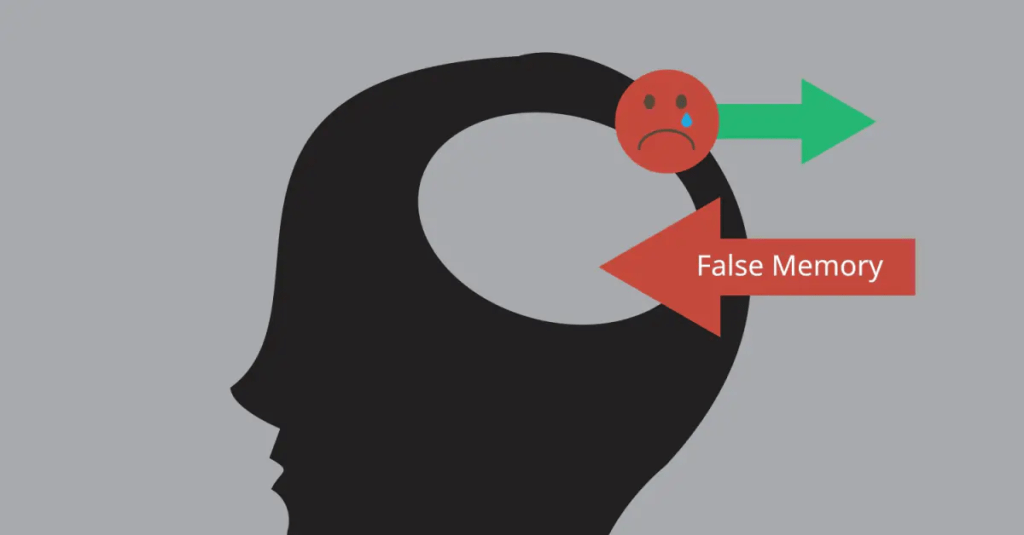
Former partners can also brainwash their children and introduce ‘false memories’. For example,  a child who was well cared for, loved and nurtured by their mother could be influenced by a bitter father, who will brainwash the son into thinking he had an awful childhood and even when the child becomes an adult, they will in turn spread these false memories to their friends and family that will back up their father’s false claims. If the mother visits the adult child (for example to support them in a creative project ) and the friends they have fed the lies to are also there, they could be cruel to the mother in order to drive her away, as her kindness will cause doubt on the lies they are spreading. The adult child will cut off all contact with the mother and cite the reason for her absence is because she is ‘bad’ which is far from the truth.

The adult child could continue lying throughout their life as they were taught it is right to do so by the parent.

The following article explains this further:

Divorced Parents Who Pit Their Children Against Former Partners Guilty of Abuse