There are however a variety of opinions on this matter which I have researched. In this post I have included the opinions of Psychologists, a Psychic Author and a Healer.

Psychology Today – C.L. Davey Ph D

There are however a variety of opinions on this matter which I have researched. In this post I have included the opinions of Psychologists, a Psychic Author and a Healer.
Psychology Today – C.L. Davey Ph D

Autism is a widespread condition and I have clients, friends and family who have been affected by this condition. Researching this subject and how to deal with the individuals affected can assist in coping with difficult relationships. Read more here:

The following article is written by the mother of a son with Aspergers. High Functioning Autism and I am sure many can relate to this:
“There is a dark side to raising a child with these challenges. My son’s honest expressions can be downright mean. He will say that I am lazy. He will say that I don’t ever do anything. He will say that I am selfish or a hypocrite. Of course, he is a teenager and I am sure from his narrow perspective what he says is truth.
Meltdowns are more frequent now than in the past. The physicality associated with his meltdowns now reminds me of when he was 3, more than when he was 10. These meltdowns are more disturbing and scary in the body of a 5’11” young man than they were in a small child. The glimmers of the sweet boy I remember are few and far between.
There are a lot of aspects of life that we as humans do not include in the stories we pass down. We don’t talk about the messier and darker aspects of common life occurrences. A great example is our tendency to remain silent on the terrifying nature of postpartum depression and psychosis. We don’t want to admit that even the most joyful parts of life can come with a dark lining.

As a parent of an Aspergers child, I live in a strange world. Strangers do not understand and even from friends and family there can be a lot of judgment. I have been told that I am not consistent enough with my son. I have been told that I am not disciplined enough. Even when there is no overt comment, there is the change in body language, tone of voice and the distancing by people who are affronted by my son.
On the other hand, my son judges me as inadequate, unfair, lazy and hypocritical. He expresses hatred for the help that I sacrifice to give him. I stand in the middle making the decisions as best I know how. This is an emotionally draining position.
My NT son sees all of this and so he asks if I regret having my Aspergers Son.
“No!” I responded without hesitation, “Raising him is challenging and there are times that he can be such a jerk but I have learned so much about myself and life through this process. I have learned to look beyond the external and set aside a lot of my preconceived judgments. I have learned to make my decisions based on who I am and who I want to be, not based on what that decision will get from others in the way of approval, acceptance, etc. It has made me so much stronger. I am proud of the person I have become and if this is the road that it took to become this person, well that is fine. I love him because he is my son, not because of what he can give me and I believe that he is an amazing person traveling his own tough road.”
That statement reflects the decision I have made. I don’t always feel the feelings that would inspire that statement therefore I don’t despise the mother that said she hated her son. I am thankful that my NT son didn’t ask me 20 minutes earlier. I don’t know that I would have regained my balance enough to answer the way I did. Just because I don’t act on the dark moments doesn’t mean they don’t exist.
My Aspergers son is mismatched to the world we live in. It seemed that My son is the round peg to the outside world’s square hole. I thought I was accepting this fact.
I have realized that I my acceptance was conditional on a belief that I could fill in the gaps between the outside expectation and my son’s reality. I believed I could make the world accept my son and acknowledge his successes. I had a distorted perception of who I needed to be in my son’s life.
I can never do or be enough to make my son and the typical world’s expectations mesh. Accepting my limitations, opened a new path. Instead of seeing the world as rigid, I saw flexibility. As I expanded my view beyond the world of the public school structure, I could see the endless variations that our world allows. My role is to guide my son as he creates his path in this world and finds his purpose.
My Aspergers-son is an important part of my life, but he is not my whole life. I did not cease to exist when he was born. Additionally, there are other small lives in my care. The loudest need cannot drown out the other needs. My son and my typical children learn from how I live. How can I tell my son that I believe that he can be an independent adult and then do everything for him?
When I give my focus to the moment at hand, I honor all the parts of my life. My time with my husband is for him alone. My time with each of my children is sacred and preserved. The time I set aside for caring for myself is spent doing ONLY that. This is a practice I have yet to perfect but the practice alone has increased my self-awareness and increase the balance between the various aspects of my life.”
I deal with many clients who have this problem and when it occurs within your family, this article provides good advice on how to deal with it.

There are a few signs of narcissistic behavior that parents should watch out for:
Inflated ego: The narcissist has a huge ego. Narcissistic adult children demand that you do what they want, try to control you, and push every boundary. Every time you give them what they want, they demand something else. They say your job is to make them happy.
Need for validation: A narcissist needs constant admiration. Often, they need praise for simple tasks, like making an appearance at your birthday party. You may find yourself giving your narcissistic adult child an inordinate amount of praise over something that’s a normal and expected part of family life.
A sense of entitlement: The narcissist feels entitled to things they should have to work for. For example, they may demand ridiculous things like financial support well into adulthood. Or, tasks they should be doing themselves, but you find yourself performing…such as doing their laundry and folding their clothes, filling out their job applications, calling into work sick for them, or fixing their breakfast or lunch to take to work.
Exploitation: A narcissist acts without conscience, thinking only of themselves. They lie, trick and steal to get what they want. This exploitation can be glaringly obvious or very subtle, so be on the lookout if you feel used. This may manifest as their throwing temper tantrums, blackmailing you by withholding their love or your grandchildren, trying to entice you with sweetness and affection when they want something, and blaming their behavior on you.
Distorted thinking: A narcissist occupies a fantastical world where he or she is the greatest and most important person in the universe. In order to maintain the fantasy, narcissists lie. They often deny things that are obvious. They may make up fantastical tales to support the fantasy.
Unpleasant personality: Contempt and belittlement are the narcissists’ tools of choice. When they feel threatened by success, they get mean. Watch out for those who are constantly putting down other peoples’ accomplishments. You may find your narcissistic adult child talking badly about their friends behind their backs, but pretending to care for them when these same friends come around
Read more here:

Narcissistic personality disorder (NPD) is diagnosed when an individual exhibits a cluster of symptoms related to an elevated sense of self-importance or worth. Online narcissism refers to the emergence of these symptoms on the internet.
Many individuals on twitter and facebook believe the world should be interested in every aspect of their lives. Similarly, on writing and blogging websites, narcissists take advantage of the self-publishing platform to soothe their vulnerable egos, and it is this phenomenon that will be focused on here. The symptoms that manifest in someone suffering from NPD are varied, but often include:
These traits can be described as a dispositional defense mechanism. NPD develops over many years to cope with a vulnerability to psychological pain. NPD sufferers are remarkably insecure, and this persecution complex is strengthened when they are inevitably trolled online. Unfortunately, the trolling intensifies their detachment from the world, and perpetuates a need to comfort their bruised ego with further narcissistic behavior.
Read more here:
People with strong narcissistic tendencies are known for certain destructive social patterns. Anybody who has had the misfortune of dealing with these types of people may notice that whenever there’s a conflict or any type of disagreement, they tend to act in an abhorrent yet predictable manner.
In this article we will explore the common behaviors and scenarios where narcissistic and otherwise toxic people (hereafter narcissists) play the victim and manipulate the narrative.
People with strong narcissistic tendencies are known for certain destructive social patterns. Anybody who has had the misfortune of dealing with these types of people may notice that whenever there’s a conflict or any type of disagreement, they tend to act in an abhorrent yet predictable manner.
In this article we will explore the common behaviors and scenarios where narcissistic and otherwise toxic people (hereafter narcissists) play the victim and manipulate the narrative.
Narcissists can’t deal with reality because it contradicts what they want to be true, and this creates painful emotions. As a coping mechanism, they learn to delude themselves that what is real is actually not real, and however they see the situation is real, even though it isn’t.
Sometimes they truly see it that way. Other times it’s just a story they tell themselves and others. And often the longer you tell a story, the more you believe it, even if initially you know it’s not true. And so eventually they may start truly believing it.
Either way, the first step is to create a version of events that is an alternative to what actually happened or what’s going on.
While delusion is more of an internal process, lying and denial is often in the context of other people.
Regular people deal with their problems by themselves, internally. Or they discuss it in a very private setting: in therapy or among very close, healthy people. Narcissists don’t have people like that in their life and are not really interested in actually resolving anything or being introspective.
Narcissists simply want to know that they are in the right. For that, they need other people’s false validation to regulate their shaky self-esteem. They need to find people who would agree with them. And in order for others to agree with them, these other people either need to be terribly unhealthy and unable to recognize their toxic tendencies, or the narcissist needs to lie and present a different story than what is actually true.
Here, they tend to flip the roles where they are good, noble, caring, virtuous and the other person is evil, cruel, selfish, and immoral. Which brings us to the next point….
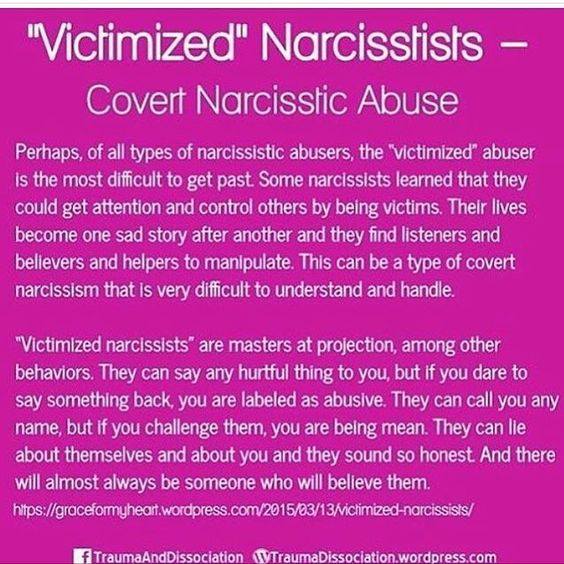
The most common way narcissists create alternative narratives is by projecting. We’ve talked about narcissistic projection in a separate article but to extract the main point, narcissists love to project.
If they say that the other person is jealous of them, then you know that the narcissist is jealous. If they say that the other person was cruel to them, then you know that the narcissist was cruel to the other person. If they say that the other person was lying and cheating, then you know they were the one lying and cheating.
Yes, sometimes it’s not as simple and there could be unhealthy behavior on both sides, but more often than not whatever the narcissist is presenting the other person as is a much more accurate description of the narcissist.
Whatever the case may be, the mechanism here is that in the narcissist’s mind they try to attribute their own unhealthy behavior, perspective, and character traits to the other person because it shifts attention and responsibility from them. And if the other person “is” all these bad things then it can’t be that I am these things—thinks the narcissist—I’m the good guy here.
Read more here:
Darious Cikanvicius – Psych Central
In 1993 I attained a certificate as a Counselor for survivors of child sexual abuse with Family Matters. This helped me gain more knowledge on the subject and gave a deeper insight into my own childhood. I also understood the reason I was over-protective with my own children and the obsession to keep them safe during childhood.
I have also participated in campaigning work for a U.S. organization against abuse within religious cults. Silentlambs
I hope the following information helps those of you that have experienced any of the issues raised in this post.

The words “child abuse” are likely to conjure up horror stories that appear from time to time – physical beatings, a child locked in a closet or tied up for long periods; or the unimaginable – like Ariel Castro’s imprisonment of young girls.
In fact, abuse takes many forms, beyond the physical. Recent research finds that its impact is long-lasting. It extends far into adulthood, where it affects both physical and mental health.
As Faulkner wrote: “The past is never dead. It’s not even past.”
This same study, combined with the findings of some other recent research, contains hopeful signs for healing and healthy growth following early abuse.

Read more here:
Childhood sexual abuse is a subject that has received much attention in recent years. Twenty-eight to 33% of women and 12 to 18% of men were victims of childhood or adolescent sexual abuse (Roland, 2002, as cited in Long, Burnett, & Thomas, 2006). Sexual abuse that does not include touch and other types of sexual abuse are reported less often, which means this number of individuals who have been sexually abused in their childhood may actually be greater (Maltz, 2002). With such a high percentage of people having experienced childhood sexual abuse, it is likely that many people seeking therapy will have histories that include sexual abuse. It is imperative that counsellors are aware of and familiar with the symptoms and long-term effects associated with childhood sexual abuse to help gain a deeper understanding of what is needed in counselling. This paper will define childhood sexual abuse and review the impact it can have, explore the long-term effects and symptoms associated with childhood sexual abuse, and discuss counselling implications.
Read more here:

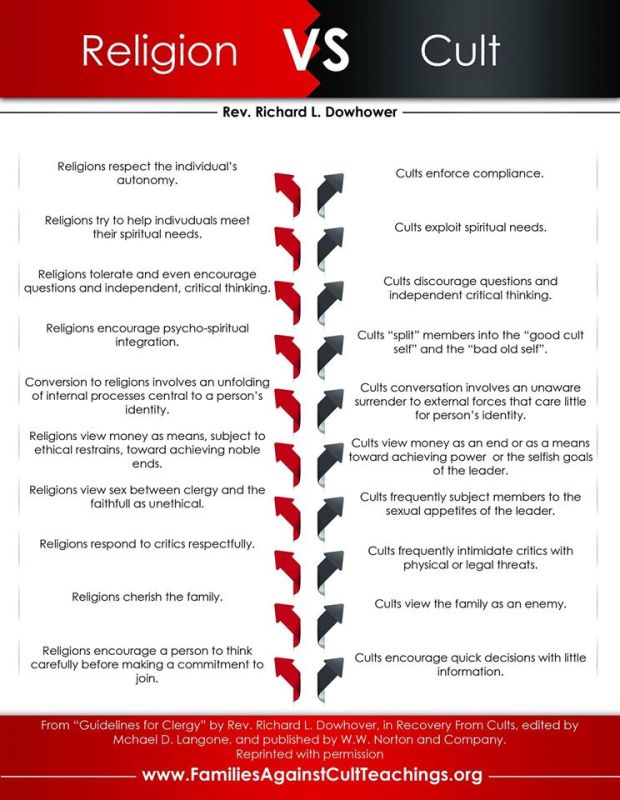
There is much variability in the thousands of groups associated with the term cult, although in general the role of the leader becomes central in the cult family. The leader takes on the role of father and/or mother, deciding how children will be raised. Parents function somewhat as middle managers in the rearing of their children.
New England Institute of Religious Research.
A cult is a group or movement exhibiting a great or excessive devotion or dedication to some person, idea, or thing, and employing unethically manipulative techniques of persuasion and control designed to advance the goals of the group’s leader, to the actual or possible detriment of members, their families, or the community.
Cult Identification List -this will give you a ‘check list’ of what to look out for when joining a group.
These groups tend to dictate, sometimes in great detail, how members should think, act, and feel, claim a special exalted status for themselves and/or their leader(s), and intensify their opposition to and alienation from society at large.
Because the capacity to exploit human beings is universal, any group could become a cult. However, most mainstream, established groups have accountability mechanisms that restrain the development of cultic subgroups.
Cult-education organizations have received inquiries about more than 3,000 groups. Although the majority of groups are small, some have tens of thousands of members. Experts estimate that five to ten million people have been involved with cultic groups at one time or another.
Mind control (also known as “brainwashing,” “coercive persuasion,” and “thought reform“) refers to a process in which a group or individual systematically uses unethically manipulative methods to persuade others to conform to the wishes of the manipulator(s). Such methods include the following:
extensive control of information in order to limit alternatives from which members may make “choices”
deception
group pressure
intense indoctrination into a belief system that denigrates independent critical thinking and considers the world outside the group to be threatening, evil, or gravely in error an insistence that members’ distress-much of which may consist of anxiety and guilt subtly induced by the group-can be relieved only by conforming to the group
physical and/or psychological debilitation through inadequate diet or fatigue the induction of dissociative (trance-like) states via the misuse of meditation, chanting, speaking in tongues, and other exercises in which attention is narrowed, suggestibility heightened, and independent critical thinking weakened
alternation of harshness/threats and leniency/love in order to effect compliance with the leadership’s wishes isolation from social supports pressured public confessions
Contrary to a popular misconception that cult members are “crazy,” research and clinical evidence strongly suggests that most cult members are relatively normal. They include the young, the middle-aged, elderly, the wealthy, the poor, the educated, and the uneducated from every ethnic and religious background. There is no easily identifiable type of person who joins cults.
After converts commit themselves to a group, the cult’s way of thinking, feeling, and acting becomes second nature, while important aspects of their pre-cult personalities are suppressed or, in a sense, decay through disuse. New converts at first frequently appear to be shell-shocked; they may appear “spaced out,” rigid and stereotyped in their responses, limited in their use of language, impaired in their ability to think critically, and oddly distant in their relationships with others. Intense cultic manipulations can trigger altered states of consciousness in some people.
People leave for a variety of reasons. After becoming aware of hypocrisy and/or corruption within the cult, converts who have maintained an element of independence and some connection with their old values may simply walk out. Others may leave because they are weary of a routine of proselytizing and fund-raising. Sometimes even the most dedicated members may feel so inadequate in the face of the cult’s demands that they walk away because they feel like abject failures. Others may renounce the cult after reconnecting to old values, goals, interests, or relationships, resulting from visits with parents, talks with ex-members, or exit counseling.
People who consider leaving a cult are usually pressured to stay. Some ex-members say they spent months, even years, trying to garner the strength to walk out. Some felt so intimidated they departed secretly.
Although many cult members eventually walk out on their own, many, if not most, who leave cults on their own are psychologically harmed, often in ways they do not understand. Some cult members never leave, and some of these are severely harmed. There is no way to predict who will leave, who won’t leave, or who will be harmed. ?
Adapted from: Cults Questions and Answers, by Micahel D. Langone, Ph.D.Copyright AFF, 1988
Leah Remini’s interview about the inner workings of Scientology
The following documentary was released in November 2018 by Leah Remini who was reasearching Scientology and Jehovahs Witnesses and the effect it has upon their former members
There is also a Facebook Link to this video

When the majority think of a “cult” they tend to focus more on religious orders. A cult can develop when a group of any kind is formed such as: “friends”, a performance group, a spiritual group etc.
You could happily be a member of a group and not realize you are gradually becoming more under the control of a particular person.
I found this article informative as it shows the type of personality to look out for in any group where there is a leader:
“Cult members are “focused on a living leader to whom members seem to display excessively zealous, unquestioning commitment.” The leader is a strong-willed, domineering character who rules the group with tight control. He lets it be known in subtle ways that he is in charge of the movement. He makes the plans, he orchestrates the movements of the group or groups (sometimes he exercises his sway over several groups). He dispatches the workers, assigns their chores, etc.
Questioning, doubt, and dissent are discouraged,” and there can be pressure or social punishment when there is disagreement with the “boss.” Those who disagree are made to feel as though they are stupid or inept. They are brainwashed with the notion that they do not have the knowledge or experience to question the leader. Younger people are particularly vulnerable to the leader’s gift of gab, and his feigned expertise. No matter how radical the leader becomes in his decisions or actions, the cult members will not criticize him. Even if there should be mild disagreement, no specific expressions are voiced. The members reason that though he may be mistaken in some of his judgments, yet the overall good he accomplishes outweighs any minor flaws.
Members are taught to “rationalize” the conduct of the leader in matters they have always “considered unethical before,” under the guise that the “end justifies the means.”

The cult leader always takes the major credit for the movement’s accomplishments. Members become psychologically dependent upon him. “What would we ever do without our leader?,” is the cult mentality.
The cult leader generates within his members “a polarized” mentality. His people evolve an us-versus-them outlook. Little by little, he criticizes other groups with which his members might tend to associate, undermining confidence in them, attempting to discredit anyone who could have influence over his flock.
An abusive person seeks to isolate the victim and make them a carbon copy of themselves by dismissing any criticism or dissent and demanding that followers or partners think like them and offer support for unacceptable acts under the guise that it benefits the group. An inability to accommodate difference and rage at those who challenge or question unethical conduct is also used to make members tow the party line and mirror the values of the leader as good despite the reality that the consequences are often harmful to the followers.
Such people and groups are dangerous as they prey on the vulnerable to build personal assets and a faulty sense of strength and power by dominating and crushing all opponents as weak. Thinking that people can know people better than they know themselves has been the basis of analysis; however, many analysts have blind spots and react with rage to justified criticism by their patients who challenge their interpretation as projection or wrong.
Beware any leader whose ego blocks him or her from being responsible for mistakes or unacceptable behaviour and instead tries to blame the victim for daring to point out his weakness or mistake. Be wary of any group that exploits its members and makes false promises or claims power or knowledge while behaving like a mad or bad man.”
If you find this behaviour in a group of people you associate with it would be wise to extricate yourself (even though this will be difficult) before any serious damage is done.
Read more here
 Taking The Helm