Suicide is newsworthy because life is precious. In 1993, a 6-year old girl living in Florida stepped in front of a train. She left a note saying that she “wanted to be with her mother” who recently died from a terminal illness.
This is the power of the human mind. A small girl thinks of the past and imagines a future that is so bleak, so devoid of meaningful moments without her mom, that she takes her own life. The same mental tools that distinguish us from other animals, the same mental tools that allow us to solve problems and produce creative works that give us symbolic immortality are the same tools that allow a 6-year old to contemplate a future that is terrible enough to physically leap into an oncoming train. If a 6-year old has the cognitive capacity to kill herself, then we need to step up our efforts to understand and prevent it from happening.
Understanding why people commit suicide and what is causing the need for such drastic measures may help you prevent a suicide attempt before it happens.
Bullying and Suicide
Bullying is ongoing aggressive or abusive behavior from one person or a group of people who harm and threaten another either physically or emotionally or both. Bullies come in many varieties and are not always physical in peer groups. Sometimes the popular or older adults band together to ostracize the person. Maybe they were once friends. They will pick on the person or ridicule them over social media such as Facebook and Twitter with harsh words and criticisms aimed at making them feel bad about themselves.
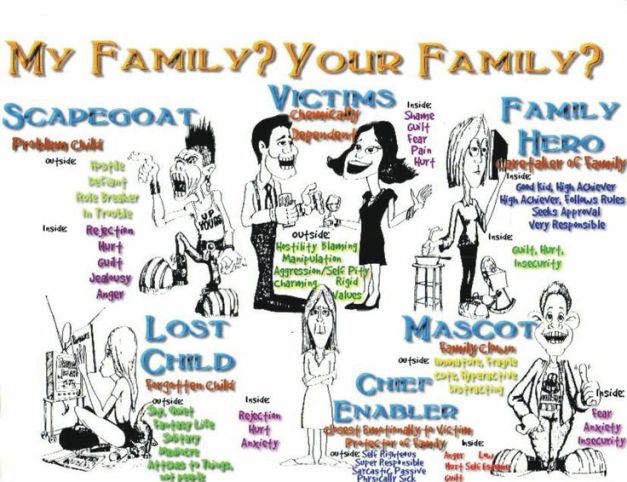
Can’t we all get along? That’s a tall order when your limelight has been snatched away by your adorable new little brother. Family, you love them and you hate them. There are so many things to consider when you think of family: there’s birth order, rivalries, the only child, to name a few.
So what is a functional family? How do we know if we have one? How would you define a functional family?
Were you considered the responsible child while your younger brother or sister was the rebel or ‘Mummy’s little one’? According to experts as children we all played a specific role in our family, although which role was not always within our control. It may be due to gender, family culture or the order in which we were born. However the legacies of being the model child or the baby may continue to help or haunt us in our adult lives and understanding these silent family agreements can help us break behavioural patterns which could at times be disabling. Flavia Mazelin Salvi explains the four different roles:
In the workplace as a young woman of 17 years of age, I witnessed and experienced sexual harassment of women by men. When I consulted mature women in the workplace, I was advised to ‘turn a blind eye’ if you wished to keep your place of employment. There have been occasions when I have spoken out and lost employment or friendships.
In my social and performance life, I have also spoken out about ‘sexist’ behaviour and sexual harrassment only to be the target of aggression by the guilty party who then created false rumours to divert the attention away from themselves.
This is a widespread problem for women and also one of the reasons clients consult us.
Image – Counselling
If you’re interested in sexuality, consider the following scenario. It’s a COMPOSITE of various situations that recur at conferences and other large gatherings. It’s particularly important that people interested in progressive politics and gender relations work this out. Again, this is a COMPOSITE–the way therapists write about cases, changing some details and adding others.
A while back I attended the national conference of a large progressive organization. It was well-organized, stimulating, and fun. The people were mostly energetic, interesting, and friendly; it was a good mix of ages, sexual orientations, and divided almost 50/50 male-female.
I was eventually asked, as a sex therapist, what I thought about Sexual Harassment. Apparently a couple at last year’s conference had approached a particular woman in her mid-30s. Eventually “Mary & John” handed the woman their card—suggesting quite clearly that they were “open” to “adult activities.”
The woman didn’t want to share this kind of fun, which of course is perfectly fine. But she was somehow “offended,” which is unfortunate. In fact, the woman felt that this invitation constituted Sexual Harassment, and she complained. Dissatisfied and emotionally distressed, this previously loyal movement member blogged about it, urging her female readers to stay away from the organization. Now the word is out to younger progressive women—don’t go to this group’s conferences.
So the leadership of said organization is scurrying around, trying to figure out what to do. “About what?” I asked. Apparently,
* Some people want a policy on Sexual Harassment * Some people want a zero-tolerance policy on Sexual Harassment—one COMPLAINT and you’re out * Some people want to issue a statement about the organization’s policy on Sexual Harassment * Some people want to persuade this woman to attend next year’s conference * Some people want to persuade this woman to stop trashing the organization
For someone who didn’t want one kind of attention, this woman has certainly managed to get plenty of another kind of attention.
This woman—and the more intimidated members of the organization—need a history lesson. In the Bad Old Days, people—men—with institutional power (professors, bosses, doctors) used sex as a bargaining chip. “Sleep with me and you’ll get ahead,” some of them told the women who reported to them. “Refuse me and you won’t.” It was ugly. It was How Things Are Done. You can see it in the show Mad Men.
In the 1970s, women began to sue their employers under the 1964 Civil Rights Act. Women demanded an end to the discrimination (“put out or get out”), and to the maintenance of hostile work or learning environments created by continuous sexual pressure. Nowadays, both kinds of pressure are considered unacceptable in most American institutions, and both employees and employers (and students and professors, etc.) have some sense of this.
But Sexual Harassment law was never designed to protect women from merely feeling uncomfortable. In a typical workday, men and women alike face many sources of discomfort: atheists face clerks wearing crosses; able-bodied people face colleagues in wheelchairs; Fundamentalist Muslims and Jews face professors dressed with arms and legs uncovered; the infertile face coworkers’ desks with photos of their kids, and parents are given time off for parenting events such as piano recitals.
No, the law is designed to simply create a level playing field of opportunity—not of emotional experience. It doesn’t require anyone to be a mind-reader, it doesn’t undo the normal uncertainties of social interaction, and it doesn’t require anyone’s social skills to be smooth as silk. Occasionally feeling offended is still considered part of the cost of being out in the world.
So what did that young woman experience? Not Sexual Harassment, but Unwanted Sexual Attention. And when the woman made it clear it was unwanted, the attention went away. That should have been the end of the story. But if the recipient of a friendly, non-pressuring, non-institutional (and OK, let’s say clumsy or even stupid) sexual invitation isn’t grown up enough, she (or he) will feel assaulted. And with today’s heightened consciousness—and internet access—she will have the option of describing herself as victimized to a large number of people.
And yet why do we privilege unwanted attention that happens to involve sexuality? Again, we’re not talking about coercion or even pressure—we’re talking about attention, invitation, or suggestion that has no connection with real-world consequences like job evaluation. Adults are the recipients of unwanted attention every single day: stories from strangers on airplanes, awkward compliments from co-workers, grocery clerks sympathetically inquiring about the brace on your wrist or that cold medicine you’re buying, Jehovah’s Witnesses or Mormon missionaries asking if they can talk with you for a just a moment about their Invisible Friend In The Sky.
Unwanted attention—whether sexual or non-sexual—is part of the cost of stepping outside your front door. With Jehovah’s Witnesses, you don’t even have to go out—you get the attention by just opening the door. When American society privileges our discomfort if the unwanted attention is sexual, that’s more about our cultural values than about any inherent hierarchy of discomfort.
In 1993 I attained a certificate as a Counselor for survivors of child sexual abuse with Family Matters. This helped me gain more knowledge on the subject and gave a deeper insight into my own childhood. I also understood the reason I was over-protective with my own children and the obsession to keep them safe during childhood.
Ihave also participated in campaigning work for a U.S. organization against abuse within religious cults. Silentlambs
I hope the following information helps those of you that have experienced any of the issues raised in this post.
The words “child abuse” are likely to conjure up horror stories that appear from time to time – physical beatings, a child locked in a closet or tied up for long periods; or the unimaginable – like Ariel Castro’s imprisonment of young girls.
In fact, abuse takes many forms, beyond the physical. Recent research finds that its impact is long-lasting. It extends far into adulthood, where it affects both physical and mental health.
As Faulkner wrote: “The past is never dead. It’s not even past.” This same study, combined with the findings of some other recent research, contains hopeful signs for healing and healthy growth following early abuse.
The Long-Term Effects of Childhood Sexual Abuse: Counseling
Childhood sexual abuse is a subject that has received much attention in recent years. Twenty-eight to 33% of women and 12 to 18% of men were victims of childhood or adolescent sexual abuse (Roland, 2002, as cited in Long, Burnett, & Thomas, 2006). Sexual abuse that does not include touch and other types of sexual abuse are reported less often, which means this number of individuals who have been sexually abused in their childhood may actually be greater (Maltz, 2002). With such a high percentage of people having experienced childhood sexual abuse, it is likely that many people seeking therapy will have histories that include sexual abuse. It is imperative that counsellors are aware of and familiar with the symptoms and long-term effects associated with childhood sexual abuse to help gain a deeper understanding of what is needed in counselling. This paper will define childhood sexual abuse and review the impact it can have, explore the long-term effects and symptoms associated with childhood sexual abuse, and discuss counselling implications.
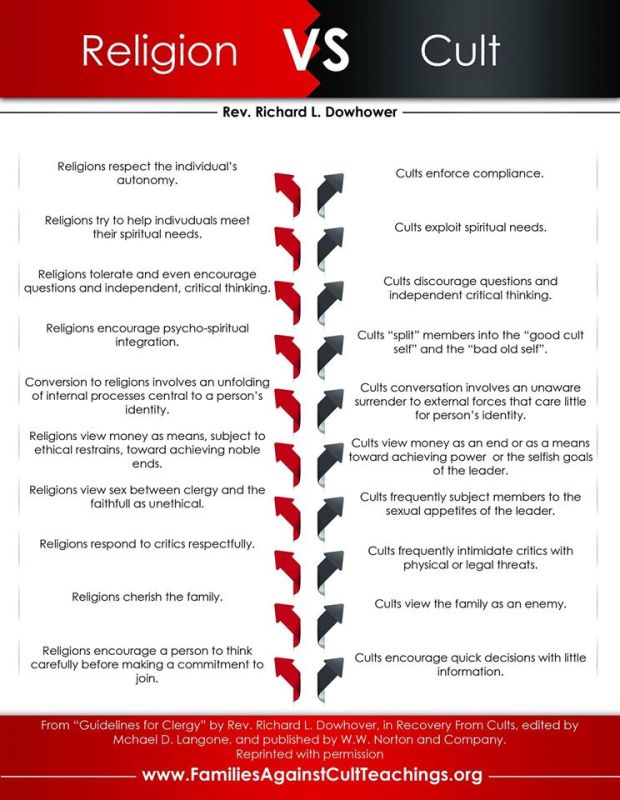
There is much variability in the thousands of groups associated with the term cult, although in general the role of the leader becomes central in the cult family. The leader takes on the role of father and/or mother, deciding how children will be raised. Parents function somewhat as middle managers in the rearing of their children.
A cult is a group or movement exhibiting a great or excessive devotion or dedication to some person, idea, or thing, and employing unethically manipulative techniques of persuasion and control designed to advance the goals of the group’s leader, to the actual or possible detriment of members, their families, or the community.
Cult Identification List -this will give you a ‘check list’ of what to look out for when joining a group.
These groups tend to dictate, sometimes in great detail, how members should think, act, and feel, claim a special exalted status for themselves and/or their leader(s), and intensify their opposition to and alienation from society at large.
Because the capacity to exploit human beings is universal, any group could become a cult. However, most mainstream, established groups have accountability mechanisms that restrain the development of cultic subgroups.
How Many Cults Exist and How Many Members Do They Have?
Cult-education organizations have received inquiries about more than 3,000 groups. Although the majority of groups are small, some have tens of thousands of members. Experts estimate that five to ten million people have been involved with cultic groups at one time or another.
What is Mind Control?
Mind control (also known as “brainwashing,” “coercive persuasion,” and “thought reform“) refers to a process in which a group or individual systematically uses unethically manipulative methods to persuade others to conform to the wishes of the manipulator(s). Such methods include the following:
extensivecontrol of information in order to limit alternatives fromwhich members may make “choices”
deception
group pressure
intense indoctrination into a belief system that denigrates independent critical thinking and considers the world outside the group to be threatening, evil, or gravely in error an insistence that members’ distress-much of which may consist of anxiety and guilt subtly induced by the group-can be relieved only by conforming to the group
physical and/or psychological debilitation through inadequate diet or fatigue the induction of dissociative (trance-like) states via the misuse of meditation, chanting, speaking in tongues, and other exercises in which attention is narrowed, suggestibility heightened, and independent critical thinking weakened
alternation of harshness/threats and leniency/love in order to effect compliance with the leadership’s wishes isolation from social supports pressured public confessions
Who Joins Cults and Why?
Contrary to a popular misconception that cult members are “crazy,” research and clinical evidence strongly suggests that most cult members are relatively normal. They include the young, the middle-aged, elderly, the wealthy, the poor, the educated, and the uneducated from every ethnic and religious background. There is no easily identifiable type of person who joins cults.
How Do People Who Join Cults Change?
After converts commit themselves to a group, the cult’s way of thinking, feeling, and acting becomes second nature, while important aspects of their pre-cult personalities are suppressed or, in a sense, decay through disuse. New converts at first frequently appear to be shell-shocked; they may appear “spaced out,” rigid and stereotyped in their responses, limited in their use of language, impaired in their ability to think critically, and oddly distant in their relationships with others. Intense cultic manipulations can trigger altered states of consciousness in some people.
Why Do People Leave Cults?
People leave for a variety of reasons. After becoming aware of hypocrisy and/or corruption within the cult, converts who have maintained an element of independence and some connection with their old values may simply walk out. Others may leave because they are weary of a routine of proselytizing and fund-raising. Sometimes even the most dedicated members may feel so inadequate in the face of the cult’s demands that they walk away because they feel like abject failures. Others may renounce the cult after reconnecting to old values, goals, interests, or relationships, resulting from visits with parents, talks with ex-members, or exit counseling.
Is Leaving a Cult Easy?
People who consider leaving a cult are usually pressured to stay. Some ex-members say they spent months, even years, trying to garner the strength to walk out. Some felt so intimidated they departed secretly.
Although many cult members eventually walk out on their own, many, if not most, who leave cults on their own are psychologically harmed, often in ways they do not understand. Some cult members never leave, and some of these are severely harmed. There is no way to predict who will leave, who won’t leave, or who will be harmed. ?
Adapted from: Cults Questions and Answers, by Micahel D. Langone, Ph.D.Copyright AFF, 1988
Leah Remini’s interview about the inner workings of Scientology
The following documentary was released in November 2018 by Leah Remini who was reasearching Scientology and Jehovahs Witnesses and the effect it has upon their former members







 Taking The Helm